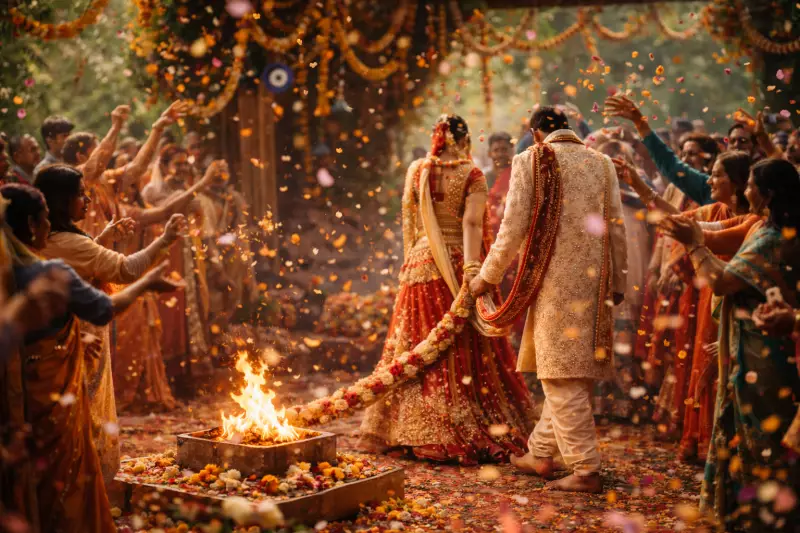
At the heart of countless Indian wedding ceremonies, a single, profound ritual unfolds: the couple's walk around the sacred fire. Known as pheras or saptapadi, these circles may appear simple, but they are densely packed with spiritual significance. What often goes unnoticed is the variation in their number. While some couples take seven rounds, others complete only four. This difference is far from arbitrary or merely a regional custom. It stems from two fundamentally distinct spiritual interpretations of marriage, partnership, and life's purpose.
The Sacred Fire: A Witness to Eternal Vows
In Hindu philosophy, the fire, or agni, is far more than a decorative element. It is considered a conscious, divine witness—a visible form of cosmic energy. Fire transforms matter, converts offerings into prayers, and turns human intention into binding commitment. When a bride and groom circle the fire, they are not performing for the audience. They are articulating solemn vows before a force believed to eternally record truth. Each phera represents a specific promise, and the total number defines the breadth of life's domains the couple consciously chooses to unite.
The Seven Pheras: A Path to Complete Union
Most prevalent in North Indian Hindu weddings, the ritual of seven pheras is rooted in the concept of marriage as a complete, holistic partnership. It encompasses every layer of human existence—material, moral, and spiritual. Each of the seven rounds symbolizes a core commitment essential for a shared life journey.

The seven vows traditionally correspond to:
- Providing nourishment and shared sustenance.
- Developing strength and mutual protection.
- Building prosperity and taking responsibility.
- Cultivating happiness and harmony.
- Cherishing progeny and continuity.
- Upholding health and longevity.
- Nurturing lifelong friendship and loyalty.
Spiritually, these vows map the entire spectrum of human life: physical needs, resources, emotions, lineage, health, and companionship. The seventh phera seals a bond that integrates the couple's path through dharma (duty), artha (prosperity), kama (joy), and ultimately, moksha (liberation). The number seven itself signifies completion and transcendence, echoing the seven chakras and the journey from instinct to higher awareness. In many traditions, it is after the seventh round that the marriage is considered irrevocable, with souls aligned across all dimensions.
The Philosophy of Four Pheras: Partnership Within Cosmic Order
In contrast, weddings featuring four pheras, commonly observed in Gujarati and certain Vaishnav traditions, are built on a different spiritual emphasis. Here, marriage is viewed not as a total merging of destinies, but as a sacred partnership that exists within a larger cosmic framework. The four pheras directly correspond to the four purusharthas, the foundational aims of human life in Hindu philosophy.
- Dharma: Righteous living and moral responsibility.
- Artha: Earning and sustaining a stable livelihood.
- Kama: Experiencing joy, affection, and desire in balance.
- Moksha: Spiritual growth and ultimate liberation.
This framework places the marital union inside a grand philosophical structure. Marriage becomes a supportive vehicle for achieving these life goals, rather than being the final destination itself. It acknowledges and supports spiritual evolution while allowing space for individual paths. The relationship intertwines lives but does not claim ownership over every aspect of each soul's independent journey.
Two Approaches: Spiritual Completeness vs. Spiritual Restraint
The core difference between four and seven pheras reflects two profound approaches to sacred commitment. The seven-phera ritual expresses spiritual completeness, envisioning marriage as a total union of lives, duties, and futures. The four-phera system expresses spiritual restraint, viewing marriage as a supportive institution for life's goals without wholly absorbing individual spiritual autonomy.

This distinction is theological, not merely geographical. Vaishnav traditions, for instance, emphasize devotion to the divine as paramount. While sacred, marriage is secondary to the primary goal of spiritual liberation (moksha). Hence, fewer pheras signify fewer vows and less emphasis on mutual ownership, focusing instead on balanced support. Other Hindu traditions place the grihastha ashrama (householder stage) at the very center of spiritual practice. For them, marriage itself is a primary path to liberation, warranting more vows and shared responsibilities.
In the language of spiritual symbolism, numbers carry deep meaning. Four represents structure, stability, and foundation—the four directions, elements, and stages of life. It signals grounding. Seven represents transcendence, moving beyond structure into holistic wholeness. It signals expansion. A couple taking four pheras is grounding their shared life within a stable cosmic order. A couple taking seven pheras is expanding their union to encompass all realms of existence.
In contemporary times, rituals are sometimes blended or altered for convenience or aesthetics. However, traditionally, the number of pheras was a conscious philosophical choice, answering a fundamental question: Is this bond meant to structure a life together, or to complete it? Beyond romance and permanence, the ritual of pheras is about alignment—stabilizing intention, duty, and awareness before the eternal witness of the sacred fire. The ancient wisdom of these customs reminds us that sacred bonds are not uniform. They are meticulously shaped to reflect the unique spiritual beliefs and conscious truths that a couple brings into the fire's transformative presence.