

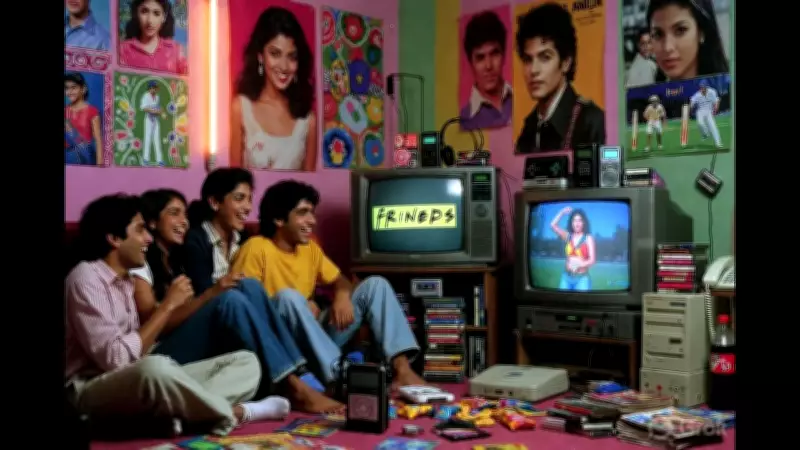
There was hope in the air. There was stability in our lives. There was new ambition in a new open economy, in India. There were friends gathered in a room sticking posters of Rangeela, Titanic, watching Friends or Will and Grace. There were teenagers playing cricket on the streets even as some discussed Manish Malhotra's era-changing costumes in Rangeela. There were people singing Alisha Chinai's hit pop music video Made in India, going 'ooo la la' over Milind Soman's bare torso. There were teenagers all over the world humming and moving their bodies to 'If you wanna be my lover' by Spice Girls, 'Everybody, yeah, rock your body' by Backstreet Boys, or were in a reflective mood listening to Kurt Cobain's 'Smells like teen spirit' – a song that became the anthem of the 1990s.
What Was Not There
There was no skipping ahead, no second screen, no algorithm predicting what comes next. Those would be next-century problems. Outside, the sound of a cricket ball striking a makeshift bat echoed through the lane. Inside, a stack of photo albums sat on a shelf. Of family, friends or David Beckham. Thick, tactile, and finite. Each photograph had weight, both literal and emotional. Every moment felt earned because access was limited, and waiting was part of the experience. It was the Nineties.
Now Imagine Our Times
A similar evening unfolds, but under LED lights and Wi-Fi signals. The teen, now an adult, scrolls endlessly through an infinite feed, pausing momentarily on images that vanish into the algorithmic void seconds later. Entertainment is no longer awaited; it is demanded, delivered, and discarded. Memory has migrated from albums to cloud storage. Time feels compressed and our attention is fractured. No wonder everyone wants the Nineties back.

The Last Analog Childhood
Not a day goes by when you don't see a Tweet or a Thread of Gen Xers or Millennials ruing over the last years of innocence and peace, and the lost years of analog. This nostalgia for the Nineties isn't just about revisiting old songs or reruns. It is a longing for a fundamentally different way of being. One that was slower, less mediated, and far more immersive. For many, this decade feels like a special time, often called the 'last analog childhood.' It was a period when life was still mostly physical and offline, but the internet was just beginning. Life was full of promise.
Why the Nineties Loom Large
To understand why the Nineties loom so large in the contemporary imagination, we need to unpack not just what that decade was, but what it has come to represent in our chaotic, anxiety-ridden times. A time where we can't seem to see the future but we know it's bleak. Childhood in that era was not curated and documented in real time. There were no smartphones to capture every fleeting moment, no social media platforms to perform identity. Experiences were lived first and remembered later. This was the last generation that was allowed this specific nostalgia. This distinction matters.
Analog Childhoods and Boredom
Analog childhoods were defined by boredom, a condition now seen as undesirable. Once it was fertile ground for creativity. Waiting for a show, a friend, or even a photograph to develop created space for anticipation. In contrast, today's digital childhood is characterized by immediacy and abundance, where the absence of stimulation feels intolerable. It's possibly the reason why the Nineties feel like a bridge between two worlds: a more 'solid,' real-world way of living, and the fast, digital life we have now.
The Emotional and Scientific Reasons
Part of the reason this nostalgia sticks around is purely emotional. People feel a sense of loss for the future they were once promised, because this one never really arrived. At least, in ways that people imagined. There's also a scientific reason behind this nostalgia. Identity in the Nineties was shaped in relative isolation from data-driven systems. Choices were influenced by immediate social circles. This allowed for a degree of unpredictability and individuality. Even Hollywood and Bollywood superstars seemed more realistic than they do now.

The Reminiscence Bump
Psychologists call it the 'reminiscence bump.' Simply put, this means people tend to remember their teenage years and early adulthood (roughly ages 10 to 30) more vividly than other periods of life. For Gen X and Millennials, those years happened in the Nineties – which is why that decade feels so important and unforgettable. This nostalgia reflects a yearning for a mental environment where attention was less fragmented and presence was more complete.
Music Triggers Nostalgia
Researchers have studied how music triggers nostalgia in very precise ways. Some research used tools that combine people's feelings, the features of a song, and brain activity to measure how nostalgic a song makes them feel. The results show something simple yet powerful: songs you personally loved in the past make you feel happier and bring back clearer memories than songs chosen by others. Remember how when old friends come visiting, you go back to 'Tip, tip barsa paani' or 'Pehla Nasha' or 'Kisi Disco mein Jaayen'? That's why 90's music feels so personal to those who grew up with it.
Why Is Gen Z Grieving a Past It Never Had?
Science calls this 'anemoia' – nostalgia for a time you never experienced (but want to belong to because neither the present nor the future gives you any sense of comfort). It's not based on real memories. It's based on imagination. Old sounds, grainy visuals, and the slightly imperfect look of Nineties media make that era feel emotional and appealing. Especially, in a world that is filtered through corrective tools to appear perfect.
For people growing up in today's highly digital, algorithm-driven world, the Nineties seem more real, more creative, and more free. Online, many say it feels like a time when people connected more naturally, without worrying about 'likes' or social media. A part of the reason why Gen Z seems so numb yet full of silent rebellion is the banality of the curated life that was handed to them by Silicon Valley entrepreneurs, who are now the tech billionaires ruling the world. From Mark Zuckerberg to Jack Dorsey, Bill Gates to Elon Musk or Sam Altman. They all created the tools to engage the youth, connect the world. So, our generation has all the tools for perfection, but still feel hollow from within. There's something very fundamental that's gone missing. And that's not just Gen Z. It includes Gen Xers, Millennials, even Boomers.
Nostalgia as Anxiety Management
To understand why the nineties feel like a solid anchor, we have to look at the big sociological shift from the Nineties to the 21st century. Polish-British sociologist, philosopher Zygmunt Bauman calls this transition 'the move from solid to liquid modernity.' Bauman argued that today's world is a 'shapeless mass' in constant change. When everything keeps changing, memory struggles to hold on to anything. Life starts to feel scattered – moving from one social media update to another, each promising a better life but often leaving people more overwhelmed.
Bauman believed that it's essential for our species to look for stability and have limits to function well on a daily basis. In the Nineties, society still had these 'solid' forms: predictable careers, stable institutions, and lasting relationships. Today, in 'liquid' modernity, these have weakened. Work, relationships, and life paths are more flexible, and also more uncertain and constantly shifting.
Anemoia is nostalgia for a time you never experienced (but want to belong to because neither the present nor the future gives you any sense of comfort). It's not based on real memories. It's based on imagination. In the Nineties, it was Urmila Matondkar in Rangeela, Shah Rukh Khan and Kajol in DDLJ, Aishwarya Rai and Sushmita Sen becoming Miss World and Miss Universe, respectively.
This creates a situation where individuals are expected to manage everything on their own, but without strong systems to support them. That tension creates inner stress. Because people naturally seek stability and safety. Bauman says in this 'liquid' world, belonging is no longer automatic. It is shaped through brands, lifestyles, and consumption. Those who can't keep up risk being left out. Seen this way, nostalgia becomes a way to find psychological comfort – a return. Even if it's only in memory, it is a return to a time that felt stable and easier to navigate.
The Resurgence of Nineties Culture
The resurgence of Nineties culture coincides with a period of heightened global uncertainty – economic instability, climate crises, and the psychological toll of constant connectivity. Nostalgia, in this context, functions as a coping mechanism, as emotional regulation that offers comfort and continuity in times of stress. But let's not forget that the 1990s, positioned just before the seismic shifts of the 21st century. Before 9/11 and before social media dominance. This decade wasn't free of problems either. But it is still remembered as a time when those problems felt less overwhelming, less existential, less personal than now – where we cannot escape the barrage of negative news hitting our phones every 5 minutes. The human brain wasn't meant to cope with 'a crisis, a second'. Standing where we are right now, the last decade of the 20th century is a balm for our withered souls and overwhelmed minds and body – especially post-Pandemic.
A Hark Back to the 1991 Indian Transition
In India, Nineties nostalgia is closely tied to the 1991 Indian economic liberalization. This wasn't just an economic shift. It changed how people experienced the world. Before 1991, television was controlled by Doordarshan. There was one dominant channel, one narrative, and a relatively 'closed' media environment. Then satellite TV arrived, led by networks like Star TV, bringing global content into Indian homes. Two Indians, Aishwarya Rai and Sushmita Sen, won Miss World and Miss Universe, respectively, in the same year. India suddenly seemed a part of the global hub. It was rising. So were people's aspirations.
Filmmaker Dibakar Banerjee captured this shift simply when he said in an interview: 'Our revolutions happened in our television sets'. The move from a single channel controlled by a knob on the TV to an 'avalanche of news' and global programming was a major break from the past. It also helped turn India's media industry into a global cultural force. Suddenly, local and global influences coexisted, creating a hybrid cultural landscape. For those who grew up during this period, nostalgia is intertwined with a sense of discovery, the excitement of first exposure to a wider world. It was a decade of possibility, where the future seemed expansive and full of promise.
Imperfection Is the Stabilizing Anchor
Nostalgia for the Nineties is also about its imperfect look and feel. In today's smooth, 'noiseless' digital world, older formats like the crackling vinyl or the grain of film feel more real. These flaws offer an authentic reflection of life and connect more closely to our lived experience. Because life is not smooth, and we cannot put our favourite Instagram filter on it. This is one of main reasons why many artists and critics today value spontaneity, disruption over perfection. The 'unfinished' quality of Nineties media feels more human.
The Nineties were also marked by shared experiences. Watching television together, playing outdoor games, participating in local events... These interactions created a sense of belonging that was grounded in reality. Today, connectivity is constant but superficial. Online interactions lack the depth and nuance of face-to-face communication. The paradox of the digital age is that increased connectivity has led to increased isolation. For Gen Z, the Nineties represent an imagined simplicity, a contrast to the complexities of their digital-native lives. Nostalgia becomes a form of escapism, a way to engage with a past that feels manageable. Even comforting.
Ghosts of Our '90s Past
English writer, and political and cultural theorist Mark Fisher built on this feeling of unease with the idea of 'hauntology'. He used it to describe how in our current times, we are all haunted by futures that were once imagined, in the Nineties, and were full of hope and promise. But they never actually came to fruition as we moved to the 21st century. In fact, with the rise of digital life and new economic systems, everyday experience changed so much that culture hit a kind of dead end. Now, we are left with the 'ghosts' of those unrealised possibilities.
That's why the 21st century feels like a slow cancellation of the future. Instead of creating something truly new, the culture keeps recycling the past. Fisher termed this phenomenon as 'formal nostalgia.' This is what we are all feeling. We are desperately looking for solace from the last decade that felt real, messy and fun to belong to. The 1990s.





