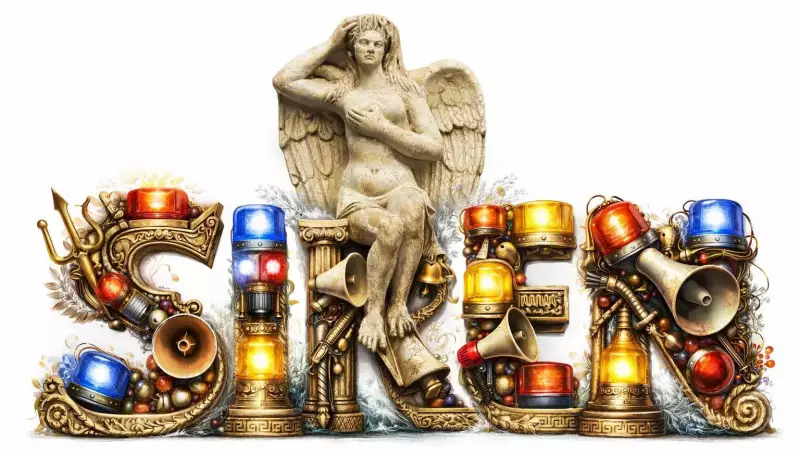
The popular word puzzle game Wordle presented its final challenge of the year on December 31, 2025, with the answer: siren. This five-letter word, however, is far more than just a game solution. It represents a fascinating linguistic survivor, a term that has travelled seamlessly from ancient mythology into the very fabric of our contemporary world, all while retaining its core, compelling meaning.
From Mythical Beings to Mechanical Wails
The word siren entered the English language through Latin (sīrēn), which itself borrowed from the Greek Seirēn. In its earliest incarnation, it named the dangerous creatures of Greek myth. These Sirens were not the gentle mermaids of later tales but potent beings whose power was entirely auditory. Their song was an irresistible command, luring sailors off course and to their doom. The myth of Odysseus famously illustrates this: he had himself tied to his ship's mast to experience their call without succumbing, a primitive 'Ulysses pact' acknowledging that future judgment cannot be trusted.
This foundational idea—a call that overrides choice—proved remarkably durable. As the word migrated into the modern era, it simply exchanged feathers for wiring. Police and ambulance sirens, factory alarms, and nuclear warning systems all operate on the same primal principle. The sound is engineered not to persuade but to compel. It cuts through noise, walls, and sleep, triggering a physical response—a spiking heart rate, narrowed thought—before the mind even locates the source. The ancient Sirens pulled sailors off course; today's siren forces everyone onto a single path of urgent reaction.

The Siren's Song in Our Digital Age
The concept of the 'siren song' has evolved into a powerful metaphor for modern temptations that feel less like choices and more like inevitabilities. This is where the word demonstrates its continued relevance. In markets, politics, and especially technology, siren-like mechanisms are everywhere.
Consider the digital landscape:
- Push notifications that demand immediate attention.
- Autoplay features on streaming platforms that remove the decision to stop.
- Infinite scrolls on social media that promise just one more piece of content.
These are not arguments; they are attention hacks. They operate on rhythm and repetition, bypassing conscious decision-making. The 'sound' may now be visual, haptic, or algorithmic, but the underlying logic remains identical to the myth: something calls, resistance weakens, and choice narrows. It creates a Sisyphean cycle where one chases the promise of the next alert, the next scroll, the next flash sale, only for the desire to reset instantly.
Why This Word Endures Across Culture
Siren has successfully colonised diverse domains without losing its essence. In literature, it describes luminous ideas or characters that lead to ruin. In music and film, siren-like sounds are used to build tension and anxiety. In pop culture, it attaches to figures who draw focus through sheer gravitational pull, not persuasion.
The word's pronunciation, SY-rən, even mimics its function—sharp and arresting at the start, fading into an inevitable end. Its survival is due to its unique ability to name a specific kind of power: the power to interrupt the self. Whether it interrupts a sailor's journey, a citizen's peace, or an individual's better judgment, a siren represents the moment when sound, desire, and authority converge on a single, compelling frequency.
The Wordle answer for New Year's Eve 2025 serves as a timely reminder of this enduring force in our lives, connecting a simple daily puzzle to deep threads in mythology, technology, and human psychology.