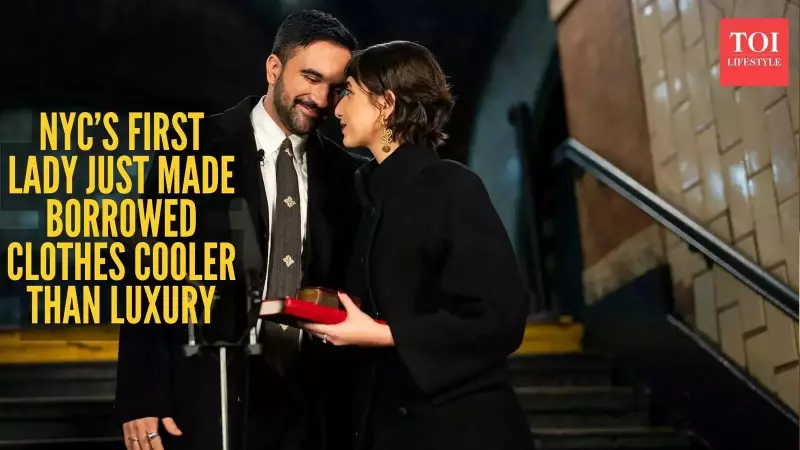
In a powerful style statement that resonated far beyond the runway, New York's new First Lady, Rama Duwaji, chose shared fashion over luxury shopping to welcome the New Year and a new political chapter. At the intimate, after-midnight inauguration ceremony for her husband, democratic socialist Zohran Mamdani, held in an abandoned subway station, Duwaji's outfit was a masterclass in intentional, sustainable dressing.
An Inauguration Outfit Built on Stories, Not Shopping Bags
Stepping into one of the biggest moments of her life, Rama Duwaji did not debut a brand-new designer ensemble. Instead, she curated a look rich with history and meaning. Her outfit was a collection of pieces with past lives: a vintage Balenciaga coat and archival earrings, both rented, paired with borrowed boots and tailored shorts. Nothing was owned for the sake of ownership; every item was chosen for its narrative and character.
This was not a one-time political costume calculated for "sensible optics." Friends and observers confirm that Duwaji has always been this person—a shopper who hunts for unique character in second-life fashion, who inherently understands that clothes do not lose their value simply because someone else wore them first. For her, choosing rental and thrifted items was muscle memory, not a strategic decision.

Quiet Political Intelligence and a Cultural Shift
Her sartorial choices carried a sharp, subtle political message. When your partner campaigns on a platform critiquing capitalist excess, appearing in head-to-toe new luxury labels invites easy criticism. By fully embracing rental fashion and re-wear culture, Duwaji didn't just avoid backlash; she reframed the entire conversation. The statement was clear: power and style do not derive from price tags.
More significantly, Rama Duwaji has arguably become the first major public figure in New York to normalise thrifting and renting at the highest levels of visibility. She presented it not as a rebellious act or a quirky personality trait, but as a normal, stylish, and powerful choice. This is precisely how cultural shifts begin—not with loud proclamations, but with visible, normalised action.
Aligning with Millennial Values and Global Trends
Duwaji's approach aligns perfectly with the evolving mindset of millennials and Gen Z towards ownership. This generation comfortably rents homes, cars, and furniture. The archaic idea that one must "own" something to enjoy it is being replaced by the value of access and experience. For them, experience is the true luxury.
Beneath this personal style lies a critical environmental imperative. The fashion industry is a major driver of waste and carbon emissions. Practices like renting, buying vintage, and thrifting fashion dramatically extend the lifespan of garments and slow down the cycle of mindless consumption. This trend is visible in India as well, where expensive wedding lehengas, sherwanis, and designer gowns are now rented with pride instead of gathering dust in closets after a single use.
Rama Duwaji gave no lectures on sustainability. She didn't need to. By simply wearing borrowed clothes to her husband's inauguration, she demonstrated that rented can be aspirational, thrifted can be glamorous, and repeating outfits can be a powerful declaration of identity. Real change, as she shows, can be quiet, stylish, and absolutely intentional.