Internet Buzzes Over Unearthing of Ancient ₹2 Kurkure Packet
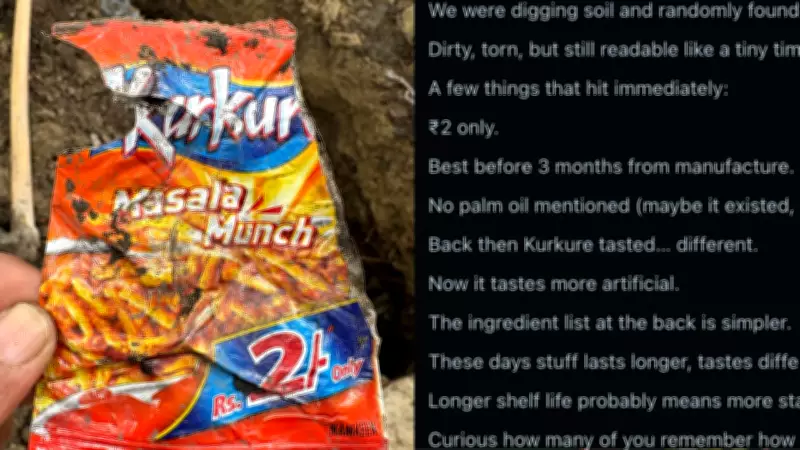
The digital realm thrives on nostalgia, but it becomes truly electrified when bizarre discoveries emerge. This week witnessed such a phenomenon when an individual claimed to have excavated an old Kurkure packet from deep underground, complete with a printed price of merely ₹2 and an expiry period of just three months.
The find, shared across social media platforms, rapidly went viral, transforming a mundane snack wrapper into a powerful catalyst for discussions about economic inflation, evolving food manufacturing practices, and most prominently, the persistent issue of plastic pollution.
A Snack Wrapper That Felt Like a Time Capsule
According to the viral caption accompanying the images, the packet surfaced during soil excavation work. Despite being dirty and slightly torn at the edges, the packaging remained remarkably legible, prompting the poster to describe it as a miniature time capsule from a bygone era.

Several details immediately captured public attention. The ₹2 price tag felt almost unbelievable to younger consumers accustomed to paying ₹10, ₹20, or even more for the same snack today, offering a stark reminder of how prices have escalated over the years.
Then there was the best before period: only three months from the date of manufacture, which contrasts sharply with the extended shelf lives commonly seen on contemporary packaged foods. The ingredient list also appeared notably shorter, and the apparent absence of explicitly mentioned palm oil sparked widespread speculation about how snack recipes may have evolved over time.
The original poster added that the snack tasted distinctly different years ago and pondered whether today's longer shelf life might be connected to increased use of stabilizers or preservatives. These observations resonated deeply, triggering a flood of memories from those who grew up enjoying the snack in the early 2000s, alongside healthy skepticism from others questioning the authenticity of the discovery.
Netizens Focus on Plastic Pollution, Not Just Pricing
While some commenters humorously reminisced about how affordable snacks once were, many quickly shifted their focus to a far more serious concern: the disturbing reality that the plastic wrapper survived intact underground for what appears to be over a decade.
One user commented bluntly, Plastic never degrades, while another pointed out how unsettling it was that the packet remained completely readable after years buried in soil. Others broadened the perspective, imagining how much plastic waste might be accumulating in land and water bodies, eventually entering human systems through microplastics.
There was characteristic online humor too, with some joking about what the original poster might have been digging for, while others made playful references to crime thriller scenarios. Yet beneath the memes and jokes, genuine environmental anxiety was unmistakable. This forgotten wrapper had become a potent symbol of how stubborn and persistent plastic waste can be, long after the consumable product inside has disappeared.
Why This Dusty Packet Struck Such a Deep Nerve
As the post spread across platforms like Reddit and Instagram, where it garnered tens of thousands of views and hundreds of comments, readers began scrutinizing every detail. Online sleuths enlarged images to examine font styles, packaging designs, and ingredient lists, debating whether these elements matched their memories from years past.
Part of the fascination stems from straightforward economics. In an era of rising prices, reminders of dramatically cheaper days feel startling and evocative, making a ₹2 snack packet instant nostalgia fuel for an entire generation.
However, the more significant reason this story resonated so powerfully is environmental. Seeing a plastic wrapper emerge from soil after years, still largely intact and readable, transforms the abstract problem of pollution into something tangible and immediate. It's one thing to read statistics about plastic waste accumulation; it's entirely another to confront photographic evidence of a snack packet that has outlived its intended purpose by many years.

For now, claims about the packet's exact age remain unverified, leaving ample room for speculation and ensuring the conversation continues to evolve. What began as a curious discovery has blossomed into a multifaceted discussion touching on consumer culture, environmental responsibility, and how everyday objects can become unexpected symbols of broader societal issues.