Unveiling the Culinary Secrets of Arunachal Pradesh
What truly defines Arunachali cuisine? As a dedicated food writer, this question has frequently occupied my thoughts, given the limited awareness and documentation surrounding the culinary heritage of India's remote North-eastern state. During a recent trip to Itanagar in November 2025, where I participated as a speaker at the Arunachal Literature Festival, I had the privilege of immersing myself in an authentic local meal. This experience vividly highlighted the delightful simplicity and profound depth of indigenous flavors that characterize this region's food culture.
Connecting with Local Food Enthusiasts
Prior to my arrival in Itanagar, I reached out to Chasoom Bosai, popularly known as Arunachal Pallet, a passionate food blogger, via Instagram. When I shared my eagerness to savor a genuine home-cooked meal, her response was enthusiastic and welcoming. "Of course, Ma'am. I'll set it up," she assured me. Regrettably, Chasoom had to depart for Delhi just before I landed, but she thoughtfully introduced me to Kapu Sanjay, a government employee based in Itanagar who also pursues photography as a side interest. "Sanjay will take you to our friend Teri Yajo Yangfo's home. She specializes in Nyishi dishes," Chasoom explained.
The Nyishi Tribe: Guardians of Ancient Culinary Traditions
The Nyishi community stands as the largest among the 28 major tribes in Arunachal Pradesh, with a population of approximately 300,000, followed closely by the Adi tribe, according to the 2001 census. Predominantly residing across eight districts of the state, many Nyishi people continue to adhere to Donyi Polo, an ancient indigenous faith that emphasizes living in harmony with nature. This deep connection to the environment profoundly influences their dietary practices and food sources.

Arunachal Pradesh's landscape, where dense forests cover about 79% of the total geographical area, ensures that culinary habits are intricately linked with nature. Staples of everyday Nyishi cuisine include rice, millets, smoked meats, bamboo shoots, yams, seasonal herbs, greens, and wild roots—all foraged from jungles or cultivated in farms and home gardens. Insects such as tari (stink bugs) and takam (grasshoppers) also feature prominently. Cooking techniques predominantly involve boiling, roasting, and using adung (bamboo tubes), while smoking and fermenting serve as time-honored methods for food preservation.
Mithun: The Sacred and Savory Centerpiece
Although pork and beef enjoy popularity, the undisputed favorite is mithun, a domesticated descendant of the wild Indian gaur. "We can't get enough of its juicy tender texture and rich, gamey flavor. Mithun is considered both sacred and a status symbol, and its sacrifice is essential at weddings, rituals, and festivals," shared Sanjay. His personal favorites include dinkiyo, a flavorful jerky made by drying mithun meat, smoked mithun with bamboo shoots, and a fiery dry meat pickle known as yamter. "You must visit in February for Nyokum Yullo, our grandest harvest festival, where we relish a traditional feast of mithun innards chutney paired with apong (millet seed wine). It's truly out of this world!" he exclaimed.
I also discovered a unique ingredient called tassey, a local flour derived from starch extracted from the inner bark of the wild palm tree. "Tassey has been the survival food of the Nyishi for millennia, serving as our go-to sustenance during droughts and other natural calamities. Today, it has evolved into more of a delicacy and is used to prepare various foods, including sweets like halwa," Sanjay informed me.
A Visit to Teri's Traditional Kitchen
The following day, Sanjay drove me to Teri's home in Mipdu village, Doimukh, a quaint town situated approximately 25 kilometers from Itanagar. Upon our arrival, our gracious hostess was already awaiting us outside her traditional bamboo house, her tribal identity elegantly reflected in the vibrant gale, or Arunachali wraparound skirt, and intricate bead jewelry she adorned.

"Welcome!" she greeted us warmly, guiding us into a spacious room centered around a fireplace and smoker. The room was devoid of furniture, except for a mattress on the floor covered with a bamboo mat. Soon, Teri joined us with steaming cups of gingery red tea. I learned that Jo's Kitchen, Teri's catering venture, was born from her fervent dedication to preserving ancestral traditions. As the first Nyishi woman to establish a food catering business in Itanagar, she views her cooking as a crucial link to thousands of generations of tribal heritage and wisdom. "These foods sustained our forefathers in health and are integral to our culture and identity. I will never let them fade away," she declared with quiet determination.
A Feast of Nyishi Delicacies
The accomplished cook had prepared an array of her signature dishes, commencing the meal with tayin amin, a savory mushroom and broken rice porridge accompanied by dry bamboo shoot chutney and boiled tapioca. The lush creaminess of the amin evoked memories of galho, the classic one-pot stew of the Nagas. "Yes, it's similar, though ours has a slightly grainier texture as we don't cook the rice as extensively," Teri noted, emphasizing that a robust al dente consistency is a defining characteristic of Nyishi cuisine.
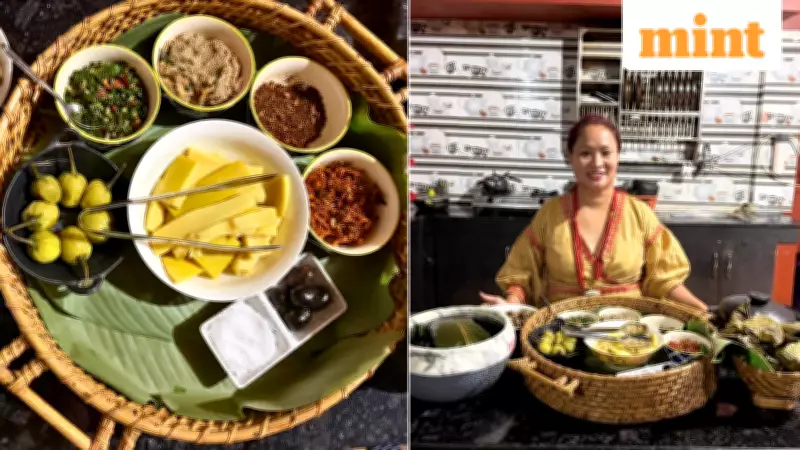
For the main course, she presented steamed sticky rice wrapped in aromatic leaves known as koham ok, braised chicken with banana flower, wild-caught fish steamed with local herbs, country chicken boiled with greens and bamboo shoots, and steamed oyster mushrooms. The accompaniments included boiled bitter eggplant and bamboo shoots, roasted wild Indian olives, spicy chicken yamter, and a piquant fermented soybean preparation called pehak.
The true highlights were the chutneys, referred to as hulis—featuring combinations like banana flower and sesame seeds, dry bamboo shoots, and fish mint, sawtooth coriander, and wild chives pounded with cherry tomatoes. "Hulis straddle the line between chutneys and salads, infusing our meals with a spicy zest. In earlier times, villagers would simply mince raw vegetables and greens, add king chilli and bamboo shoots, and enjoy these chutneys as snacks, akin to how people relish pizza today," Sanjay elaborated.
The Symphony of Wild Greens and Indigenous Ingredients
The extensive use of wild greens in the cooking was nothing short of astonishing. The harmonious pairing of high-quality proteins with these regional, seasonal greens felt impeccably balanced. Sawtooth coriander imparted a grassy, citrusy tang to the steamed fish, while majenga, an aromatic herb, introduced a distinctive tongue-tingling numbness to the country chicken. Simultaneously, perilla seeds contributed a subtle nuttiness that complemented the bird's richness.
This experience transcended mere dining; it was an immersive cultural lesson—a delectable glimpse into a remote border state where antiquity and modernity converge. We lingered long after the meal, engaging in heartfelt conversations and sharing memories. As Teri embraced me in farewell, her gentle face illuminated with a smile. "I'm overjoyed that you tasted our food. Now, go forth and share the story of Arunachali cuisine with the world," she urged.
Sona Bahadur is an independent journalist and author based in Mumbai, dedicated to exploring and documenting diverse culinary traditions across India.