It's not every day you hear a 400-year-old indigenous spirit introduced with a curious footnote: it once made Time magazine's list of the world's worst spirits. This was how Hansel Vaz, founder of Cazulo Premium Feni, presented Goa's signature craft spirit, feni, at a recent session in Bengaluru. The event was held at The Good Craft Co (TGCC) Flavour Lab, an alcohol experience centre, late last month.
From Humble Origins to Global Ambition
Vaz described feni as a "primitive spirit" with "nothing evolved about it." He positioned it alongside other historical Indian spirits like mahua and toddy, calling them the "rank outsiders" that nonetheless make the loudest noise. Despite this self-deprecating description, Vaz highlighted the spirit's natural complexity, which has won praise from experts worldwide.
He shared that iconic Japanese bartender Hiroyasu Kayama-san has called feni "the most original in its making process" and even carried bottles back to Japan. Vaz stressed the need for a new approach: "In India we never showcase our indigenous spirits, unlike the monks in Europe who made chartreuse and benedictine famous. We should make feni famous, not just in India but in the world." For him, traceability from the fruit grove to the bottle is key to this mission.

The traditional process of making feni involves crushing ripe cashew fruit to extract juice, which is then naturally fermented in half-buried earthen pots for several days. Distillation occurs in traditional earthenware pot stills called bhattis. The first distillate yields a low-alcohol urrak, while the second produces the final spirit at around 40% alcohol by volume.
A Modern Showcase for Ancient Spirits
At the TGCC bar, Vaz presented a lineup of six feni expressions for tasting. This included straight-up coconut and cashew feni, the zingy ginger-flavoured Além, a version infused with earthy dukshiri (Indian sarsaparilla), a rich 'coffee conserva' variant, and India's first Feni RTD (ready-to-drink) – a blend of feni with lime, sugar, and green chilli. The session culminated with two feni-based cocktails crafted by TGCC's in-house mixologist, Neil Alexander.
The first cocktail combined cashew feni with lacto-fermented basil and chilli, lemon puree, a tincture of Goan tirphal pepper, and a soda spritz. The second was a luscious digestif blending coconut feni with condensed milk, blitzed biscuit, vanilla, salted toffee, and aromatic bitters.
This tasting was part of a weekend workshop at TGCC, a 17,500 sq ft space in Whitefield, Bengaluru, created by Diageo India. TGCC hosts spirit-specific three-hour sessions focusing on ingredients, unique processes, and storytelling. The Flavour Lab, soft-launched in September 2024, is appended to Diageo India's own research lab on the premises.
Vikram Damodaran, Diageo’s Chief Innovation Officer and creator of the Godawan single malt, emphasized the shift in perspective: "The marketing focus for Indian spirits has been largely centred on their taste and prices, but today the narrative behind the liquid is just as important." Storytelling, he asserts, is the new route to understanding India's craft spirits.
An Incubator for Spirit Innovation
The concept for TGCC as an incubator for spirits startups took root when Nao Spirits, makers of Greater Than gin, sought Diageo's help. Anand Virmani, Nao’s co-founder and master distiller, explained they needed shelf-testing and technical assistance for their strawberry-infused gin, Punk. Diageo's experts helped them stabilize the liquid and address scalability and marketability issues.
This successful collaboration sparked the idea to extend Diageo's expertise to other startups and to hitherto neglected indigenous spirits like feni, toddy, and mahua. The Flavour Lab itself is an immersive experience. Guests are taken through a museum of historical distilling artefacts, get to handle ingredients, and view a miniature working copper pot-still and a room filled with tiny wooden casks used for flavour analysis.

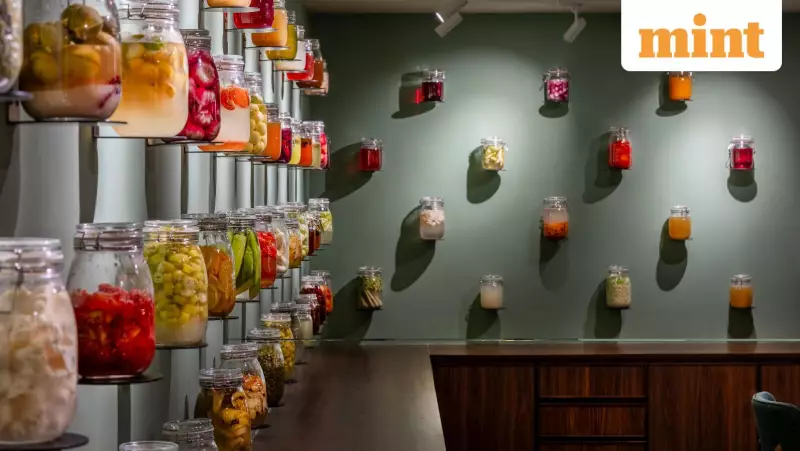
A highlight is the forest-green "Living Wall of Flavours," curated by Kobo Fermentary founder and TGCC consultant Payal Shah. Here, 68 living ferments are housed in glass jars. Shah, who joined TGCC in October 2023, describes fermentation as a fundamental pillar of flavour. Her ferments, ranging from lacto-fermented cherry tomatoes to vinegars made from vegetable scraps, often serve as secret ingredients that add depth to TGCC's cocktails.
She works closely with mixologist Neil Alexander, whom she calls a mastermind. Alexander, 42, returned to India from abroad, drawn by the lure of a research lab. He notes that India's cocktail scene is rapidly growing, with a maturing clientele. "People want to see layered drinks, flavours, modern mixology, new techniques," he says. "It’s all about complex tastes and aromas now, and a storyline that talks not just about ingredients but the ideas behind it: you need to make a connection."
TGCC's Flavour Lab holds these three-hour sessions on Saturdays. They are open to all, but prior registration is required.