

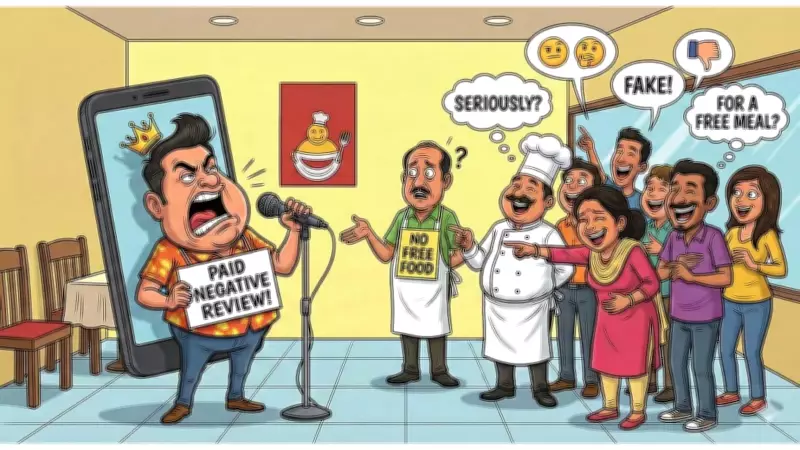
Kolkata Food Scene Confronts Influencer Ethics After Viral Controversy
The recent controversy involving food vlogger Sayak Chakraborty has reignited intense debates around paid content, public call-outs, and online accountability within Kolkata's vibrant culinary community. More significantly, this episode has forced the city's entire food ecosystem to confront a fundamental question: What truly qualifies someone as an influencer, and what responsibilities come with that label?
Business owners, veteran food documentarians, and discerning consumers argue that this controversy exposes critical fault lines where credibility, restraint, and ethical conduct matter just as much as reach and visibility. As the boundaries between restaurant reviewer, food vlogger, and social media influencer continue to blur, Kolkata's dining scene finds itself under renewed and necessary scrutiny.
Influence Without Credibility Isn't Influence
Amid conflicting claims about whether the incident involved a genuine human error amplified into viral content or a coordinated act with different intentions, restaurateurs say this controversy reveals how loosely the term "influencer" is applied today. Sunando Banerjee, restaurateur behind Hanglaatherium and former Foodka vlogger, argues that influence has been dangerously reduced to mere visibility.

"It has become entirely too casual. Someone becomes an influencer simply by talking in front of a camera," Banerjee states. He observes that many food vloggers enter this space without conducting basic research or understanding hospitality fundamentals, often normalizing negativity through what he describes as "crass language and inappropriate expressions."
Veteran food documentarian Indrajit Lahiri, creator of Foodka and Mohamushkil platforms that chronicle Kolkata's rich food culture, offers a more direct perspective. "I genuinely don't understand what we mean when we use the word influencer today," Lahiri admits. "What we really do is document a slice of time." He calls "influencer" one of the most abused words of our era, cautioning that serious problems emerge when content shifts from documentation to provocation or instigation.
Lahiri emphasizes that judging any restaurant based on a single visit is inherently unfair, noting that "it could simply be a bad day for the establishment." This perspective highlights the need for more nuanced evaluation in food content creation.
Can Restaurants Really Function Without Vloggers?
For emerging brands and fledgling restaurants, vloggers and Instagram creators often feel unavoidable for generating buzz. However, Banerjee insists that any engagement must maintain professional standards. "Whether the arrangement involves paid promotion, barter exchange, or complimentary meals, the evaluation should be conducted with the same rigor as any legitimate media platform," he asserts.
Some established brands consciously opt out of influencer-driven marketing strategies. Piyush Kankaria, co-founder of The Yellow Straw and Yours Truly Coffee Roaster, explains that they never built their brand around influencer coverage. "People visited our establishments and created content organically. That helped generate authentic buzz within Kolkata's coffee community," Kankaria reveals.
While acknowledging the importance of content creators within the food ecosystem, he adds a crucial qualification: "They cannot serve as the sole authority determining whether a brand is good or bad." This statement underscores the need for balanced perspectives in food evaluation.
The Significant Cost of Public Call-Outs
Shahbaaz Zaman, founder and administrator of FoodZpah, points to the disproportionate power that seasoned creators wield in today's digital landscape. Regarding the Sayak episode, he notes that it doesn't appear to have been a premeditated paid act but likely unfolded impulsively. However, he adds that public backlash rarely stems from a single moment.
"People are never just upset with a content creator based on one isolated context," Zaman observes, suggesting this incident became a tipping point for pent-up anger linked to past controversies and accumulated grievances. This erosion of trust extends visibly to consumers as well.

Debankan Banerjee, who operates the cloud kitchen Charcoal & Wok, describes "influencer" as a "heavy term" that carries heightened expectations. As a consumer himself, he admits growing increasingly wary of one-sided praise in food content. "When I encounter only effusive praise without balanced perspective, I become genuinely suspicious," Banerjee confesses, adding that he now relies on multiple reviews and cross-checks experiences before trusting any recommendations.
When Content Creation Turns Coercive
Disturbing accounts have emerged about coercive practices within Kolkata's food scene. Staff at a small takeaway café in South Kolkata shared an alarming incident with media: Four young men who had been frequenting the establishment introduced themselves as vloggers and influencers when the owner was absent. They ordered substantial food—both for dine-in and takeaway—but refused to pay.
When café staff later attempted to follow up about the promised content, they discovered the group had provided completely fake contact information. A South Kolkata café owner expressed frustration about this growing trend: "Arm-twisting and coercing business owners to provide free food is becoming standard practice. This has to stop. We cannot function in constant fear of negative posts by people with cameras posing as authorities on food and hospitality."
Indrajit Lahiri offers a crucial distinction: "Content creators are very rarely true influencers. An authentic influencer could be a respected sportsperson, a celebrated actor, or an established politician." This perspective challenges the current inflation of the influencer label.
Jhilam Gupta, another prominent vlogger, expresses similar uncertainty about the term's meaning: "I genuinely don't know how or who we influence. Documenting everyday life—shopping, apartments, food—is not influence. I simply make videos and earn because people watch them."
Piyush Kankaria, serving as chapter head of the National Restaurant Association of India (NRAI), emphasizes responsible social media use: "A service error does not justify criminal action, and social media platforms must be used with far greater sensitivity. NRAI stands in solidarity with establishments facing such challenges."
Sunando Banerjee calls for more balanced perspectives: "We need to acknowledge how we've normalized public negativity. No business intentionally sets out to offer poor service; a bad experience could simply reflect a bad day."
Shahbaaz Zaman concludes with an observation about content dynamics: "Negative content spreads far faster than positive content. Sensational formats travel more extensively, and audiences share equal responsibility in this ecosystem." This comprehensive examination reveals Kolkata's food community at a crossroads, grappling with definitions, ethics, and the true meaning of influence in the digital age.
