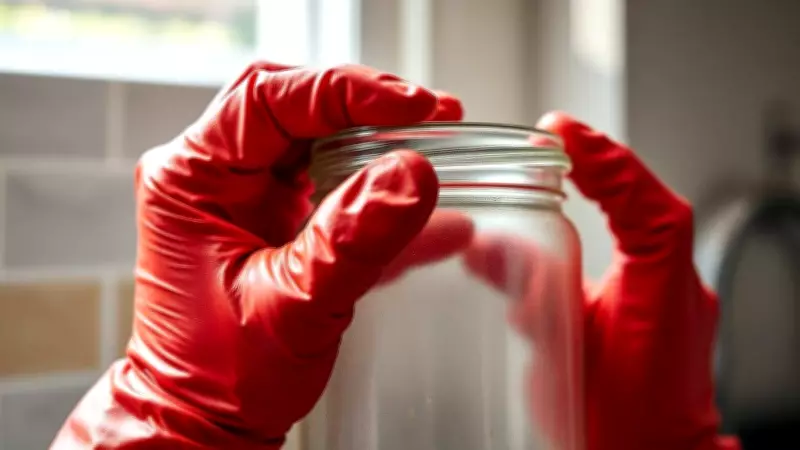
Unlocking Jars: The Simple Physics of Using Rubber Gloves for a Perfect Grip
This scenario is all too familiar for many: you are in the midst of preparing a delicious meal or attempting to access your homemade preserves, but that stubborn jar lid simply will not budge. You might try wrapping it in a dishcloth or pouring boiling water over it, yet these methods often leave you with sore hands and an unopened jar. Contrary to popular belief, immense strength is not always necessary; instead, a growing number of homemakers are turning to a straightforward solution: rubber gloves.
The Rapid Success of a Simple Hack
The appeal of this trick lies in its immediate effectiveness. When you slip on a pair of latex or rubber gloves, your hands transform from slippery surfaces into high-torque tools. This clever approach exemplifies how everyday items can solve practical mechanical challenges, turning a frustrating kitchen ordeal into a convenient and swift resolution. Despite its simplicity, there is solid physics behind why rubber outperforms metal when a lid becomes stuck.
Friction and Tribology for a Firm Grip
A difficult jar lid is not merely hard to remove; it frequently stems from insufficient friction generated by our skin. Our fingers are naturally lubricated and smooth, causing them to slip easily over metal or plastic surfaces. This is where tribology, the study of friction, comes into play. Research, such as the paper Finger friction: Grip and opening packaging, indicates that the materials between our fingers and a surface can drastically alter our ability to exert force.

By wearing rubber gloves, you increase the coefficient of friction between your hand and the lid. Instead of your skin sliding across, the rubber bites into the lid, allowing you to channel all your muscle power into a twisting motion without wasting energy on preventing slippage. Further insights from experiments like Tribological properties of MAO ceramic coatings with annulus array texture on disposable surgical gloves reveal a direct link between glove material and texture, enhancing gripping capability.
Textured gloves provide mechanical gripping through small patterns that act like teeth, locking into the jar's grooves and stabilizing the lid. This enables you to apply precise torque to break the vacuum seal effortlessly, avoiding strain.
Helping Your Body Biomechanically
Beyond the satisfying pop of a jar opening, using rubber gloves safeguards your body. Tight seals can lead to poor biomechanics, such as awkward gripping and twisting, which may strain elbow and shoulder joints. According to the article Jar-opening challenges. Part 1: an apparatus for assessing hand and finger torques and forces in a jar-opening activity, the forces involved are greater than many realize.
Specialized measurements show how much pressure fingers must exert to overcome lid resistance. Gloves enhance muscle efficiency by handling the attachment to the lid, allowing muscles to focus solely on rotation. This reduces the necessary squeezing force, benefiting individuals with arthritis or those engaged in precision work. Moreover, this method surpasses using wet towels or sponges, which can introduce moisture and weaken grip. Latex and rubber are waterproof, maintaining grip even on damp or cold jars, as supported by studies like Permeation of a Metalworking Fluid Through a Latex Glove Under Field Use Conditions, which confirm the material's stability under various conditions.
Cost-Effective Kitchen Solutions
Effective kitchen solutions do not require expensive gadgets; sometimes, thinking outside the box yields better results. By understanding the interplay between material friction and movements, you can transform ordinary gloves into a powerful tool for preserving food freshness and enhancing efficiency in meal preparation.