

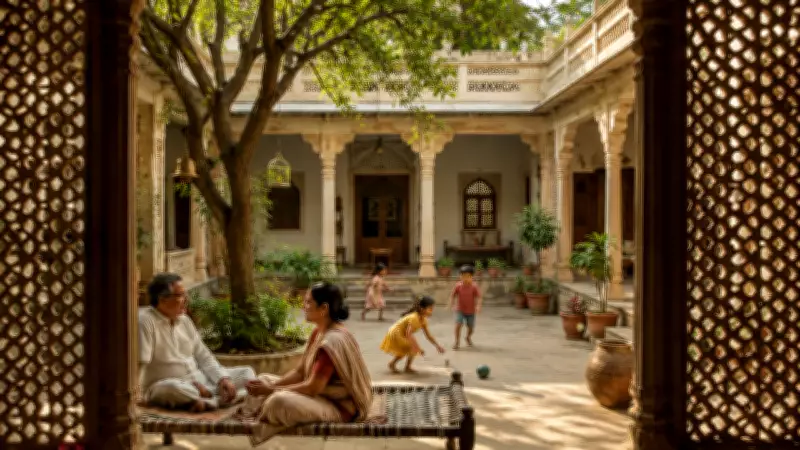
There is a particular kind of comfort that comes from sitting inside an old Indian home in the middle of summer. Not air-conditioned cool. The other kind, the kind that comes from thick walls, shaded courtyards, and cross-ventilation that somebody figured out centuries ago without a degree in architecture. Modern homes are sleeker, no question. But they sweat more, they echo more, and they somehow feel less like places people actually live in. Here are the old features worth bringing back.
1. The Courtyard That Made the House Breathe
The aangan, or central open courtyard, was not decorative. It was functional in ways that would impress a climate engineer today. Hot air rose and escaped through the open centre while cooler air circulated through the surrounding rooms. In the evenings, families gathered there. In the mornings, it caught the early light. Children played in it, elders sat in it, and festivals happened in it. It was the lungs of the house.
Modern urban homes have traded the courtyard for an extra bedroom, which is understandable when land costs what it does. But architects working on independent houses and farmhouses are beginning to bring it back, and the results speak for themselves. A well-designed central courtyard can reduce indoor temperatures by several degrees without a single watt of electricity. Add a plant or a small water feature, and you have also got something that genuinely calms you down when you walk in from the street.

2. Jali Screens and What They Actually Did
Intricate latticed screens, known as jalis, were everywhere in traditional Indian homes, especially in Rajasthan and across the Mughal-influenced north. They looked beautiful, yes. But they also filtered harsh sunlight into dappled patterns, allowed air to pass through freely, and gave the people inside a view out while limiting the view in. They were privacy screens, air filters, and light diffusers all at once, cut from stone or wood without any moving parts.
Today's equivalent is usually a solid wall or a glass window with a heavy curtain. Neither does what jali does. A few contemporary architects are reviving jali screens in concrete, metal, and even 3D-printed versions, which is encouraging. But they are still treated as an aesthetic choice rather than the practical climate solution they always were.
3. The Verandah That Nobody Builds Anymore
Sit on an old colonial home's verandah and you will understand immediately what has been lost. It is a transitional space, not quite inside, not quite outside. It catches the breeze, it provides shade, it gives you somewhere to be without committing to either the social world of the street or the private world of the home. In traditional homes in South India, the thinnai served exactly this purpose, a raised platform at the entrance where guests could sit, conversations could happen, and the household could observe the neighbourhood without inviting it in.
Modern homes go straight from the front door to the living room. That buffer is gone, and the loss is real. The verandah was not just a porch. It was a social institution. And in a country where the weather allows for outdoor living for most of the year, it makes no sense that we stopped building them.
4. Lime Plaster Walls and the Quiet They Created
Old homes plastered with lime had a texture and a temperature that cement simply does not replicate. Lime plaster breathes. It absorbs moisture when humidity rises and releases it when the air dries. It keeps walls cooler. It is also naturally anti-microbial, which is not a small thing. And the finish it gives, that slightly warm, slightly irregular surface, is something that people are now paying premium prices to fake with Venetian plaster and textured paint.
Lime plaster fell out of fashion because cement was faster and cheaper to apply at scale. But for anyone building or renovating a home now, it is worth the conversation with your contractor. What you get in return, cooler walls, better air quality, and a finish that actually looks like it belongs in India, is worth the extra effort.

5. What These Spaces Had in Common
None of these features were accidents of taste. They were solutions to real problems: heat, humidity, privacy, community, water. They were developed over centuries of trial and error in a climate that punishes bad decisions quickly. Modern building materials and design approaches have solved some problems while creating others: homes that cost a fortune to cool, that feel sterile, that cut people off from each other and from the outside world.
Bringing these features back does not mean building museums to live in. It means paying attention to what actually worked, and being honest that not everything that replaced it was an improvement.
