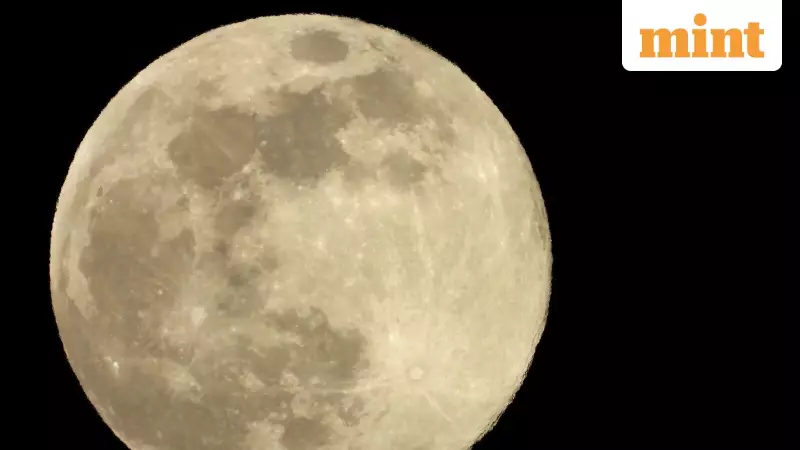
The night sky offered a spectacular farewell to 2025 as the year's final supermoon, romantically dubbed the 'Cold Moon', reached its brilliant peak on Thursday, December 4th. This celestial event marked the conclusion of a trio of supermoons this year, captivating skywatchers across India and the globe with its enhanced luminosity.
What Made the 'Cold Moon' a Supermoon?
A supermoon is not just any full moon. It is a special alignment where the full moon coincides with perigee—the point in the moon's oval-shaped orbit where it is closest to Earth. During this event, the moon was approximately 357,000 kilometres away, making it roughly 10-14% nearer than its average distance.
This proximity has a visible effect. Astronomers note that a supermoon can appear slightly larger in the sky and shine up to 30% brighter compared to the faintest full moon of the year. "When you have a supermoon, that effect is just slightly more striking," explained astronomer William Alston from the University of Hertfordshire, as reported by AP.

Netizens Capture the Celestial Spectacle
As the Cold Moon illuminated the December night, social media platforms were flooded with breathtaking images shared by enthusiastic netizens. From the urban skylines of Mumbai and Delhi to the serene backdrops of rural India, photographers and amateur stargazers captured the moon's majestic glow, turning the event into a shared global experience.
The term 'Cold Moon' itself is steeped in tradition, originating from Northern Hemisphere folklore that references the long and frigid nights characteristic of December.
When is the Next Supermoon?
The supermoon series is set to continue into the new year. According to NASA, the next supermoon event is scheduled for January 2026. This will be the fourth consecutive supermoon in the current celestial sequence, offering another chance for observers to witness our lunar neighbour in its grandest guise.
For now, the stunning images of the 2025 Cold Moon serve as a beautiful reminder of the wonders that unfold right above us, inviting everyone to look up and appreciate the cosmos.