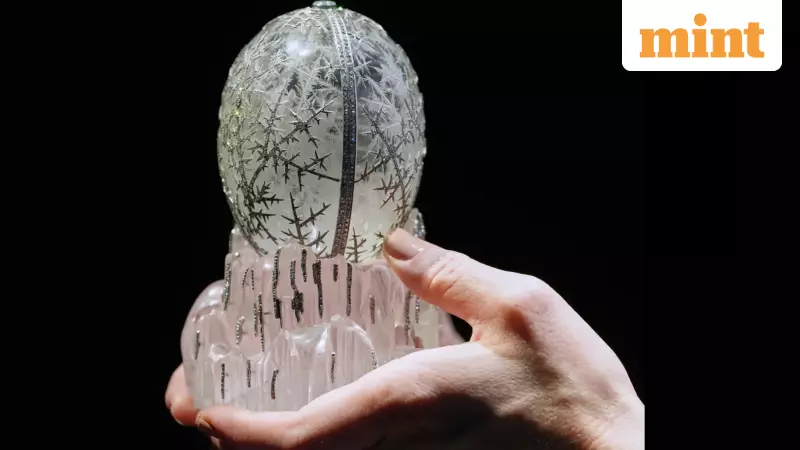
In a landmark sale that has captivated the world of art and antiques, one of the rarest Fabergé eggs ever created has been sold for a staggering sum, setting a new auction record. The exquisite Winter Egg, commissioned by Russia's last Tsar, Nicholas II, in 1913, was purchased by an anonymous bidder for £22.9 million ($30.2 million) at Christie's in London.
The Record-Breaking Auction Moment
The bidding war for this piece of imperial history was intense but brief, concluding in just three minutes. The final hammer price comfortably exceeded the auction house's pre-sale estimate of £20 million ($26 million). This monumental sale underscores the unparalleled value and enduring fascination with the creations of the House of Fabergé.
Margo Oganesian, the head of Christie’s Fabergé and Russian artworks department, emphasised the object's significance. In a statement, she said the record price reaffirmed the "enduring significance, rarity and brilliance" of the egg, which she hailed as one of Fabergé's finest works. She described it as the most spectacular and artistically inventive of the entire series, with a timeless, modern design.

Why is the Winter Egg So Special?
The Winter Egg's value lies in its extreme scarcity and breathtaking artistry. Of the 50 Imperial Eggs originally made for the Russian royal family, only a handful remain in private collections. The Winter Egg is one of just seven still held privately, with the others either lost or housed in museums. No Imperial Egg had appeared at auction for over two decades prior to this sale.
What sets this egg apart is its stunning design and unique provenance. Crafted primarily from rock crystal to mimic a block of ice, its surface is engraved with a delicate platinum snowflake pattern adorned with 4,500 rose-cut diamonds to simulate frost. Inside lies one of Fabergé's famous hidden surprises: a delicate basket of wood anemones, meticulously fashioned from white quartz, nephrite, and garnets.
Adding to its uniqueness, the Winter Egg was designed by a female artisan, Alma Pihl. She reportedly found inspiration for the frosty patterns by watching ice crystals form on her workshop window. Tsar Nicholas II purchased this masterpiece for his mother, Empress Maria Feodorovna, for 24,600 roubles—one of the highest prices Fabergé ever commanded.
Artistry Over Intrinsic Value
Experts point out that the egg's astronomical value is not in its raw materials but in its peerless craftsmanship. Kieran McCarthy, co-managing director of the renowned antique jewellers Wartski, explained that the thousands of tiny diamonds have "no intrinsic value" on their own. Their worth is derived entirely from their role in realising a "scintillating idea of frost." He poetically noted that holding the egg "is like holding a lump of ice in your hand."
The sale of the Winter Egg is a powerful reminder of Fabergé's legacy, where transcendent artistry transforms precious materials into objects of historic and cultural importance.
Separate Incident: Fabergé Locket Theft in New Zealand
In an unrelated but curious event highlighting the enduring allure of Fabergé items, a man in New Zealand has been charged with theft after allegedly swallowing a diamond-set Fabergé locket during a robbery. The incident occurred at Partridge Jewellers in central Auckland.
Police reported that the locket, valued at NZ$33,585 (approx. $19,300 or £14,600), has not been recovered. The 32-year-old suspect was arrested shortly after the incident, underwent medical checks, and remains in custody. He faces additional charges for stealing an iPad from the same store earlier in November and for taking cat litter and flea-control products from a private address.
The suspect is scheduled to reappear in court on December 8.