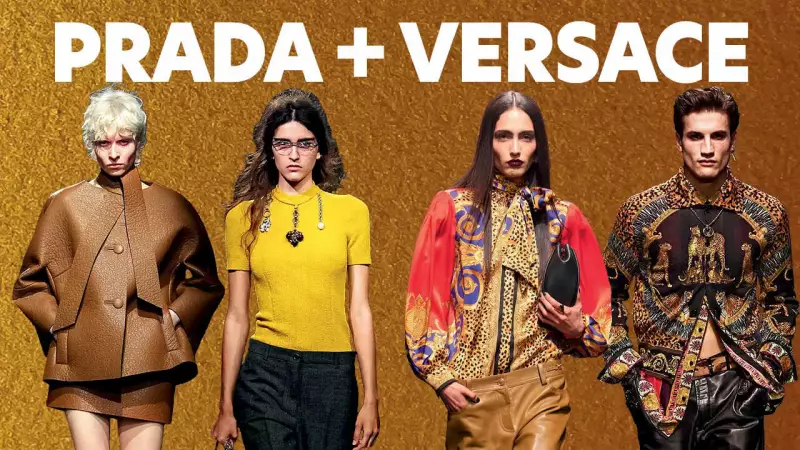
The fashion world erupted with a familiar mix of speculation, panic, and memes when the Prada Group announced its acquisition of the iconic Italian house, Versace. Yet, beyond the initial noise lies a monumental question for the luxury sector: What happens when Prada's famed intellectual minimalism takes the reins of Versace's unapologetic, loud, and glamorous legacy?
The Promise: Legacy Over Quick Profits
Prada's leadership has been quick to dispel notions of a short-term financial play. CEO Andrea Guerra has committed the group to being "fully engaged with Versace for at least three years." He lavished praise on Versace, calling it "the brand that invented fashion as we know it," crediting it with creating modern glamour, introducing the supermodel phenomenon, and seamlessly integrating music into fashion. The official stance, echoed by Prada Group chairman Patrizio Bertelli, is one of preservation and empowerment. "We aim to continue Versace's legacy – celebrating and reinterpreting its bold and timeless aesthetic," Bertelli stated, promising a strong platform backed by sustained investment.
A Daunting Historical Precedent
However, the road ahead is fraught with historical warning signs. Prada's own track record with heritage acquisitions—like Jil Sander, Helmut Lang, and Church's—offers little comfort, demonstrating that reviving faded glory is notoriously difficult. Versace itself has been struggling to recapture its peak momentum for over two decades, posting an operating loss in its last fiscal year under previous owner Capri Holdings. Luxury turnarounds are rarely straightforward, as noted by industry observers.

Analyst Luca Solca of Bernstein Group framed the challenge succinctly: "Versace is long past its heyday. The challenge and the opportunity is to make it relevant again... They are going to have to invent something which is going to make the brand attractive, desirable and interesting again."
Strategy: Discipline Meets Spectacle
The core strategy appears to be a fusion of opposites: injecting Prada's operational discipline and efficient global machinery into Versace's spectacular, culture-driving identity. Versace's greatest asset is its deep pop-cultural resonance, born from Greek mythology and elevated through 90s supermodels and music. Prada plans to leverage this capital aggressively through red-carpet dominance, celebrity collaborations, and bold digital storytelling.
A key focus will be elevating the brand's premium positioning. HSBC's Erwan Rambourg pointed out the immediate pain this may cause: "They should reestablish Versace as a premium brand, rather than one dependent on outlet malls... But getting out of outlets isn’t going to be good initially for sales or margins. The next 12 months will be rough."
Sudden Leadership Shake-up Adds Complexity
Complicating Prada's promise of stability was the abrupt exit of Versace's creative director, Dario Vitale, shortly after the acquisition. Vitale's debut for Spring 2026, inspired by Gianni Versace's Miami years, had been well-received, making his departure puzzling. Fashion commentators expressed disappointment, with one noting it was the first time they "really understood the brand" in a progressive way. This move stands in contrast to CEO Andrea Guerra's earlier assurance about caring for Versace's team and avoiding drastic changes that could "kill the patient."
The Global Growth Blueprint
On the operational front, the merger unlocks significant potential. Versace gains access to Prada's streamlined supply chains, in-house manufacturing, and vertical global network. The brand's headquarters will shift from Capri's New York to Milan, integrating into Prada's ecosystem. With a well-diversified revenue base (42% EMEA, 31% Americas, 27% APAC) and 227 retail stores globally, Versace is poised for expansion. Prada can now drive growth in underpenetrated markets like Southeast Asia and the Middle East, using its established infrastructure.

The ultimate test of this high-stakes merger will be whether Prada's disciplined approach can sharpen Versace's spectacular edge, or whether it will inadvertently dull the very essence that made the house iconic. The next three years, beginning with a potentially turbulent first twelve months, will write the answer.