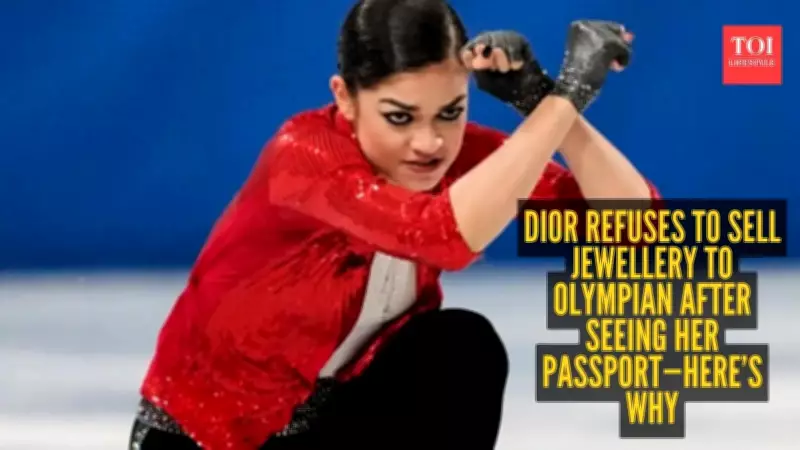
Russian Skater's Airport Shopping Trip Blocked by Sanctions
Luxury shopping at international airports typically represents a swift, indulgent experience for travelers, particularly during high-profile events like the Winter Olympics. However, for Russian figure skater Adeliia Petrosian, a routine stop at Milan's airport transformed into a deeply uncomfortable encounter that has since ignited widespread discussion online.
A Shopping Stop That Turned Sour
The 18-year-old athlete, who had traveled to Milan for the 2026 Winter Olympics, decided to browse through the airport's luxury boutiques like many international travelers. She entered a Dior store intending to purchase a ring and a pair of earrings—ordinary items for any luxury shopper. The situation took an unexpected turn when staff requested to see her passport for verification purposes.
During an appearance on the ALEKÓ In My Bag show, Petrosian recounted the moment with clarity. The sales assistant noticed her burgundy Russian passport and immediately informed her that they could not complete any sale to her. Just like that, her shopping plans were abruptly terminated.

"I still feel a bit bitter about what happened," the skater admitted, noting that the experience lingered with her long after departing the store.
Not an Isolated Incident
What made the situation particularly striking was that the refusal was not confined to a single luxury brand. According to Petrosian's account, Louis Vuitton maintains a similar policy regarding Russian customers. In an attempt to circumvent the restriction, she even asked a friend from Georgia to make the purchase on her behalf. This strategy proved unsuccessful as well, with store staff reportedly denying the sale once they noticed the friend's travel itinerary included onward travel to Moscow.
"They apologised and still said no," Petrosian shared. "It just felt strange." For someone accustomed to the global, welcoming image projected by luxury fashion houses, the experience proved particularly jarring and confusing.
The Geopolitical Context Behind the Refusal
While the incident felt personal to Petrosian in the moment, it actually stems from much broader geopolitical decisions implemented at an international level. The European Union has enforced stringent sanctions against Russia following the invasion of Ukraine. Among these regulations is a prohibition on exporting luxury goods valued above €300 to Russia—a category that encompasses designer handbags, jewelry, and numerous other items typically sold by brands like Dior and Louis Vuitton.
These sanctions form part of a comprehensive effort by the EU and G7 nations to restrict Russia's economic access globally. Rather than merely increasing trade tariffs, these measures impose limitations on both imports and exports, particularly targeting sectors such as luxury goods, technology, and industrial equipment.
Consequently, while the refusal might appear to be a store-level decision, it actually represents a compliance issue that luxury brands are legally obligated to follow meticulously to avoid violating international sanctions.
When Fashion Intersects with International Politics
This incident underscores how profoundly politics has begun to intersect with fashion and lifestyle—a convergence that has become increasingly visible in recent years. Luxury brands have long cultivated images of global inclusivity and accessibility, yet situations like this reveal how significantly they remain influenced by international policies and geopolitical realities.
For individuals like Petrosian, who competed at the Olympics as a neutral athlete without national representation, these boundaries can feel particularly ambiguous and frustrating. It is worth noting that Russian athletes have already encountered various restrictions on the global sporting stage, including limitations on participation in major international competitions.
A Moment That Sparked Broader Conversation
Petrosian's experience has resonated deeply across digital platforms—not merely because it involves prestigious brands like Dior and Louis Vuitton, but because it raises fundamental questions about the relationship between commerce and politics:

- Can luxury retail ever remain truly apolitical in today's interconnected world?
- Where should brands draw the line between policy compliance and individual customer experience?
- How does it feel for consumers who find themselves caught between geopolitical conflicts and personal shopping desires?
Currently, there are no simple answers to these complex questions. However, one reality has become unmistakably clear: what began as a straightforward shopping excursion evolved into a conversation extending far beyond fashion and retail. In our contemporary global landscape, even the color of one's passport can dramatically alter everyday experiences and opportunities.