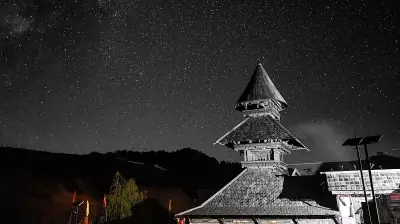
The year 2026 will commence not just with celebrations but with a dazzling celestial spectacle. A Supermoon, specifically the Wolf Moon, will illuminate the night sky on January 1, 2026, offering a breathtaking start to the new year for skywatchers across India and the globe.
What is a Supermoon and When to See It?
A Supermoon occurs when a Full Moon coincides with the moon's closest approach to Earth in its elliptical orbit, known as perigee. This makes the moon appear larger and brighter than a regular Full Moon. According to astronomical data, the Supermoon will reach its peak illumination in India during the afternoon hours of January 1.
However, the best time for observation will be after sunset. The moon will rise in the east as the sun sets, presenting a perfect opportunity for viewing. The exact moment of the full phase is calculated for 3:15 PM IST on January 1. Despite being daytime in India, the moon will still be visible and spectacular later in the evening.

The Significance of the Wolf Moon
The first Full Moon of the year is traditionally called the Wolf Moon. This name originates from Native American and colonial traditions, associated with the time of year when wolf packs were heard howling outside villages due to hunger in the deep winter. This Supermoon is not just a visual treat but also carries this rich cultural nomenclature.
This event is particularly special as it combines the phenomenon of a Supermoon with the symbolism of a new year's beginning. It will be the first of two Supermoons in 2026, with the second one expected later in the year.
How to Watch the Supermoon from India
Witnessing this astronomical event requires minimal equipment but some planning. Here are the best ways to enjoy the 2026 New Year Supermoon:
Find a Clear View: Look for an open area with an unobstructed view of the eastern horizon. Parks, terraces, or open fields away from city lights are ideal.
Timing is Key: While the peak is in the afternoon, plan to look east just after sunset. The moonrise will be the most dramatic and photogenic time, as the moon appears large near the horizon due to the "Moon Illusion."
No Special Gear Needed: The Supermoon can be enjoyed with the naked eye. However, using a pair of binoculars or a small telescope can enhance the view, allowing you to see lunar craters and maria (the dark plains) in greater detail.
Photography Tips: For those wanting to capture the moment, use a camera with a good zoom lens. Stabilize your camera on a tripod and use a remote shutter or timer to avoid blur. Experiment with different exposures.
This celestial event is a free and accessible wonder for everyone. It serves as a reminder of the natural cycles that govern our planet and provides a moment of collective awe as we step into a new year. Mark your calendars for January 1, 2026, and prepare to welcome the new year under the glow of a magnificent Super Wolf Moon.