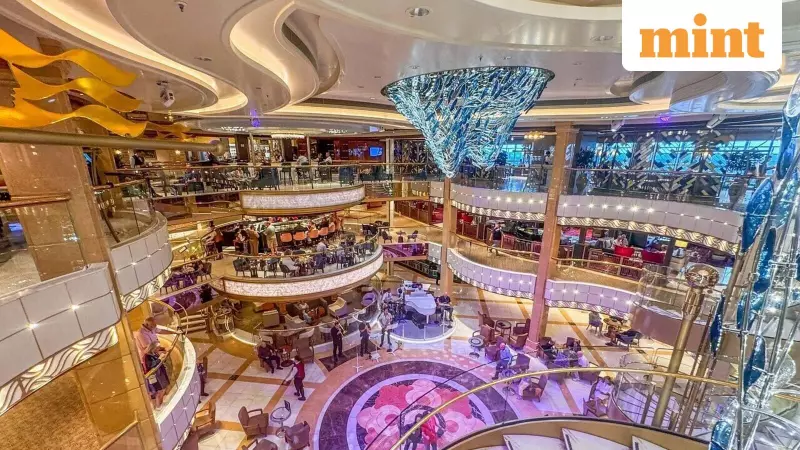
While many of us stress over cooking Christmas dinner for a dozen guests, imagine the task facing Chef Gary Thomas. At 1 PM, his restaurant is silent. By 7 PM, it will be packed. The tables set for 500 will turn over three times. And this is just one of three floors in his dining room. By the end of service, nearly 6,000 people will have dined in under two and a half hours. This is a single venue among the 26 restaurants under his command. By day's end, his army of 344 chefs and 1,700 service staff will have prepared, served, and cleaned up after an astounding 100,000 meals. All this happens not on land, but floating on the Caribbean aboard Star of the Seas, the largest cruise ship ever built.
The Floating City's Culinary Command Centre
With nearly 17 years at sea, Chef Gary now heads catering for Royal Caribbean International. He oversees thousands of culinary professionals across a fleet of 29 ships and two private resorts. The Star of the Seas is his 16th vessel that has held the "world's largest" title. At full capacity, it carries around 7,600 guests and 2,350 crew. Longer than the Eiffel Tower is tall, the 250,000-tonne ship boasts over 20 decks, seven pools, an ice rink, and the largest waterpark at sea. While officially powered by liquid natural gas, its real engine is the vast quantity of food produced daily to keep passengers satisfied.
"A cruise ship is not an aeroplane; there are no reheated ready meals," the operation underscores. Everything from butchering meat and filleting fish to baking bread and frying eggs happens on board. "The only thing we don't have is a live cattle farm," jokes Chef Gary. "But never say never." The scale demands military discipline, a principle borrowed from Auguste Escoffier, the 19th-century French chef who revolutionised kitchen hierarchy and specialisation.

Military Precision and AI Forecasting: The Logistics of $1.5M in Ingredients
The operation's nerve centre is the crew-only decks, home to a corridor nicknamed the "I-95," a 300-metre highway running the ship's length. Here, Inventory Manager Randy Nicolas reigns supreme. His mission: ensure chefs never run out of anything needed for those 100,000 daily meals. He manages 25,000 line items, including 15,000 lobster tails and 400 tonnes of bottled water. The weekly ingredient bill for a cruise is a staggering $1.5 million, doubling for longer voyages.
Daily protein service reaches 6,800 kilograms. This includes deboning chickens, french-trimming lamb, pin-boning salmon, and deveining prawns. This cornucopia is stored in massive walk-in freezers; the fish freezer alone is 210 square metres. Dry stores hold two tonnes of sugar and nearly four tonnes of rice. Multiple chillers are dedicated to dairy.
Randy uses sophisticated software called Crunchtime, which turbocharges Escoffier's mise-en-place ("putting in place") principle. Using AI and historical data, it predicts demand with pinpoint accuracy. "It can tell us, for example, for tonight, we need 1,422 portions of calamari," Randy explains. He also acts as an ingredients oracle, analysing passenger demographics to tailor orders. "Americans want burgers and fries; Europeans want pasta and a wider variety of vegetables." More children mean more potatoes to peel.
The Human Cost and the Battle Against Waste
Behind the gleaming buffet displays lies immense human effort. The chefs, often from emerging markets like the Philippines, Indonesia, India, and South Africa, work seven days a week on contracts lasting up to eight months. Stops at private islands like "Perfect Day at CocoCay" are especially taxing, as food is prepared on the ship the night before, requiring overnight work.
Food safety is paramount. "A norovirus outbreak can destroy a cruise," notes Chef Gary, referencing a 2014 incident on the Explorer of the Seas where 684 people fell ill. His kitchens are maintained with hospital-grade cleanliness.

Despite precise forecasting, waste is an inevitable challenge of the all-you-can-eat model. Buffet food is discarded after three hours for safety. Excess is pulped, with some incinerated to help power the ship's top-deck waterpark. The industry joke that "passengers gain a pound a day" hints at the scale of consumption.
The loading operation is a high-stakes race against the clock. On port days, scores of pre-packed food pallets are forklifted to stock island restaurants. Delays can mean burning extra fuel or ruining thousands of passengers' booked excursions. "Early is on time. On time is late. And late is unacceptable," Randy stresses.
As sunburnt passengers heap their plates at the buffet, admiring watermelon lotus flowers and expertly grilled steaks, few comprehend the monumental logistics on their behalf. It's a feat of modern engineering, historical kitchen doctrine, and sheer human toil, all to ensure that life aboard this floating city is, above all, well-fed.