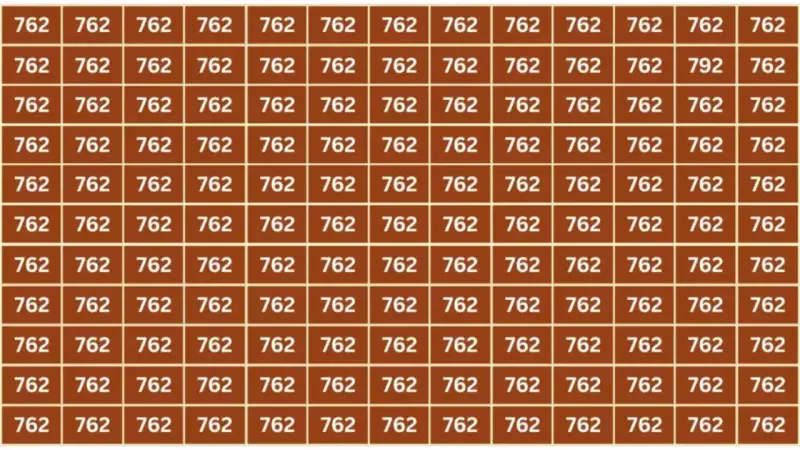
At first look, the image seems mundanely perfect. A neat grid presents row after row, box after box, all displaying the identical number: 762. Your mind instantly relaxes, believing it has decoded the entire scene. This is precisely where the clever deception starts.
The Hidden Intruder in Plain Sight
Concealed within this orderly, repetitive array is a solitary, sneaky 792. Just one. The fascinating part is that your eyes and brain actively resist finding it. Human brains are wired to adore patterns. Once they identify repetition, they switch to autopilot. The moment you think, "Everything here is 762," your brain ceases to scrutinize each number individually and begins assuming the next one will be the same.
This puzzle confounds you not due to its complexity, but because your mind becomes overly confident. You likely gave the image a quick scan and concluded, "All the same." A second, slower, row-by-row examination might still yield nothing. That's when doubt seeps in. Is there truly a different number, or is this a trick?

The answer is yes, you are being played—in the most delightful way. The 792 is hiding in plain sight. It isn't camouflaged by colour, angled differently, or blurred. It appears almost identical to the others, so similar that your brain happily categorises it as "same." The difference is minute but crucial. A single digit has changed, and unless you are paying meticulous attention, your gaze slides right past it.
How Your Brain's Shortcuts Make You Miss Details
This is a textbook demonstration of selective attention. When we anticipate sameness, we stop noticing fine details. It's the same reason you might reread a paragraph without absorbing its meaning, or why you overlook typos in your own writing but catch them immediately in others'. Familiarity breeds carelessness.
The key to spotting the 792 is to deliberately slow down and shatter the perceived pattern. Instead of scanning for the complete number, focus on individual digits. Look only at the middle digit, or concentrate solely on the last one. Suddenly, the invisible becomes glaringly obvious. Once you see it, you cannot unsee it.
The Real Win is Outsmarting Your Own Mind
This moment of discovery delivers an oddly satisfying "Aha!"—a tiny rush of victory when your brain disengages from autopilot and re-engages with focused awareness. Puzzles like this are enjoyable because they aren't truly tests of eyesight; they are tests of conscious awareness.
They serve as a reminder of how often we navigate life assuming things are uniform, familiar, and predictable. While this mental efficiency is helpful most of the time, it can sometimes cause us to miss the one detail that matters. So, the 792 is indeed there. It was always there. You simply needed to stop trusting your brain's automatic shortcuts.
Congratulations if you found it—you have officially outsmarted your own mind. And that is arguably the most rewarding kind of victory.