India's rich history is etched in stone and mortar across its vast landscape. For centuries, powerful dynasties have risen and fallen, each leaving behind a legacy of breathtaking monuments that tell tales of faith, power, artistry, and engineering genius. These structures are more than just tourist attractions; they are chronicles of the subcontinent's diverse cultural and political evolution. Let's embark on a journey through ten such iconic landmarks, each a masterpiece created by the rulers of its time.
Ancient Foundations: Stupas and Early Temples
Some of India's oldest surviving structures are testaments to the early mastery of stone construction and deep spiritual devotion. The Sanchi Stupa in Madhya Pradesh stands as a prime example. Originally commissioned by the great Mauryan Emperor Ashoka in the 3rd century BCE, it is one of India's oldest stone structures. Its massive hemispherical dome and ornately carved gateways, known as toranas, are adorned with Buddhist symbols and narratives, offering a serene yet awe-inspiring glimpse into ancient Indian art. Recognized as a UNESCO World Heritage Site, it showcases the Mauryan empire's advanced stonework.
Moving south, the Pallava dynasty pioneered Dravidian temple architecture. Their legacy is magnificently captured in the Shore Temple at Mahabalipuram, Tamil Nadu. Dating to the 8th century CE, this structural stone temple stands dramatically against the shoreline of the Bay of Bengal. The Pallavas were masters of both rock-cut and free-standing temples, and this monument's resilience against the elements highlights their architectural innovation, setting a template for South Indian temple design for centuries to come.

Medieval Marvels: Blending Styles and Scaling Heights
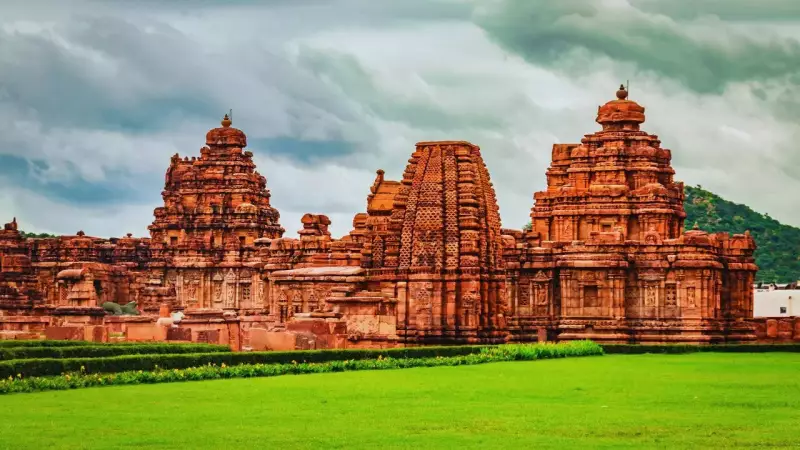
The medieval period saw the flourishing of distinct regional styles and the synthesis of various architectural influences. In Karnataka, the Chalukya dynasty created the Pattadakal Group of Monuments, a UNESCO World Heritage Site. Built during the 7th–8th century CE, temples like the Virupaksha and Mallikarjuna exhibit a rare and harmonious fusion of the northern Nagara and southern Dravidian architectural styles, reflecting the dynasty's extensive reach and artistic ambition.
Another southern powerhouse, the Chola Empire, reached new heights—literally—with the Brihadeeswarar Temple in Thanjavur, Tamil Nadu. Built by Emperor Rajaraja I in the 11th century CE, this UNESCO-listed temple soars to 66 metres. Its towering vimana (tower), the massive monolithic Nandi (bull), and the precise mathematical planning involved make it one of the greatest engineering feats of its time, embodying the peak of Chola power and Tamil architectural genius.
In the north, the advent of the Delhi Sultanate introduced new forms. The Qutub Minar in New Delhi, the world's tallest brick minaret, is an enduring symbol of this era. Its fluted shafts, intricate carvings of Arabic inscriptions, and alternating bands of red sandstone and marble reflect the early Indo-Islamic architectural style. The complex, including the Quwwat-ul-Islam Mosque, is another prized UNESCO World Heritage Site.
Regional Gems and Imperial Grandeur
Beyond the well-known empires, regional dynasties created unique wonders. In Assam, the Ahom dynasty, which ruled for nearly 600 years, built the Rang Ghar in Sivasagar. Often called the Colosseum of the East, it is one of Asia's oldest surviving amphitheatres. Built by Swargadeo Pramatta Singha, its roof is designed to resemble the inverted hull of an Ahom royal boat, a distinctive architectural signature. It was used by Ahom royalty to watch sports and cultural events.
In Telangana, the Kakatiya dynasty is celebrated for the exquisite Ramappa Temple (recently declared a UNESCO site). Famous for its lightweight floating bricks, intricate stucco sculptures, and a star-shaped platform, the temple showcases exceptional engineering. Uniquely, it is the only temple in India named after its architect, Ramappa.

The ruins of Hampi in Karnataka speak of the glorious Vijayanagara Empire (14th–16th century CE). This sprawling UNESCO World Heritage Site, once a thriving capital, features majestic temples like the Virupaksha Temple, royal enclosures, bazaars, and elephant stables, mirroring the empire's immense wealth and cultural sophistication.
No list is complete without the crowning jewel of the Mughal Empire—the Taj Mahal in Agra, Uttar Pradesh. Built by Emperor Shah Jahan as a mausoleum for his wife Mumtaz Mahal, it is the ultimate symbol of love and architectural perfection. Its flawless symmetry, gleaming white marble, exquisite pietra dura inlay work, and serene charbagh (Mughal garden) represent a sublime fusion of Persian, Indian, and Ottoman influences, making it one of the most recognized monuments on Earth.
Finally, the Maratha Empire's political might is symbolized by Shaniwar Wada in Pune, Maharashtra. Built by the Peshwas, this fortification was the seat of Maratha power. Though largely destroyed by a fire in 1828, its imposing gates, robust fortifications, and surviving structures like the fountain system offer a powerful glimpse into the empire's martial strength and administrative grandeur, complete with a legacy of historic tales.