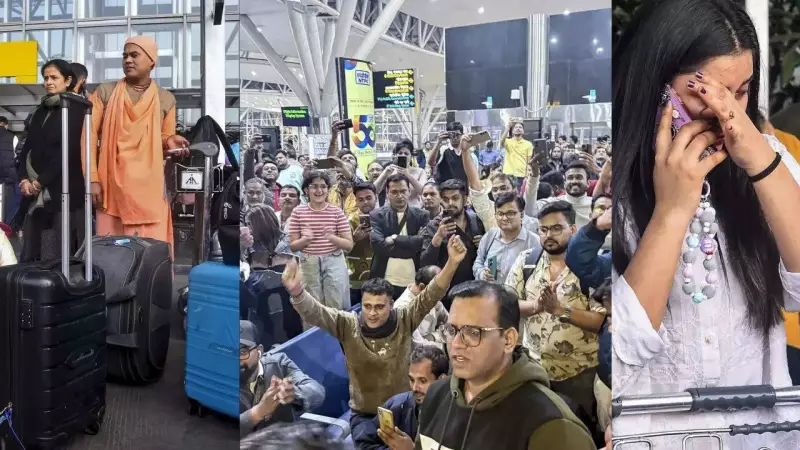
Passengers across India faced severe travel disruptions as budget carrier IndiGo cancelled over 1,000 flights amid operational chaos. The situation prompted the government to intervene, putting new pilot duty time rules on hold in an urgent bid to restore normalcy.
Passenger Ordeals: Missed Opportunities and Lost Luggage
At airports nationwide, scenes of frustration unfolded. In Ahmedabad's Sardar Vallabhbhai Patel International Airport, long queues formed as travellers grappled with cancellations. One affected group was a team of six students with two mentors, selected for the Smart India Hackathon 2025 at North-Eastern Hill University in Guwahati. Their 6:15 am connecting flight from Kolkata was cancelled, dashing their hopes. "Our hard work of 6-7 months is now wasted. Such opportunities are rare... we were selected in the first attempt," a team member lamented, noting that a train would take three days, making participation impossible.
Other passengers reported significant baggage and logistical nightmares. One traveller was stranded for two days in Kolkata and Hyderabad before reaching Indore via another airline, only to find his luggage still missing. Another passenger in Indore reported, "My luggage has not arrived since 2 days and there is no information." Despite being given a propriety report and a contact number, their calls went unanswered.

Families in Distress: From Skating Competitions to Medical Trips
The cancellations had a cascading effect on families with critical travel needs. At Delhi's IGI Airport, 37-year-old Mangaljeet Singh from Ludhiana sat with his family outside Terminal 2's Gate 2. Their journey to Visakhapatnam for his son's national skating competition was in tatters. Their first flight from Ludhiana to Delhi was cancelled, forcing a road trip to the capital, only to discover their connecting flight was also scrapped. The competition was postponed by a day due to similar delays faced by many participants. The family of five secured only two tickets on another airline, forcing Singh's wife, three-year-old daughter, and 64-year-old mother to return to Ludhiana. "If my son misses the competition, his year-long efforts will come to naught," Singh said.
In Terminal 1, 34-year-old Rinpuii from Aizawl waited for over five hours with her unwell two-year-old daughter, trying to reach a medical specialist in Thiruvananthapuram. She met Delhi resident Carolyn, 22, who was also trying to get home to Aizawl and had nowhere to stay in Delhi. Another passenger, 26-year-old Pankaj Gupta from Alwar, had planned a surprise flight home via Jaipur for his elderly parents, who had never flown before. Their initial joy turned to despair as their plans were cancelled.
A group of 30 tourists from Raipur, returning from Dharamshala, were stranded at Delhi's Terminal 2 for two days. Hemit Navdia, 23, managing the group, stated, "It's costing me a lot extra to manage so many people in this condition. We don't have any accommodation here." The airport authority eventually provided them with some food.
Government and Regulatory Response
In response to the crisis, the government suspended the Directorate General of Civil Aviation’s (DGCA) Flight Duty Time Limitations (FDTL) orders with immediate effect. Union Aviation Minister Ram Mohan Naidu stated the decision prioritised passengers, especially senior citizens, students, and patients. The DGCA has formed a four-member committee to review the operational disruptions and assess accountability. Aviation authorities have also offered Airbus A320-type-rated flight operations inspectors to assist IndiGo in resuming operations.
DGCA chief Faiz Ahmed Kidwai appealed for pilot cooperation, citing the upcoming fog season, peak holidays, and marriage travel season. "Passenger volumes are expected to rise sharply, and weather-related impacts may further complicate scheduling and flight safety," he said.

Meanwhile, senior pilots expressed frustration over working conditions, with one stating airlines treat them as "mere cost-cutting items" during good times. IndiGo CEO Pieter Elbers acknowledged the crisis had shaken passenger confidence but projected that normal operations could return between 10 and 15 December.