The Unseen Guardian of Kohima: A Journey to Pulie Badze
There is a unique sensation that envelops you in Kohima, a feeling of being watched not by human eyes, but by something far more ancient and serene. This comforting presence comes from a distant cross perched high on a hill, silently overseeing the bustling city below. This iconic landmark, the Pulie Badze white cross, became the centerpiece of an unforgettable adventure during a recent visit to Nagaland's capital.
An Unexpected Afternoon of Exploration
My business meeting concluded earlier than expected, gifting me with an entire afternoon of unplanned freedom. As we navigated through Kohima's unusually busy streets, the city felt different from its quieter seasons. Traffic flowed like a restless river through the urban landscape, creating an energy that contrasted with the peaceful hills surrounding us. Having explored familiar sites like Kisama Heritage Village the previous night, we yearned for something less traveled, a path where we could still feel like newcomers.
We considered the usual destinations—the solemn Kohima War Cemetery, the majestic cathedral—but realized we had visited them multiple times before. Khonoma Green Village beckoned with its ecological wonders, but distance and evening commitments made it impractical. Then, as we drove through the city, my eyes caught the distant silhouette of a cross standing sentinel on a hilltop. "What about that hill?" I asked our companion Vibei. "That's Mount Pulie Badze," he replied, sparking our curiosity.

The Legend of Pulie Badze: A Tale as Old as Time
Pulie Badze is more than just a mountain peak rising 2,296 meters above sea level in Kohima District. It serves as a natural watchtower overlooking Nagaland's capital, embodying both geographical prominence and cultural significance. Located in Jotsoma, this majestic peak forms the heart of the Pulie Badze Wildlife Sanctuary, a protected area celebrated for its rich biodiversity. However, what truly captured my imagination was not the ecological wonders, but a local legend passed down through generations.
The story begins with Pulie Nakhro, son of Khrutshie, a respected and physically strong man from Zutshüma (modern-day Jotsoma). His parents arranged his marriage to Chaselie-ü from the Geisuonuoimia clan, hoping for a harmonious union. After their wedding, Pulie planned a grand feast and patiently awaited their harvest. But as the crops neared maturity, an unseen creature began destroying their fields.
Determined to protect their livelihood, Pulie prepared meticulously for a hunt, sharpening his dao and spear. At dawn, he encountered a massive snake, "Tinyhü Rapphe," ravaging their crops. With precision, he hurled his spear, striking the serpent, though it escaped with the weapon embedded in its body. Shortly after this encounter, misfortune struck as illness overcame Pulie. Despite his wife's healing rituals, his strength faded. In her despair, she cried, "What will become of me after you are gone?" Pulie comforted her, promising that after his death, their field Tsakrakhalie Zie would belong to her.
When Pulie passed away, villagers discovered the wounded snake dead at the foothills of Sopfuno Tsiekhie, with Pulie's spear nearby. From a hilltop, his grieving father cried out, "Pulie, who would not hold the feast!" Suddenly, a voice echoed from the mountain above, "Ho! Ho!" Believing his son now resided on the hill, the father erected a stone platform at its summit—a seat for Pulie. Thus, the hill became known as Pulie Badze, meaning "Pulie's Seat."
The Journey to the Summit
Inspired by this legend, we embarked on our journey to Pulie Badze, located approximately 7-10 kilometers from Kohima town—a 30-40 minute drive depending on traffic conditions. Before leaving the city outskirts, we packed a simple lunch and some renowned Rusoma oranges, celebrated for their exceptional sweetness and juicy freshness.

The road to Jotsoma welcomed us with breathtaking greenery and vibrant cherry blossoms contrasting beautifully against the clear blue sky. As we ascended, human settlements gradually disappeared, replaced by the soothing sounds of nature and our vehicle's steady hum. We reached the mountain base surprisingly quickly, where paying the entry fee reminded me of my inadequate attire—I stood in formal shoes, completely unprepared for trekking.
The forest trail proved remarkably dense, with the midday sun struggling to penetrate the thick canopy. Filtered beams of light created magical patterns, while the crisp, clean air filled our lungs with freshness that contrasted sharply with urban pollution. This natural sanctuary offered a profound reminder of nature's simple yet powerful gifts, like small pockets of heaven quietly preserved on Earth.
The Final Ascent and Breathtaking Revelation
At the last motorable point, the mountain demanded we continue on foot—no wheels or engines, just the timeless connection between traveler and trail. I glanced at my inappropriate shoes with mixed amusement and concern, then shrugged and proceeded. Stepping onto the forest floor felt like entering another realm, ancient and listening, reminiscent of mystical forests from literature.
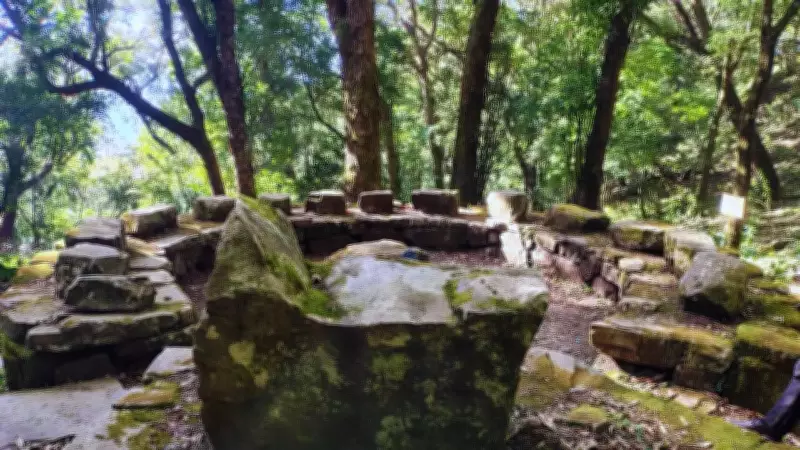
Along the path, small wooden boards displayed Bible verses and encouraging quotes, providing unexpected companionship during challenging stretches. The journey began to feel like a pilgrimage, enhanced by occasional stone seats placed thoughtfully for weary travelers. Deep within the woodland, we discovered a remarkable stone circle—massive rocks arranged in a ring, weathered by time and draped in soft green moss. This formation appeared like seats for ancient gatherings, evoking images from legendary tales.
The final incline tested our endurance, but just as our legs protested, a refreshing cold wind revived our spirits. The summit revealed itself in one breathtaking panorama. Above us stretched an immense, pure blue sky that seemed painted by divine hands, with clouds swirling like artistic brushstrokes. Below, Kohima nestled peacefully among rolling hills, its rooftops and ridges forming a living tapestry. The white cross stood silently as a guardian, while distant mountains faded into layered shades of blue, creating horizons that whispered of undiscovered places.
Standing between sky and earth, with Kohima sparkling like a jewel at our feet, the world felt wonderfully small and heaven remarkably close. "Breathtaking" seemed inadequate to describe the moment—a perfect culmination of legend, nature, and spiritual elevation.
About the author: Mr. Ngayaipam A. Shimray is a young professional at NITI Aayog, Government of India, contributing to policy research and development initiatives. An avid explorer and traveler, he possesses deep appreciation for nature and discovering new destinations.