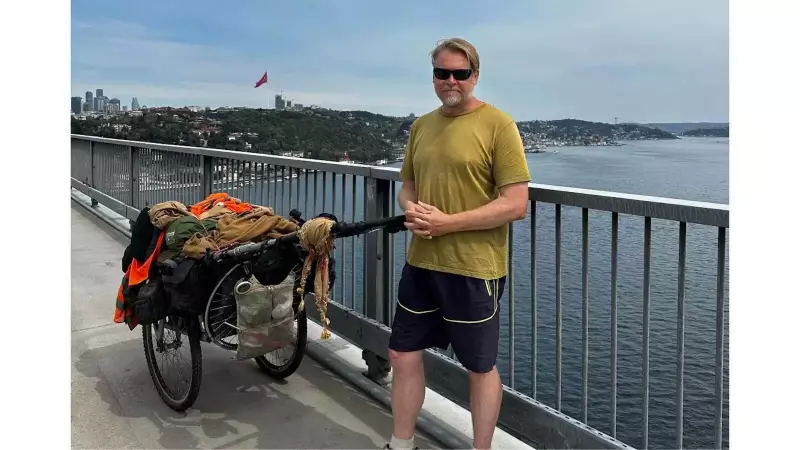
In an era of instant gratification, one man's nearly three-decade-long quest stands as a monumental testament to human will. Karl Bushby, a 56-year-old former British paratrooper, is on the final stretch of an unprecedented journey: a continuous, unbroken walk around the world that began in 1998. With less than a thousand miles to go, he is expected to finally reach his hometown of Hull, England, by September 2026, concluding a 31,000-mile odyssey that has redefined the limits of modern exploration.
From Barroom Bet to Global Odyssey: The Goliath Expedition
What began as a restless idea in his twenties has transformed into a 27-year saga of survival. Born in Hull in 1969, Bushby's path was shaped by his service in the British Army's Parachute Regiment, where the loss of comrades cemented his belief in seizing life's grand adventures. In November 1998, with just $500 and paper maps, he set off from Punta Arenas, Chile, on what he named the Goliath Expedition. His self-imposed rules were simple yet brutal: no advancing by vehicle, and no returning home until he could step onto British soil on foot.
His trek took him the length of the Americas, through the harsh terrains of Patagonia and the Andes. He crossed Mexico and the United States before entering Russia and Mongolia. One of the most perilous chapters came in 2006, when he and adventurer Dimitri Kieffer walked across the frozen, shifting ice of the Bering Strait from Alaska to Russia, a feat few have dared.

Political Hurdles and Human Kindness
Bushby discovered that his greatest obstacles were often man-made, not geographical. In Russia, he was detained for 57 days for entering at an unofficial point. A five-year Russian visa ban in 2013 forced a major halt. In a remarkable act of protest, he walked from Los Angeles to the Russian Embassy in Washington, D.C., and successfully overturned the ban. The COVID-19 pandemic and financial woes caused further years of delay.
Faced with another geopolitical block in 2024, Bushby chose a radical solution. To bypass Iran and Russia, he swam across the Caspian Sea from Kazakhstan to Azerbaijan, a 31-day aquatic marathon sleeping on support boats. He then walked through the Caucasus, Turkey, and into Europe, reaching Hungary by late 2025.
Despite the solitude, Bushby insists he never walked alone. Across 25 countries, strangers provided food, shelter, money, and critical medical aid. He has survived a deep wrist gash he stitched himself, a stomach infection in Peru, and countless other crises thanks to local generosity. He often states that 99.99% of the people he met were kind, revealing the best of humanity.
The Final Steps and a Life After the Walk
As the end draws near, Bushby feels a complex mix of pride, exhaustion, and apprehension. For 27 years, his singular purpose has been to wake up and move closer to home. Completing this life-defining mission brings both triumph and a sense of loss. He acknowledges the profound loneliness and psychological strain of a life perpetually in motion.
Looking beyond the finish line, Bushby hopes to channel his unique experience into science outreach and education, inspiring others with the lessons learned about our planet and its people. His journey is more than an expedition; it is a profound study in persistence, humility, and connection.
When Karl Bushby finally steps into Hull in 2026, he will close a chapter on one of the most extraordinary human journeys of the modern era. It is a powerful reminder of what is possible when one person simply decides never to stop moving forward.