In an age where most hill stations are crowded with traffic, honking taxis, and endless hotel construction, Matheran feels almost unreal. Sitting on a small plateau in the Western Ghats near Mumbai, this quiet hill station remains India's only vehicle-free zone where travelers still arrive on foot, by horse, or by a slow-moving toy train.
The ban on vehicles is not just a tourism gimmick here. It is central to Matheran's geography, ecology, and identity. Over the years, the hill station has evolved with policies developed around its fragile ecology and debates about sustainability and accessibility.
Geographical Description of Matheran
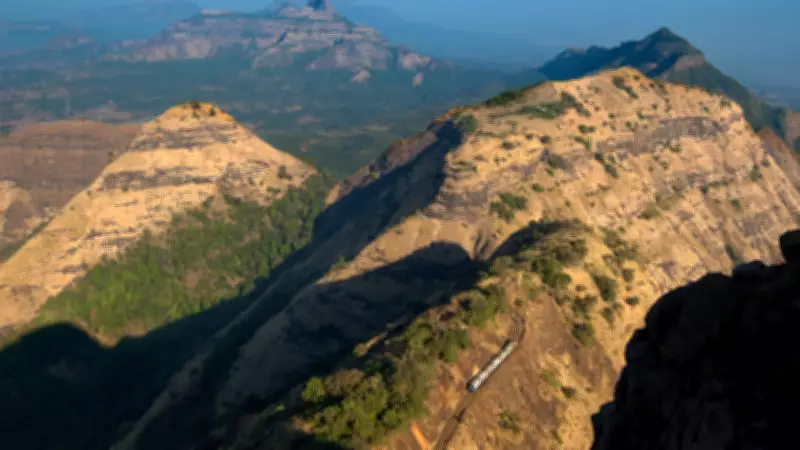
Located in the Karjat taluka of Raigad district in Maharashtra, Matheran sits at an elevation of roughly 760-800 meters above sea level on the edge of the Sahyadri range. It lies around 80-90 km from Mumbai and about 120 km from Pune, making it one of the most accessible hill escapes for western India.

The name "Matheran" translates to "forest on the forehead" in Marathi, which describes it perfectly. Dense woodland surrounds the plateau, with steep valleys opening around its edges. The landscape is defined by rust-red laterite trails, old British-era bungalows, and thick monsoon greenery. Unlike many hill stations that gradually turned into traffic-heavy commercial towns, Matheran still feels unusually old-world. Much of that comes from one defining rule: vehicles are not allowed inside.
Why Are Vehicles Banned in Matheran?
The restriction dates back to concerns over the plateau's fragile ecology. Matheran was developed in the 1850s as a colonial summer retreat, but over time authorities recognized that its narrow paths, forest cover, and erosion-prone slopes could not sustain regular automobile traffic.
Eventually, the Ministry of Environment and Forests notified Matheran as an eco-sensitive zone. Private vehicles were banned beyond Dasturi Naka, the final motorable point below the town. The idea was both environmental and experiential: protect the plateau from pollution, heavy construction, and slope damage while preserving the quiet character of the hill station.
The result is a rare Indian travel experience where the absence of vehicles becomes part of the attraction itself. Visitors arrive and suddenly realize the difference: no honking, no pollution, no traffic, but only calm and quiet atmosphere.
How Do People Move Around Then?
That is where Matheran becomes interesting. To reach the hill station, travelers usually first arrive at Neral, the nearest railhead on the Mumbai-Karjat line. From there, the famous Matheran Hill Railway, the toy train built in 1907, slowly climbs into the hills through forests and curves. The ride itself is one of Matheran's biggest attractions.
Those traveling by road can drive only till Dasturi Naka, where vehicles must be parked. From there, the market area is roughly a 30–40-minute walk away. Inside Matheran, movement traditionally depended on three options: walking, horses, and hand-pulled rickshaws. Around 460 licensed horses and ponies still operate across the hill station, carrying tourists, luggage, and supplies through the forest paths. Porters continue to carry goods uphill manually or using pack animals.
Walking, though, remains the real way to experience Matheran. Most viewpoints, lakes, and forest trails are connected by pedestrian tracks shaded by trees.
The Big Change with Supreme Court Order
In recent years, however, the model has started evolving. In 2022, the Supreme Court allowed limited battery-operated e-rickshaws inside Matheran on an experimental basis. These electric vehicles started running on selected routes between Dasturi Naka and the railway station, becoming an alternative for elderly travelers or those who are unable to walk long routes.
Later, in 2025, the Supreme Court ordered an end to hand-pulled rickshaws, calling the practice "inhuman." The court directed the state government to give e-rickshaw permits and livelihood schemes to pullers and also continued the ban on fuel-based vehicles.
The transition has not been entirely smooth. Horse owners worry about losing business, while locals continue debating how to balance environmental protection with accessibility for residents, students, and elderly people who live here year-round.

What Has the Vehicle Ban Achieved?
The effects are immediately visible. Matheran has cleaner air and significantly lower noise levels than most popular hill stations near Mumbai and Pune. The absence of traffic also helps preserve the forested atmosphere that defines the destination. Environmentally, the eco-sensitive zone status has limited large-scale construction and aggressive road expansion, helping maintain the plateau's fragile ecosystem and reducing pressure on slopes vulnerable to erosion.
Tourism-wise, the "Asia's only automobile-free hill station" label has become its strongest identity. Many visitors now come specifically because the town feels slower, quieter, and more immersive than conventional tourist centers.
What Should Travelers Do in Matheran?
The charm here lies less in wandering through the landscape than just ticking off a destinations checklist. Popular spots include Panorama Point for sunrise views, Louisa Point for cliffs and views of Prabal Fort, and Echo Point, where voices bounce dramatically across the valleys. Charlotte Lake, surrounded by trees and mist during monsoon, remains one of the town's calmest corners.
Forest walks are central to the experience. The red-earth trails connecting viewpoints become especially beautiful during the rains, when waterfalls appear across the cliffs and the plateau turns intensely green. And of course, there is the toy train: slow, scenic, and deeply nostalgic.
Best Time to Visit
October to May is considered the most comfortable season, with pleasant weather ideal for walking and sightseeing. Monsoon, however, is when Matheran looks its most dramatic. From June to September, the forests become lush, waterfalls return, and clouds drift through the pathways. But be careful of slippery trails, heavy rain, and occasional toy-train suspensions due to landslide risks.
Still, for many travelers, that rain-soaked version of Matheran is exactly the point. Because in a country obsessed with speed, Matheran remains one of the few places where traffic leaves behind long before the holiday begins.