India's forests are home to some of the world's most fascinating birds, and among them, hornbills stand out as true icons. With their large, curved bills and often elaborate casques, these birds are not just visually stunning but play a critical role as forest architects and seed dispersers. Across the subcontinent, from the Western Ghats to the Northeast and the remote Andaman Islands, India provides a habitat for nine distinct species of hornbills.
The Vital Role and Diverse Habitats of Indian Hornbills
Hornbills are essential for the health of India's ecosystems. By consuming vast quantities of fruits, especially figs, they carry seeds over long distances, helping regenerate forests. Their unique nesting behaviour, where the female seals herself inside a tree cavity during incubation, also highlights their fascinating biology. These birds are found in varied landscapes, including the dense evergreen forests of the Western Ghats, the rainforests of the Northeast, the central Indian woodlands, and isolated islands.
A Closer Look at India's Nine Hornbill Species
Each of India's hornbills has unique characteristics and faces specific conservation challenges. Here is a detailed overview of these magnificent birds.

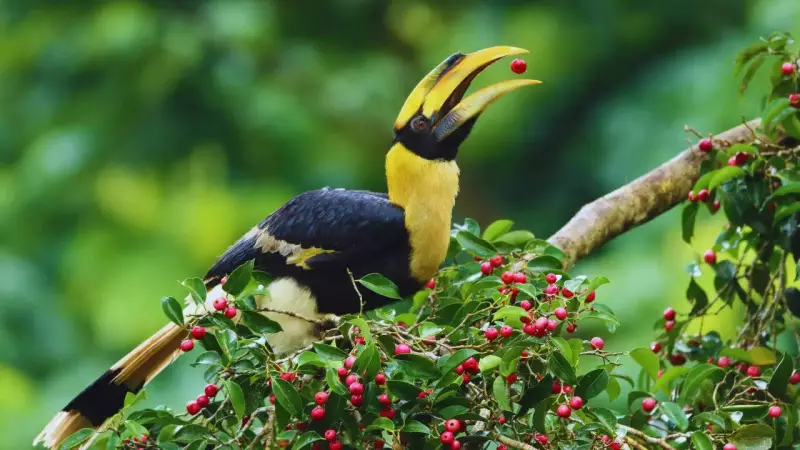
The Great Hornbill is perhaps the most recognizable. Its massive yellow-and-black casque and loud wingbeats make it a majestic sight in the evergreen forests of the Western Ghats and Northeast India. As a primary consumer of figs, it is a crucial long-distance seed disperser for the forest canopy.
The Rufous-necked Hornbill, with its distinctive chestnut-coloured neck and dark body, is one of India's rarest. It is confined to the montane and lowland forests of Arunachal Pradesh, Nagaland, and parts of Assam. Its rapidly shrinking habitat makes it a high-priority species for conservation efforts.
The Wreathed Hornbill graces the northeastern rainforests. Preferring undisturbed primary forests, these birds are often seen flying across valleys in groups. Their diet is predominantly fruit-based, though they occasionally prey on small animals, and they are increasingly pressured by habitat disturbance.
The Narcondam Hornbill represents a unique natural heritage. This species is endemic to the tiny volcanic Narcondam Island in the Andaman Sea, existing nowhere else on Earth. With its entire global population restricted to an island just 6 kilometres wide, it is extremely vulnerable to any natural or human-induced changes.
Austen's Brown Hornbill, also known as the White-throated Brown Hornbill, is a more elusive species of the Northeast. Its warm brown plumage and slender profile help it blend into the deep forest interiors of states like Arunachal Pradesh and Mizoram, making it less conspicuous than its boldly coloured relatives.
The Malabar Pied Hornbill is a striking black-and-white bird primarily found in the Western Ghats and central India. More adaptable than some species, it can be spotted in riverine areas and even near human settlements where fruiting trees are present, feeding heavily on figs.
The Malabar Grey Hornbill is a Western Ghats endemic that lacks a prominent casque. Smaller and more agile, it is often seen in pairs or family groups in the mid-canopy. Its loud, cackling call is a familiar sound in the forests of Kerala, Karnataka, Tamil Nadu, and Goa.
The Indian Grey Hornbill is the most widespread and adaptable species across India. Found in plains, low hills, and even semi-urban areas with old trees, its uniform grey plumage and modest casque make it a common, though ecologically important, resident.
The Oriental Pied Hornbill is a charismatic and tolerant species of Northeast India. Recognizable by its black plumage, white belly, and large pale bill, it can survive in disturbed habitats, including areas near villages and plantations, as long as fruiting trees remain.

Conservation: The Future of India's Hornbills
The survival of these nine species hinges on the preservation of their forest habitats. Deforestation, fragmentation, and hunting pose significant threats. Species with restricted ranges, like the Narcondam and Rufous-necked Hornbills, are particularly at risk. Conservation initiatives focused on protecting old-growth forests, maintaining corridors for movement, and involving local communities are vital. Birdwatching and responsible eco-tourism also play a role in raising awareness and generating support for the protection of these magnificent forest architects of India.