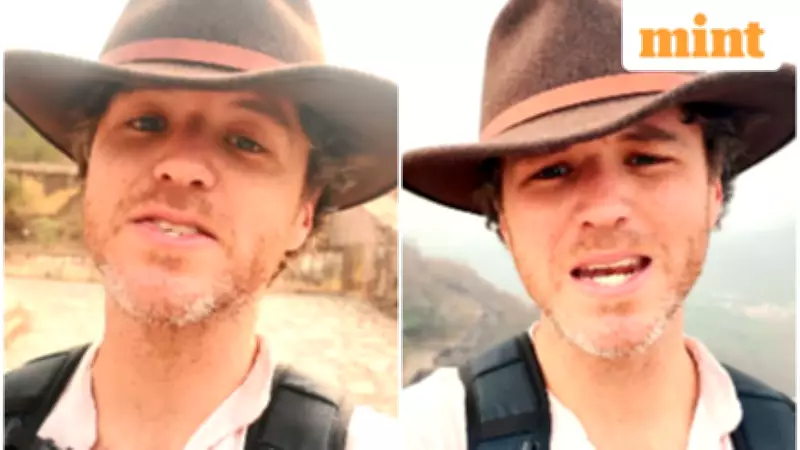
American Traveler's 'Lazy Indians' Remark at Amber Fort Sparks Heated Online Debate
A viral Instagram video featuring American traveler Charlie Evans has ignited a fierce online discussion after he made sweeping generalizations about Indians being "lazy" and "out of shape" during his visit to Jaipur's historic Amber Fort. The video, which has garnered significant attention across social media platforms, shows Evans descending from the fort while commenting on Indian visitors who had paused during the steep climb.
The Controversial Video and Its Content
In the now-viral clip, Charlie Evans is seen walking down from Amber Fort while observing numerous Indian tourists who had stopped midway during the ascent. He specifically noted that many people were resting, smoking, or drinking beverages instead of completing the challenging walk to the summit. Based on this single observation, Evans made broad generalizations, claiming this behavior demonstrated Indians' unwillingness to "go the extra mile."
"I know why Indians are out of shape," Evans states in the video, adding that numerous tourists appeared "stranded halfway up" and showed little interest in finishing the climb despite having paid the entry fee. He repeatedly emphasized his viewpoint throughout the video, insisting that the scene validated his perception of Indians as fundamentally lazy.

Social Media Reactions and Divided Responses
The video has since accumulated over 4.36 lakh views on Instagram, triggering a flood of reactions ranging from agreement to outright outrage. While a small segment of users echoed Evans' remarks, arguing that fitness and exercise culture could be improved in India, a much larger contingent pushed back strongly against his comments.
Many social media users criticized Evans' remarks as:
- Stereotypical and insensitive
- Rooted in cultural ignorance
- An unfair generalization based on limited experience
Humorous and Thoughtful Counterarguments
Several responses used humor to challenge Evans' claims. One user quipped, "Indians won't climb a hill unless there's a temple on top," while another added, "Put a temple at the peak and see how fast people reach there." These comments highlighted cultural and motivational factors that Evans may have overlooked.
Other users took a more measured approach, urging the American traveler to avoid making sweeping judgments about an entire population based on a single experience. One particularly thoughtful comment read: "FYI, the British came, admired, looted, divided and ruled, and left with our resources. So most Indians don't appreciate an English-speaking foreigner blaming Indians, even if you think you're being honest. Some people are health-conscious, others are not. Please come, visit and enjoy our country — but don't generalise."
Acknowledging Valid Concerns While Rejecting Generalizations
A few users acknowledged that the video touched on some uncomfortable truths about lifestyle habits. One person commented, "You're right. None of my friends want to join me for cycling at 6am on a weekend," suggesting that certain aspects of modern Indian lifestyles could benefit from more physical activity.
However, several others reframed the issue entirely, arguing that the core problem wasn't laziness but rather motivation. One user insightfully noted, "It's not laziness, it's motivation. Tell them there's a world-renowned temple on top and they'll run." This perspective emphasized how cultural context and purpose significantly influence behavior patterns.
The Broader Implications of the Debate
The viral video and subsequent debate highlight several important issues:

- The dangers of making sweeping generalizations about any culture or population
- The complex relationship between tourism, cultural perception, and cross-cultural understanding
- Legitimate conversations about health and fitness that can occur without resorting to stereotypes
- The power of social media to amplify both constructive dialogue and divisive rhetoric
As the discussion continues to unfold online, it serves as a reminder of how cultural encounters in the digital age can quickly escalate into broader conversations about representation, perception, and mutual understanding between different societies.