

Himachal Chief Secretary Informs NGT of Action Against Officials for Kasol Garbage Mismanagement
In a significant development, Himachal Pradesh Chief Secretary Sanjay Gupta has formally informed the National Green Tribunal (NGT) that decisive action has been initiated against officials responsible for the mismanagement of garbage disposal in Kasol. Kasol, renowned as one of the state's premier tourist destinations, has been grappling with severe waste management issues, prompting judicial intervention.
Formal Complaints and Notices Issued
According to a detailed affidavit recently submitted to the NGT, Chief Secretary Gupta stated that a formal complaint was lodged against Ghanshyam Sharma, the Member Secretary of the Special Area Development Authority (SADA), Manikaran, and Gaurav Malik of Lakshay Total Solution Ltd. The complaint alleges violations of the Environment Protection Act, 1986. Both individuals received official notices from the government on January 8, and the process for imposing penalties against them is currently underway.
Inquiry and Inspection Findings
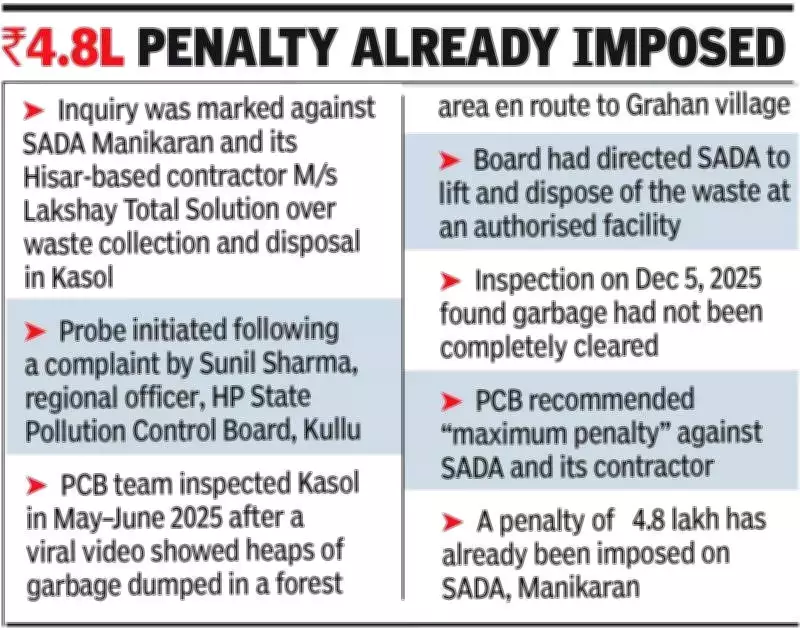
The inquiry was specifically marked against SADA, Manikaran, and its Hisar-based contractor, M/s Lakshay Total Solution, entities entrusted with the collection and scientific disposal of waste in Kasol. This action was initiated following a complaint by Sunil Sharma, Regional Officer of the Himachal Pradesh State Pollution Control Board in Kullu.

A team from the Pollution Control Board conducted thorough inspections in Kasol, Kullu district, during May and June 2025. This inspection was prompted after a video showing massive heaps of garbage dumped in a forest area along the route to Grahan village in Kasol went viral on social media platforms. The Board subsequently ordered SADA to lift the garbage and dispose of it at an authorized facility. However, a follow-up inspection on December 5, 2025, revealed that the garbage had not been completely removed, indicating non-compliance.
Penalties and NGT Directives
The Pollution Control Board, in its complaint to the Environment Secretary, recommended the "maximum penalty" against SADA and its contractor for their failure to dispose of garbage scientifically. In a prior action, the Board had already imposed a penalty of Rs 4.8 lakh against SADA, Manikaran.
It is important to note that the NGT took suo motu cognizance of the garbage disposal problem in Kasol in June 2025. The Tribunal issued notices to multiple authorities, including the Himachal Pradesh Pollution Control Board, the Central Pollution Control Board, the Union Ministry of Environment, Forest and Climate Change, the Kullu Deputy Commissioner, and SADA (Manikaran), making them respondents in the case.
Chief Secretary Gupta filed the affidavit after the NGT, last year, made him a respondent and directed him to submit a report detailing the actions taken for the implementation of solid waste management rules in Kullu. The Tribunal also directed the Chief Secretary to issue orders for the imposition of penalties against concerned government departments, officials, and individual violators of environmental regulations.
Long-term Solutions and Infrastructure Development
Meanwhile, to address the persistent problem of garbage disposal in Kasol, the affidavit stated that land measuring 0.1982 hectares has been identified for the establishment of a solid waste management plant. According to the Kullu administration, the project has received in-principle approval from the Ministry of Environment, Forest and Climate Change.
Until the permanent solid waste management plant becomes operational, four temporary sites have been identified for garbage disposal. Additionally, a Material Recovery Facility (MRF) is currently under construction in Kasol. This facility is designed to process garbage before its final disposal, representing a step towards more sustainable waste management practices in the ecologically sensitive region.
This comprehensive response from the state administration underscores the seriousness with which environmental violations are being treated, especially in high-traffic tourist areas like Kasol, which are vital to Himachal Pradesh's economy and natural heritage.






