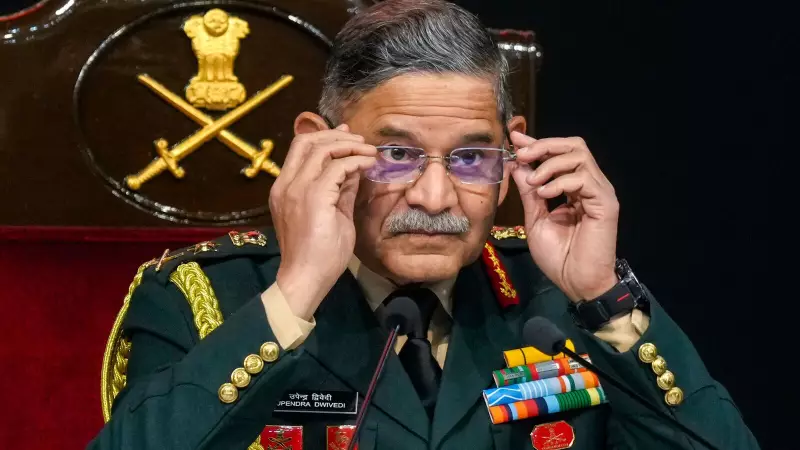
Indian Army Chief General Upendra Dwivedi delivered a strong statement on Tuesday, January 13, dismissing Chinese assertions over the Shaksgam Valley. He made it clear that India does not accept the 1963 boundary agreement between Pakistan and China.
India's Firm Stance on Sovereignty
During a press conference, General Dwivedi emphasized India's position. He labeled the 1963 pact as illegal. The Army Chief also addressed the China-Pakistan Economic Corridor directly.
"We do not accept any activity there," General Dwivedi stated firmly. "As far as the China-Pakistan Economic Corridor is concerned, we do not accept it and consider it an illegal action being carried out by the two nations."

Background of the Dispute
India's remarks came in response to recent comments from Chinese Foreign Ministry spokesperson Mao Ning. Mao had asserted that the Shaksgam Valley "belongs to China."
When questioned about border issues and CPEC, Mao Ning defended China's actions. "The territory you mentioned belongs to China," he said. "It's fully justified for China to conduct infrastructure construction on its own territory."
The Chinese spokesperson further referenced the 1960s boundary agreement. He described it as an exercise of rights between two sovereign states. According to a Global Times report, Mao Ning stressed that this agreement and CPEC do not alter China's stance on the Kashmir issue.
Understanding Shaksgam Valley's Location
The Shaksgam Valley holds significant strategic importance. It borders:
- Xinjiang Province of China to the north
- The Northern Areas of Pakistan-occupied Jammu and Kashmir to the south and west
- The Siachen Glacier region to the east
India's Consistent Position
This is not the first time India has rejected Chinese activities in the region. Earlier on January 9, India had already denounced China's infrastructure buildup through CPEC in Shaksgam Valley. Indian authorities called these actions "illegal and invalid."
India has consistently maintained that Shaksgam Valley forms an integral part of its territory. Ministry of External Affairs spokesperson Randhir Jaiswal articulated this position clearly.
"Shaksgam Valley is an Indian territory," Jaiswal declared. "We have never recognised the so-called China-Pakistan boundary agreement of 1963. We have consistently maintained that the agreement is illegal and invalid."
Jaiswal also addressed the economic corridor specifically. "We do not recognise the so-called China-Pakistan Economic Corridor either, which passes through Indian territory, which is under forcible and illegal occupation of Pakistan."
India's Broader Territorial Assertion
The Ministry of External Affairs spokesperson reinforced India's comprehensive claim. "The entire UTs of J&K and Ladakh are an integral and inalienable part of India," Jaiswal stated.
He confirmed that this position has been communicated repeatedly to Chinese and Pakistani authorities. India has consistently protested Chinese attempts to change ground realities in Shaksgam Valley.
"We further reserve the right to take necessary measures to safeguard our interests," Jaiswal added, underscoring India's determination to protect its territorial integrity.