

NASA's Artemis II Mission Achieves Historic Milestone Near the Moon
NASA's Artemis II crew accomplished a groundbreaking achievement on Monday during their lunar flyby, as the Orion capsule reached its maximum distance from Earth and entered a rare solar eclipse phase. This event marks a significant step in human space exploration, pushing the boundaries of what has been possible since the Apollo era.
Breaking the Apollo 13 Distance Record
The spacecraft traveled an impressive 252,756 miles (406,771 kilometers) from Earth, surpassing the previous human distance record of 248,655 miles set by Apollo 13 in 1970. This milestone was achieved on the far side of the Moon, establishing the farthest point humans have ever ventured into space. The accomplishment highlights the advancements in space technology and mission planning since the historic Apollo missions.
Witnessing a Solar Eclipse from Lunar Orbit
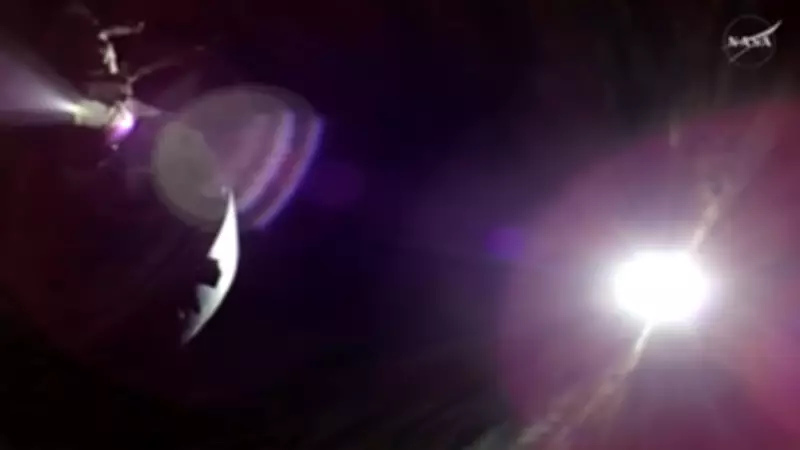
During the flyby, a unique alignment of the Sun, Moon, and Orion capsule created a solar eclipse that lasted approximately one hour. From the astronauts' perspective, the Sun was completely obscured by the Moon, allowing them to observe a darkened lunar surface and study the solar corona in unprecedented detail. This rare celestial event provided valuable scientific opportunities for the crew.

As expected, Mission Control temporarily lost communication with the capsule for about 30 to 40 minutes while it passed behind the Moon. This communication blackout is a standard occurrence during lunar missions but adds to the drama and isolation of deep space travel.
Crew Reactions and Observations
Canadian astronaut Jeremy Hansen expressed awe ahead of the flyby, radioing, "It is blowing my mind what you can see with the naked eye from the moon right now. It is just unbelievable." Commander Reid Wiseman described the view as "Such a majestic view out here," as the crew captured stunning images of the Moon and Earth together.
The closest approach to the Moon occurred during the communication blackout at a distance of 4,067 miles (6,545 kilometers), with the spacecraft traveling at approximately 3,139 mph (5,052 kph). At this point, the crew began their return journey to Earth on a free-return trajectory, ensuring a safe path back home.
Scientific Activities and Lunar Naming Proposal
During the seven-hour lunar flyby, which served as the highlight of Artemis II's nearly 10-day test mission, the astronauts conducted an intensive observation phase. They surveyed more than two dozen targets using high-powered Nikon cameras and iPhones, capturing detailed images of impact craters and other prominent lunar features. One key area of study was the Orientale Basin, a large impact basin on the Moon's surface.
Moments after breaking the distance record, the astronauts proposed naming two lunar craters "Integrity" and "Carroll," the latter in memory of Commander Wiseman's late wife. This gesture adds a personal and emotional dimension to the mission's scientific achievements.
Mission Overview and Future Implications
Artemis II was launched from Kennedy Space Center's Launch Complex 39B atop NASA's Space Launch System rocket on April 1. The mission is a critical step in NASA's Artemis program, which aims to establish sustainable lunar exploration and lay the groundwork for eventual human missions to Mars. The successful flyby and record-breaking distance demonstrate the program's progress toward these ambitious goals.
The mission is set to conclude with a splashdown in the Pacific Ocean on Friday, marking the end of a historic journey that has expanded human presence in deep space. The data and experiences gathered from Artemis II will inform future missions, including Artemis III, which plans to land astronauts on the lunar surface.
This achievement not only honors the legacy of past space exploration but also opens new frontiers for scientific discovery and international collaboration in space. The Artemis program represents a renewed commitment to exploring beyond Earth, with the Moon serving as a stepping stone for future interplanetary travel.






