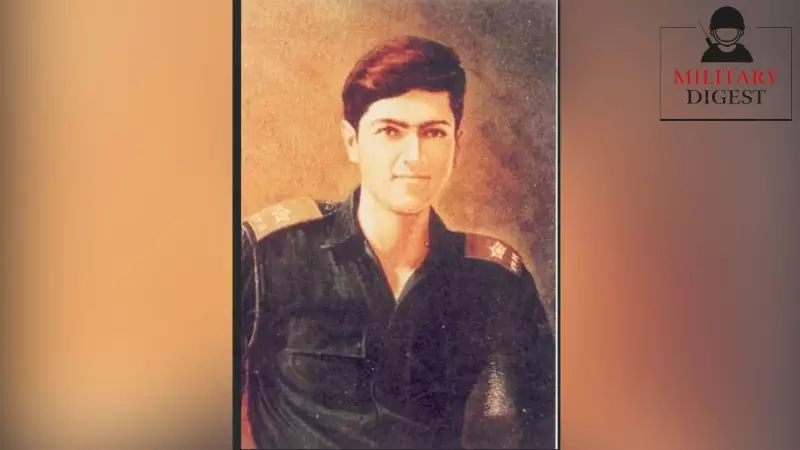
The story of Second Lieutenant Arun Khetarpal, Param Vir Chakra, is a timeless saga of youthful valour that continues to resonate across generations. A young officer of just 21, his brief but brilliant life, culminating in the fierce tank battles of the 1971 Indo-Pak war, remains one of the most poignant chapters in Indian military history. His legacy, now brought into focus by the biographical film Ikkis, exemplifies the spirit of 'Never Give In'.
The Schoolboy Who Dreamt of the Army
Arun Khetarpal's journey began at the prestigious Lawrence School in Sanawar, nestled in the hills near Kasauli. The school's motto, 'Never Give In', etched at its entrance, became the defining principle of his character. Fellow students remember a quiet yet determined boy, an excellent saxophone player in the school band, whose calm exterior hid a steely resolve. It was here that he decided to serve the nation. In June 1967, he joined the National Defence Academy (NDA) and was commissioned into the famed 17 Poona Horse in June 1971, mere months before war clouds gathered.
A Plea for Battle: Defying the Young Officers' Course
As his regiment prepared for combat, young Khetarpal faced a heart-wrenching obstacle. He received orders to attend the mandatory Young Officers' (YOs) course in Ahmednagar. For any other new officer, this might have been a respite from the impending dangers of war. But for Khetarpal, it was a potential lifetime missed opportunity. In a moving account later narrated by his Commanding Officer, Lt Col (later Lt Gen) Hanut Singh, a distraught Khetarpal pleaded for a chance to fight.

"Sir, the regiment is going to war. This is the opportunity of a lifetime. If I miss out now, I shall never see action again in my life," Khetarpal implored, with tears in his eyes. Touched by the young officer's fervour, Lt Col Hanut Singh made a critical decision. He pulled Khetarpal off the course and arranged for a mini YOs course within the regiment, personally testing him afterwards. Satisfied with his competence, Hanut Singh granted him command of a troop of Centurion tanks. Khetarpal's promise was simple: "Sir, I will not let you down."
Immortality at Basantar: The Final Stand
During the Battle of Basantar in December 1971, Second Lieutenant Arun Khetarpal's troop was tasked with holding a vital position against a fierce Pakistani armoured counter-attack. In what would become the Indian Army's largest tank battle, Khetarpal displayed extraordinary courage and tactical brilliance. His tank, named Famagusta, engaged and destroyed multiple enemy tanks. Even after his own tank was hit, he refused to abandon his position, choosing to fight on and inflict maximum damage on the advancing enemy forces. He was mortally wounded in this fierce engagement, having lived up to his word and the highest traditions of the Indian Army.
For his exemplary leadership, raw courage, and supreme sacrifice, he was awarded the Param Vir Chakra, India's highest military honour, posthumously. His remains were cremated on the battlefield, and his tank Famagusta is now preserved at the Armoured Corps Centre and School in Ahmednagar.
An Enduring Legacy: From Sanawar to Silver Screen
The boy soldier's story has found a new audience through the film Ikkis, sparking discussions about valour and sacrifice. While the film's thematic choices have been debated, it has undeniably reignited interest in this young hero. Lt Gen Hanut Singh fittingly compared him to the 'schoolboy' in Henry Newbolt's poem Vitai Lampada, who rallies the ranks. Khetarpal, with his solitary pip on the shoulder, truly 'played the game' superbly well.
His story circles back to the slopes of Sanawar, where a teenage Khetarpal would sing the school song: "Never give in... Somebody's got to stop the rot And why not you." At 21, Second Lieutenant Arun Khetarpal did exactly that, becoming an immortal symbol of bravery for the nation.