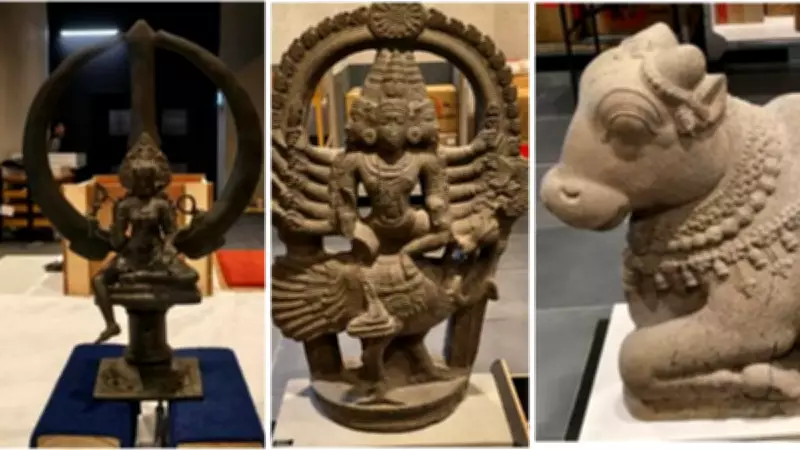
Australia has announced the return of three significant Indian artefacts—a statue of Bhadrakali, a figure of Murugan, and a sculpture of Nandi—during Prime Minister Narendra Modi's visit to the country. The repatriation marks a milestone in cultural diplomacy between the two nations, as India simultaneously prepares to return the remains of an Australian First Nations ancestor currently housed at the Government Museum in Chennai.
Details of the Artefacts and Their Significance
The three artefacts, which are believed to have been taken from India decades ago, hold deep religious and historical importance. The Bhadrakali statue, representing a fierce form of the goddess Kali, is a key icon in Hindu worship, particularly in South India. The Murugan figure depicts the Hindu deity of war and victory, revered primarily in Tamil Nadu and Sri Lanka. The Nandi sculpture, a bull mount of Lord Shiva, is commonly found in temples across India. According to the Australian government, these items were identified through collaboration with Indian authorities and cultural experts.
India's Commitment to Repatriation
In a reciprocal gesture, India has agreed to return the skeletal remains of an Australian First Nations ancestor that have been stored at the Government Museum in Chennai for over a century. The remains are believed to belong to an Indigenous Australian who died in the late 19th or early 20th century. The Australian High Commission confirmed that the repatriation process has been initiated in coordination with Indian officials and Indigenous community representatives. "This act reflects the deep respect both nations hold for each other's cultural heritage," said a spokesperson for the Australian Department of Foreign Affairs and Trade.

Impact on Bilateral Relations
The announcement was made during PM Modi's official visit to Australia, which focused on strengthening ties in trade, defense, and cultural exchange. The return of artefacts is seen as a symbol of trust and mutual respect. India's Ministry of External Affairs stated that the decision aligns with India's ongoing efforts to retrieve its cultural property from abroad. "We welcome Australia's gesture and are equally committed to returning cultural items to their rightful homes," a ministry official said.
The repatriation of the First Nations ancestor's remains is particularly significant for Indigenous Australian communities, who have long campaigned for the return of ancestral remains held in overseas institutions. The Australian government has been actively pursuing such repatriations worldwide, and India's cooperation sets a positive precedent.
Future Collaborations
Both countries have agreed to enhance cooperation on cultural heritage protection and repatriation. This includes sharing best practices for identifying and verifying stolen or exported artefacts. The success of this exchange is expected to pave the way for further repatriations in the future.