

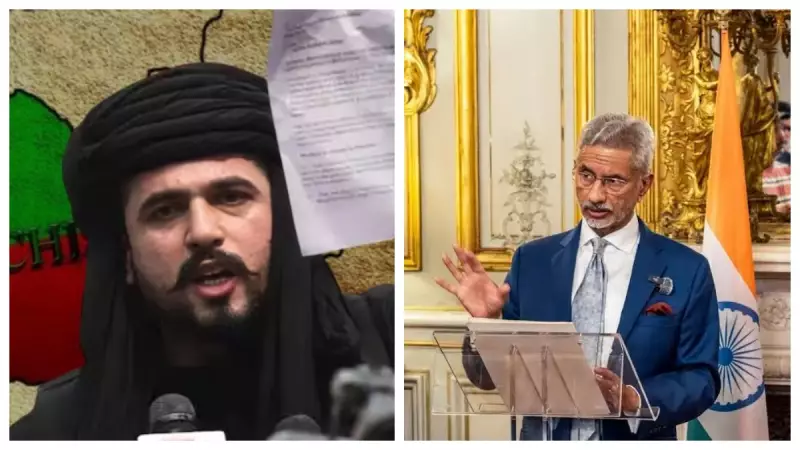
In a significant development raising alarms about regional security, a prominent Baloch leader has directly addressed India's External Affairs Minister, Dr. S. Jaishankar, warning of a potential Chinese military deployment in Pakistan's restive Balochistan province. The communication, dated January 2, 2026, underscores growing fears that China's deepening strategic interests could lead to a direct military footprint, posing a serious threat to the stability of the entire region.
The Core Warning in the Letter
The Baloch leader's letter to the Indian Foreign Minister outlines a grave concern. It states that China, under the pretext of securing its massive infrastructure investments, particularly the China-Pakistan Economic Corridor (CPEC), is considering the deployment of its military forces within Balochistan. This move is framed not as a peacekeeping effort but as a strategic expansion to protect its assets from the long-running Baloch insurgency, which opposes both the Pakistani state and Chinese projects perceived as exploitative.
The correspondence highlights that such a step would dramatically alter the geopolitical landscape. It would represent a formal militarization of China's Belt and Road Initiative (BRI) in a highly volatile area, effectively bringing the People's Liberation Army (PLA) to India's western periphery. The leader emphasized that this poses a direct security challenge not only to Baloch aspirations but also to neighboring nations, including India, by amplifying tensions and potentially triggering a broader conflict.

Context: CPEC and the Baloch Insurgency
To understand the urgency of the warning, one must look at the ground realities in Balochistan. The province is rich in natural resources but has seen a decades-long struggle for autonomy and rights. The multi-billion dollar CPEC, which passes through Balochistan, is a cornerstone of China's global ambitions. However, it has faced fierce resistance from Baloch groups who allege that the project extracts their wealth without benefiting the local population and leads to demographic changes.
Attacks on Chinese engineers and workers have been recurrent, prompting Beijing to pressure Pakistan for enhanced security. The letter suggests that the logical next step for China, frustrated with the persistent insecurity, could be to deploy its own security forces—a move that would be a first in the context of CPEC and would signify a major escalation. This aligns with China's growing willingness to secure its overseas interests through military means, as seen in other parts of the world.
Regional Implications and Strategic Concerns
The potential deployment of Chinese troops in Balochistan sends shockwaves beyond the province's borders. For India, it represents a classic pincer movement, with Chinese military presence now potentially looming on both the eastern (Line of Actual Control) and western fronts. This could severely complicate India's strategic calculus and defense planning.
Furthermore, it threatens to destabilize the already fragile security equilibrium in South Asia. It could draw other regional powers into the fray and intensify the proxy dynamics at play. The letter to Dr. Jaishankar appears to be an effort to alert the international community, and India in particular, to this looming shift and to seek diplomatic intervention before the situation becomes irreversible.
The Baloch leader's appeal underscores a critical juncture: the local conflict in Balochistan is now at risk of being internationalized with the entry of a global power's military. This transforms it from an internal Pakistani issue into a potential flashpoint for international confrontation.
What Happens Next?
The Indian government has not issued an official public response to the letter as of now. However, security analysts believe the contents will be taken very seriously in New Delhi's security and foreign policy circles. India has consistently opposed CPEC as it passes through Pakistan-occupied Kashmir, territory India claims as its own. A Chinese military presence along the corridor would add a severe new dimension to this existing dispute.

The ball is now in the courts of multiple actors. Pakistan faces the dilemma of accepting a foreign military on its soil to protect foreign investments, which would be a blow to its sovereignty. China must weigh the strategic benefits against the risks of entangling its military in a complex ethnic insurgency. The international community, including the US and Gulf nations, will be watching closely as this development could affect energy routes and regional alliances.
In conclusion, the letter from the Baloch leader to India's top diplomat is more than a plea; it is a stark warning of an impending geopolitical earthquake. The possibility of Chinese military forces deploying in Balochistan under the guise of securing CPEC is a clear and present danger that could redefine security, sovereignty, and power dynamics in South Asia for decades to come.





