

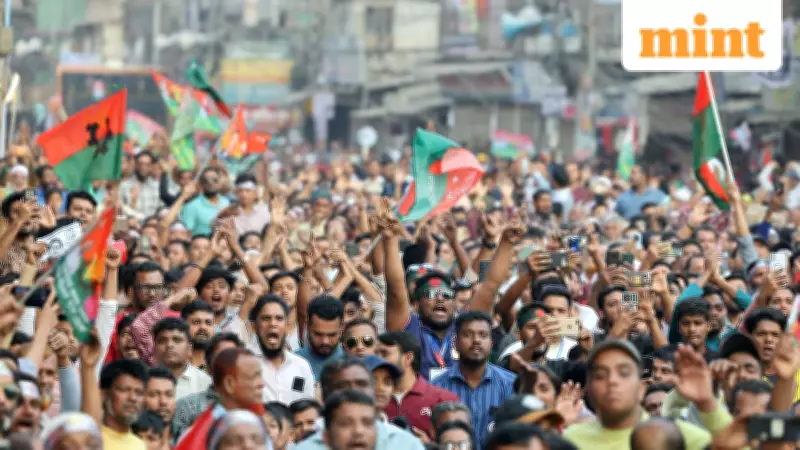
Bangladesh Elections 2026: A Nation Votes Amidst Regional Uncertainty
On 12 February, over 127 million Bangladeshi citizens are set to cast their votes in a crucial national election, marking the conclusion of an 18-month interim government led by Nobel laureate Muhammad Yunus. This caretaker administration assumed power following a student-led uprising that ousted Sheikh Hasina's Awami League party after 15 years of rule. High-intensity political campaigning concluded tonight, precisely 48 hours before polling begins, with 51 parties vying for power, though the primary contenders are the Bangladesh Nationalist Party (BNP) and Jamaat-e-Islami.
From Strategic Comfort to Bilateral Uncertainty
For 15 years under Sheikh Hasina's Awami League government, India enjoyed a period of robust strategic comfort in Dhaka, treating Bangladesh as a key ally in South Asian security. Hasina served as prime minister from 1996 to 2001 and again from 2009 to 2024, fostering close ties with New Delhi. However, her removal in August 2024 and the exclusion of the Awami League from this election—due to allegations of involvement in a deadly crackdown on 2024 student protests that killed 1,400 people—has ended that predictability. The likely rise of the BNP and Jamaat-e-Islami, historically more critical of India, introduces significant uncertainty into bilateral relations.
Cooling Ties and Economic Repercussions
India has long been Bangladesh's largest trading partner in Asia, with exports worth $11.1 billion between April 2023 and March 2024, including textiles, tea, and auto parts, while imports from Bangladesh totaled $1.8 billion. However, ties deteriorated rapidly after Hasina's ouster on 5 August 2024, exacerbated by violence against minorities, particularly the Hindu community. In response, India has restricted tourist visas for Bangladeshis and withdrawn diplomats' families, citing security concerns ahead of the elections. New Delhi fears that Hasina's removal has emboldened groups hostile to India, amid growing anti-India rhetoric and attacks on minorities, including Bangladesh's 13 million Hindus.

The diplomatic strain has spilled into sports, with Bangladesh withdrawing from the men's T20 World Cup after the ICC refused to move matches from India to Sri Lanka. This followed the dropping of Bangladeshi bowler Mustafizur Rahman from an IPL team under pressure from Hindu groups. Additionally, India's Budget 2026 halved development assistance to Bangladesh to ₹60 crore, down from ₹120 crore in 2025-26, reflecting the frosty bilateral climate.
Extradition Calls and Historical Grievances
Bangladesh's interim government has repeatedly sought India's extradition of Sheikh Hasina, especially after a Dhaka court sentenced her to death for ordering the 2024 crackdown, though she denies the charges. The two main electoral contenders, the BNP led by Tarique Rahman and Jamaat-e-Islami, have historically had less friendly ties with India compared to Hasina's era. Humaiun Kobir, foreign affairs adviser to Tarique Rahman, stated that many Bangladeshis view India as complicit in Hasina's alleged crimes, highlighting deep-seated grievances.
Security Implications for India's Northeast
Bangladesh, sharing a 4,000 km border with India across five northeastern states, relies on its neighbor for trade, transit, and security cooperation. Under Hasina, Dhaka actively countered anti-India militant groups, but a shift in government could weaken this cooperation. If the next administration adopts a more nationalist stance toward India, it may complicate cross-border insurgency management, border security, and migration flows, directly impacting India's internal security architecture in the northeast.
The China Factor and Regional Dynamics
Analysts suggest Bangladesh may strengthen ties with China, which offers substantial economic incentives and avoids entanglement in issues involving Bangladesh's Hindu minority. Thomas Kean of the International Crisis Group noted that if India-Bangladesh relations falter, Dhaka could accelerate engagement with Beijing. However, experts like Lailufar Yasmin of Dhaka University emphasize that Bangladesh cannot sideline India entirely, needing pragmatic relations with both giants.

Water-Sharing and Diplomatic Gestures
Long-standing disputes, including water-sharing and border killings, have fueled resentment, with many Bangladeshis perceiving India as legitimizing Hasina's rule. BNP secretary general Mirza Fakhrul Islam Alamgir called for sincere resolution of these issues, highlighting the need for fair trade and an end to border violence. Despite tensions, limited cooperation persists, as seen in Indian Foreign Minister S. Jaishankar's condolence visit to Tarique Rahman in December, offering a positive diplomatic gesture.
Key Takeaways and Future Prospects
The election could significantly alter India-Bangladesh relations, challenging historical ties if the BNP and Jamaat-e-Islami assume power. Stability in Bangladesh is crucial for India's security and regional connectivity efforts. As Dr. Chietigj Bajpayee noted, chronic instability in Bangladesh threatens India's northeast and undermines its global aspirations as a "voice" of the Global South. Former ambassador Humayun Kabir stressed that any new government will need to reset relations with India due to domestic pressures, while Tarique Rahman has signaled a conciliatory approach, aiming for friendship with all nations while protecting Bangladesh's interests.





