Bareilly's Dawn: Bells, Barricades, and a City's Rebirth
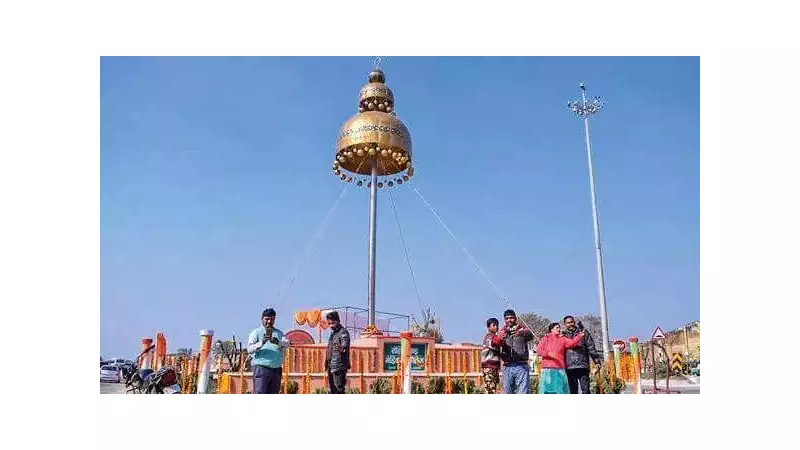
Winter fog hangs over Bareilly each morning. The ancient Alakhnath temple awakens before the city does. Temple bells ring out, their sound cutting through the cold air. Just outside, steel barricades and construction equipment signal a massive transformation. The Rs 230-crore Nath Corridor project is reshaping this Uttar Pradesh city.
A New Identity Forged in Stone and Steel
Chief Minister Yogi Adityanath has brought his corridor template to Bareilly. He first used this approach in Kashi and Ayodhya. In March 2025, Adityanath declared that Bareilly should no longer be defined by its famous jhumka earrings. He said the city's true identity lies in its "Nath legacy." The Chief Minister repeated this message in August, recalling Bareilly's communal tensions before 2017.
The tourism numbers tell a compelling story. Official data shows Bareilly welcomed over one crore domestic visitors in 2025. The city also hosted 1,056 foreign tourists. These figures put Bareilly on par with popular destinations like Goa. The Nath Corridor forms the heart of this tourism push. It connects seven Shaivite temples into one continuous pilgrimage circuit.

Ravinder Mishra, deputy director of the UP State Tourism Development Corporation, calls these numbers unprecedented. "Bareilly has always had ancient temples dating back to the Mahabharata era," Mishra explains. "What was missing was visibility and proper infrastructure. The Nath Corridor brings these sacred sites onto the state's religious tourism map." Authorities are developing Bareilly as a complete circuit. Plans include temples, mela grounds, museums, parks, and better connectivity.
Economic Winds of Change
The economic impact is already visible across Bareilly. Hoteliers report higher weekend occupancy during festivals. Taxi unions note increased inter-district and inter-state bookings. The city's airport, inaugurated in 2019, now ranks first in Uttar Pradesh for customer satisfaction. Nationally, it holds the seventh position in an Airports Authority of India survey.
For civic authorities, this corridor represents more than religious tourism. Mayor Umesh Gautam sees it as a long-delayed urban reset. "Bareilly grew without proper planning for decades," Gautam states. "Now we are creating capacity with new hotels, shopping malls, and urban haats. This project is not just about temples. It is about making Bareilly future-ready."
A Plural Past Faces a Singular Narrative
Bareilly differs fundamentally from Ayodhya or Varanasi. Those cities developed almost entirely around pilgrimage. Bareilly has long been a plural city. It is home to the Dargah-e-Ala Hazrat, the shrine of Imam Ahmad Raza Khan. He founded the Barelvi school of Sunni Islam, with followers worldwide. For generations, people knew Bareilly as 'Ala Hazrat ki nagri'—a center of Sufi scholarship and devotional culture.
That identity is receding from official tourism narratives today. Former Congress MLA Mujahid Hassan Khan voices concern. "Bareilly is being consciously projected as a Hindu religious city," Khan observes. "Muslim heritage sites that once defined the town are absent from this new development story." He points to dargahs, khanqahs, and cultural centers associated with classical music traditions. These sites draw global visitors but receive little state investment.
Muslim shopkeepers in temple zones express unease. They worry about space, visibility, and survival in a tourism economy shaped by Hindu religious narratives. Zahid Khan, a garment trader, shares his family's perspective. "We have lived here for generations," he says. "Tourists are always welcome, but we fear what this progress might mean for our livelihoods. We want a place in this development."

Political Resonance and Scholarly Warnings
The symbolism carries clear political weight. Bareilly was once a weak point for the BJP. Today, the party holds key legislative seats, the mayor's office, and a stronger local organization. Mayor Gautam rejects talk of a "cultural shift." He argues the Nath Corridor corrects decades of neglect toward Bareilly's ancient Hindu past. "Bareilly's history predates its Sufi associations," Gautam insists. "It is rooted in Hindu mythology. What is happening is a correction."
Scholars caution that transposing the corridor model into mixed cities carries risks. Dr. Vandana Sharma, a political science professor at Bareilly College, offers a measured perspective. "Roads alone do not create identity," she notes. "Bareilly's strength lies in its layered history. Why foreground only one narrative? Why not create an identity based on communal harmony and shared beauty?"
Experts like Sharma believe Bareilly's trajectory will test the corridor model's scalability in diverse urban settings. Managed carefully, it could combine pilgrimage, tourism, and economic vibrancy. If mismanaged, it risks social tensions, community alienation, and uneven growth. The city stands at a crossroads, its future being written in both ancient stone and modern concrete.