Canada Revises Position on India's Alleged Role in Violent Crimes
In a significant diplomatic development, Canada announced on Wednesday that it no longer believes India is linked to violent crimes on its soil. This shift signals a thaw in relations ahead of Prime Minister Mark Carney's scheduled visit to New Delhi, marking a departure from months of heightened tensions between the two nations.
Official Statements Reflect Renewed Confidence
According to a report by The Toronto Star, a senior Canadian official stated during a background briefing that Ottawa is now confident such alleged activities are no longer continuing. "We have a very robust diplomatic engagement, including between national security advisers, and I think we can say we're confident that that activity is not continuing," the official said.
Another official emphasized that the upcoming visit itself reflects this reassessment, noting, "I really don't think we'd be taking this trip if we thought these kinds of activities were continuing." The Prime Minister's Office later clarified that Canada will continue to address transnational repression, organized crime, and criminal activity within its borders while re-engaging with India through law enforcement and security channels.

Background of Strained Ties and Recent Thaw
The reassessment follows months of high-level security dialogue between Canada and India. Officials indicated that communication channels between national security advisers and law enforcement agencies remain active, with engagement being approached in a "step-by-step" and cautious manner. The Toronto Star highlighted that Carney's government views the visit as part of a broader effort to stabilize relations with key global partners, particularly in the Indo-Pacific region.
However, some Sikh community leaders in Canada have expressed concern over the renewed engagement. They argue that investigations into past allegations should continue transparently even as diplomatic ties improve.
Carney's 'Pragmatic' Reset with India
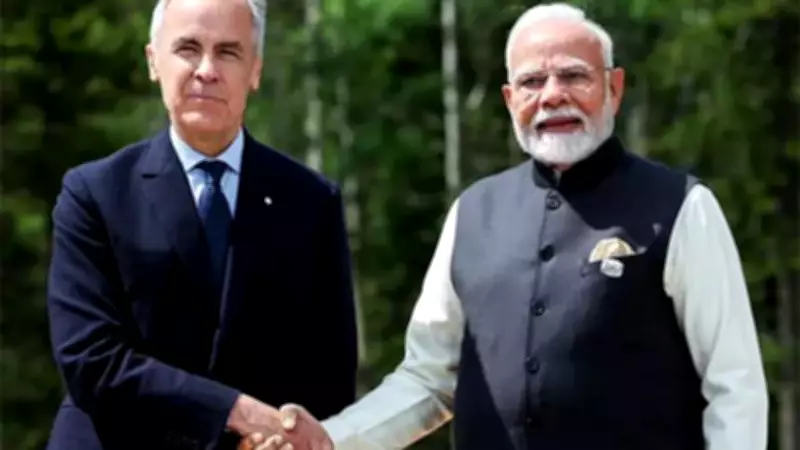
Prime Minister Mark Carney is scheduled to visit Mumbai and New Delhi, marking his first trip to India as Prime Minister. He is set to meet with Prime Minister Narendra Modi, business leaders, and officials to expand cooperation in areas such as:
- Trade
- Energy
- Technology
- Artificial Intelligence
- Defense
Canada sees India as an important economic partner, with bilateral trade reaching $30.8 billion in 2024. Both sides have discussed reviving negotiations for a Comprehensive Economic Partnership Agreement (CEPA), which aims to double trade to $70 billion by 2030. Carney's government views engagement with India as part of a broader effort to diversify Canada's trade partnerships amid global uncertainties.
Criticism from Sikh Activists and Official Responses
The shift has drawn criticism from some Sikh activists. Moninder Singh, a religious leader in British Columbia, told The Toronto Star that he had received multiple police warnings about threats to his life since the killing of Hardeep Singh Nijjar. He described the renewed engagement as a betrayal.
In response, Canadian officials stated that security dialogue with India continues. Trade Minister Maninder Sidhu emphasized that Canada can both protect communities at home and engage internationally on economic matters.
Diplomatic Row After Nijjar Killing
Relations between Canada and India deteriorated sharply after the killing of Hardeep Singh Nijjar, a Sikh separatist leader, in British Columbia in June 2023. Months later, then-Prime Minister Justin Trudeau told the Canadian Parliament there were "credible allegations" linking Indian government agents to the killing.
India rejected the allegations as "absurd," leading to tit-for-tat expulsions of diplomats, suspension of visa services, and a freeze in trade talks. In October 2024, the Royal Canadian Mounted Police (RCMP) claimed it had evidence linking Indian government agents to violent criminal activity in Canada, including threats against Khalistan activists. Canadian officials later suggested they believed India's Home Affairs Minister Amit Shah was connected to the allegations, which New Delhi strongly denied.

India maintained that Canada was giving space to extremist and secessionist elements. After Trudeau's exit, India's Ministry of External Affairs expressed readiness to rebuild ties based on "mutual trust and sensitivity." MEA spokesperson Randhir Jaiswal stated that the downturn in relations was caused by the "license that was given to the extremist and secessionist elements" in Canada.