

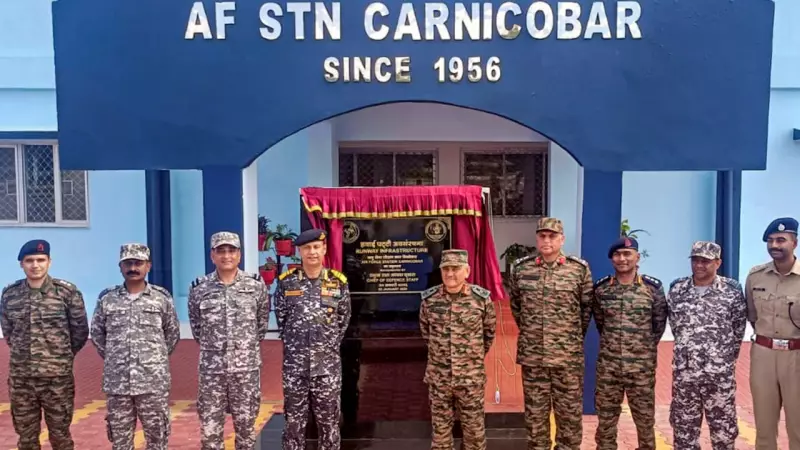
In a significant move to bolster India's military posture in a critical maritime region, Chief of Defence Staff General Anil Chauhan inaugurated a major runway upgrade at the Indian Air Force's Car Nicobar air base on Friday.
A Strategic Leap in the Bay of Bengal
The modernisation of the airbase, located in the Andaman and Nicobar Islands, is designed to significantly enhance the IAF's rapid response capabilities and extend India's strategic reach over the Malacca Strait, one of the world's most crucial shipping lanes. General Chauhan arrived at Car Nicobar around 11.30 am and was received by Vice Admiral Ajay Kochhar, the commander-in-chief of the Andaman and Nicobar Command (ANC), along with other senior officials stationed on the island.
The key improvements as part of this infrastructure facelift include the expansion of apron areas to ensure smoother and more efficient aircraft movement. This upgrade is expected to allow the IAF to conduct long-range firing exercises in minimal time, sharpening its operational readiness.

The Tri-Service Command's Pivotal Hub
Car Nicobar is an integral component of the Andaman and Nicobar Command (ANC), which holds the unique distinction of being India's only unified tri-service command, seamlessly integrating assets and personnel from the Army, Navy, and Air Force. Situated at the heart of the Bay of Bengal, the base serves as a vital springboard for operations across the vast Indo-Pacific region.
The strategic importance of the base is multifaceted:
- It enables the rapid deployment of forces and equipment.
- It enhances India's capacity for humanitarian assistance and disaster relief operations.
- It acts as a key deterrent against threats to India's maritime security interests.
Most critically, its proximity to the Malacca Strait underscores its essential role in safeguarding some of the globe's busiest sea lanes, through which a substantial portion of the world's trade passes.
From Tragedy to a Bastion of Resilience
The history of Car Nicobar is marked by profound tragedy. On December 26, 2004, a monstrous tsunami devastated the island, claiming the lives of 122 air warriors and their family members, along with hundreds of civilians. The catastrophe redrew the coastline, erased villages, and left behind haunting remnants of settlements.
This disaster prompted a strategic re-evaluation, transforming Car Nicobar from a site of immense grief into a hub of national resilience and military preparedness. Rebuilt from the ground up, the airbase now hosts advanced assets like the C-130J Super Hercules transport aircraft, elite paratroopers, and sophisticated surveillance systems, standing as a testament to India's commitment to securing its eastern flank.
The inauguration of the upgraded runway marks the latest chapter in this transformation, directly contributing to strengthening India's defensive and operational architecture in a region of escalating geopolitical significance.






