

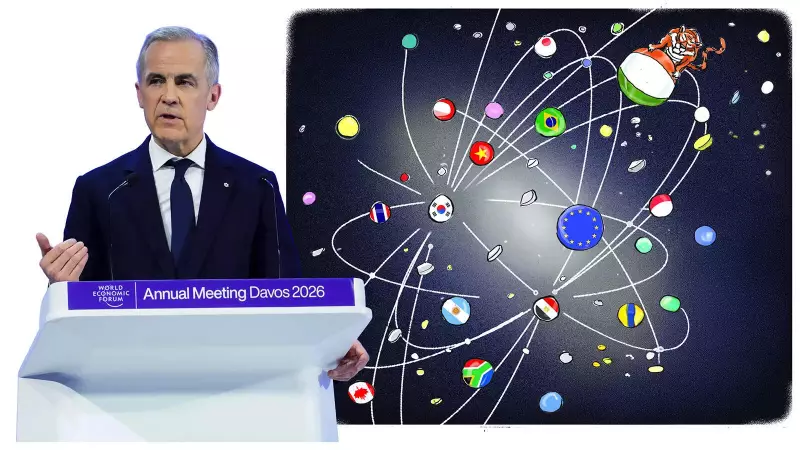
Carney's Davos Declaration: A Resonant Echo of India's Global Perspective
Canadian Prime Minister Mark Carney's recent address at the World Economic Forum in Davos has created significant ripples across international diplomatic circles, particularly resonating with India's longstanding positions on global governance. The speech, delivered with remarkable clarity and conviction, represents what many analysts are calling a watershed moment in international relations—one that aligns remarkably well with New Delhi's vision for a more equitable world order.
A Historic Moment of Recognition
Carney's words carried particular weight when he described a transformative moment in history, echoing sentiments that have long been central to India's diplomatic narrative. His observation about nations stepping "from the old to the new" and suppressed national souls finding utterance mirrors India's own journey from colonial subjugation to becoming a confident global voice advocating for multipolarity and reformed multilateral institutions.
The Canadian leader's acknowledgment represents what many Indian diplomats and policymakers have been articulating for decades: that the traditional international rules-based order has often served as a facade for power projection by dominant nations rather than genuine global cooperation. Carney's speech effectively validated India's consistent position that true international cooperation must move beyond what he termed "big power rivalry" and "hegemony" toward more inclusive frameworks.

India's Strategic Autonomy Vindicated
For generations of Indians who have navigated complex international waters while maintaining strategic autonomy, Carney's address felt particularly significant. His critique of what he called "variable geometry" and "issue-based coalitions"—concepts that have often been used to marginalize emerging powers—struck a chord with India's diplomatic community that has long advocated for more consistent and principled international engagement.
The speech's most powerful resonance came in its recognition of middle powers and developing nations coming together to secure their interests. This directly aligns with India's approach of building coalitions among what Carney described as countries "in between" major power blocs—a strategy New Delhi has perfected through forums like the G20, BRICS, and various South-South cooperation initiatives.
A Welcome Shift in Global Discourse
Carney's emergence as a voice challenging traditional power structures represents what many Indian analysts see as a significant shift in global discourse. His reference to rising "from the ashes of Bandung like a Phoenix" particularly resonated, evoking memories of the 1955 Asian-African Conference where newly independent nations first articulated their vision for a post-colonial world order free from great power domination.
The Canadian leader's willingness to speak what many consider uncomfortable truths about international power dynamics has been welcomed in New Delhi as a sign that traditional Western powers are beginning to recognize the limitations of existing frameworks. This acknowledgment comes at a crucial time when India is positioning itself as a leading voice for the Global South and advocating for comprehensive reform of international institutions.
Implications for India's Global Role
Carney's speech has several important implications for India's international positioning:
- It validates India's long-standing critique of unequal global governance structures
- It strengthens New Delhi's arguments for more representative international institutions
- It provides diplomatic support for India's approach of strategic autonomy in foreign policy
- It creates potential for enhanced cooperation between like-minded nations seeking to reform global systems
The address represents more than just rhetorical alignment—it signals a potential shift in how traditional Western powers perceive and engage with emerging nations like India. As global power dynamics continue to evolve, Carney's words suggest that the international community may be moving toward greater recognition of the perspectives that India has championed for decades.






