Rajnath Singh Hails Chandrayaan as Modern Embodiment of India's Ancient Scientific Legacy
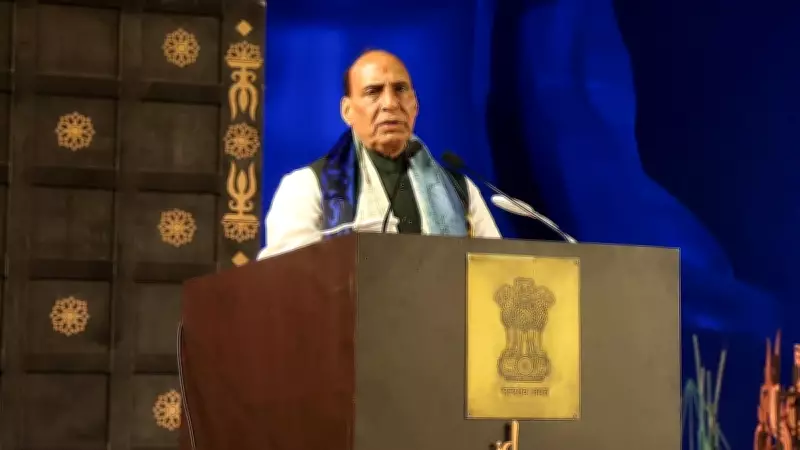
Defence Minister Rajnath Singh has articulated a compelling perspective on India's burgeoning space endeavors, positioning missions such as the Chandrayaan lunar exploration program as contemporary manifestations of the nation's profound and time-honored scientific heritage. In a recent address, Singh underscored that these advanced technological pursuits are not merely modern innovations but are deeply rooted in India's historical legacy of scientific inquiry and astronomical wisdom.
Bridging Millennia: From Ancient Wisdom to Space Exploration
Singh emphasized that India's space programs, including the highly acclaimed Chandrayaan missions, serve as a powerful bridge connecting the country's ancient scientific traditions with its present-day aspirations in space technology. He pointed out that historical texts and scholarly works from ancient India contain extensive references to astronomy, mathematics, and celestial observations, which laid the foundational groundwork for today's exploratory missions.
The defence minister remarked, "Our space achievements are a testament to the scientific temperament that has been an integral part of our civilization for centuries." He highlighted that the meticulous planning and execution of projects like Chandrayaan-3, which successfully landed on the lunar south pole, reflect the same spirit of curiosity and precision that characterized ancient Indian scholars.

Chandrayaan Missions: A Symbol of National Pride and Heritage
The Chandrayaan series, operated by the Indian Space Research Organisation (ISRO), has garnered global acclaim for its cost-effectiveness and groundbreaking discoveries. Singh noted that these missions encapsulate the essence of India's scientific heritage by demonstrating innovative problem-solving and resilience. The successful soft landing of Chandrayaan-3, in particular, has been hailed as a monumental achievement that showcases India's capability to excel in high-stakes space exploration.
Singh elaborated that the space program's achievements are a source of immense national pride, reinforcing India's position as a key player in the global space community. He connected this modern success to ancient practices, such as the detailed astronomical records maintained by scholars like Aryabhata and Bhaskara, whose contributions have influenced scientific thought worldwide.
Government Support and Future Prospects
In his address, Singh reaffirmed the Indian government's unwavering commitment to advancing space research and development. He outlined ongoing initiatives aimed at fostering innovation and collaboration within the space sector, ensuring that India continues to build on its ancient scientific heritage while pushing the boundaries of modern technology.
Key aspects of this support include:
- Enhanced funding for ISRO and related space projects to accelerate mission timelines and technological advancements.
- Promotion of public-private partnerships to drive innovation and commercialize space technologies.
- Educational programs and scholarships designed to inspire the next generation of scientists and engineers, drawing inspiration from India's rich scientific history.
- International collaborations that leverage India's expertise in space exploration, fostering global scientific exchange.
Conclusion: A Legacy of Innovation and Exploration
Rajnath Singh's remarks highlight a broader narrative that positions India's space programs as a natural extension of its ancient scientific heritage. By viewing missions like Chandrayaan through this lens, he emphasizes the continuity of India's quest for knowledge and its ability to adapt historical insights to modern challenges. As India continues to make strides in space exploration, this blend of tradition and innovation promises to shape a future where the country remains at the forefront of scientific discovery, honoring its past while reaching for the stars.