

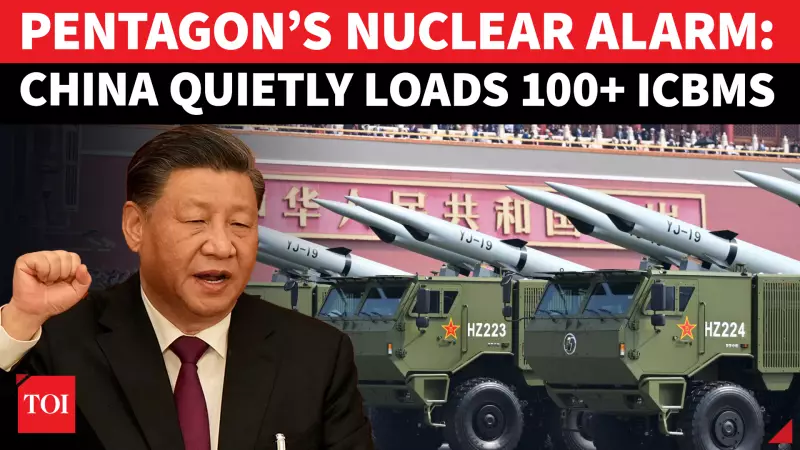
A recently disclosed draft report from the United States Pentagon has ignited renewed international concern over China's advancing nuclear capabilities. The document alleges that Beijing has likely placed more than 100 intercontinental ballistic missiles (ICBMs) on active alert within newly constructed silo fields situated close to the Mongolian border.
Details of the Pentagon's Assessment
According to the report, which surfaced for global scrutiny on December 23, 2025, this move represents the most rapid buildup of atomic weapons by any nuclear power in history. American officials cited in the assessment have raised alarms, suggesting that if the current pace continues, China's arsenal of nuclear warheads could surpass the 1,000 mark by the year 2030. This potential milestone marks a significant shift in the global strategic balance, moving China from a historically smaller nuclear force to a major atomic power.
Beijing's Firm Rejection and Global Implications
In response to the allegations detailed in the Pentagon's draft, Beijing has categorically rejected charges that it is engaging in an arms race. Chinese authorities have consistently framed their military modernization, including nuclear deterrence, as a necessary step for national defense and as a minimal, self-protective measure. However, the scale and speed of the silo construction and missile loading, as highlighted by the U.S. report, have prompted deep analysis in diplomatic and defense circles worldwide.

The development near the Mongolian border is particularly noteworthy for strategic planners. The placement of such a large number of land-based ICBMs in hardened silos comulates a nation's second-strike capability, ensuring a retaliatory force can survive an initial attack. This advancement directly impacts the strategic calculus of other major powers, including the United States, Russia, and India, potentially triggering new dynamics in arms control discussions and regional security postures.
A New Chapter in Strategic Competition
The leaked findings underscore a pivotal moment in 21st-century geopolitics. The claim of over 100 loaded ICBMs operationalizes a substantial portion of China's nuclear triad far sooner than many external estimates had predicted. For the international community, and especially for nations in the Indo-Pacific region, this acceleration presents a complex set of challenges. It raises urgent questions about transparency, risk reduction, and the future of nuclear deterrence in an increasingly multipolar world.
While China maintains its stance against an arms race, the tangible evidence of expansion presented by U.S. intelligence is set to dominate security dialogues. The period leading to 2030 will be critical in observing how global powers adapt their strategies, diplomacy, and defense postures in response to what the Pentagon describes as the fastest nuclear expansion ever witnessed.






