China Reasserts Territorial Claims Over Shaksgam Valley
China reaffirmed its territorial claims over the Shaksgam Valley in Jammu and Kashmir on Monday. The Chinese government defended its infrastructure projects in the region. It rejected India's objections to these activities.
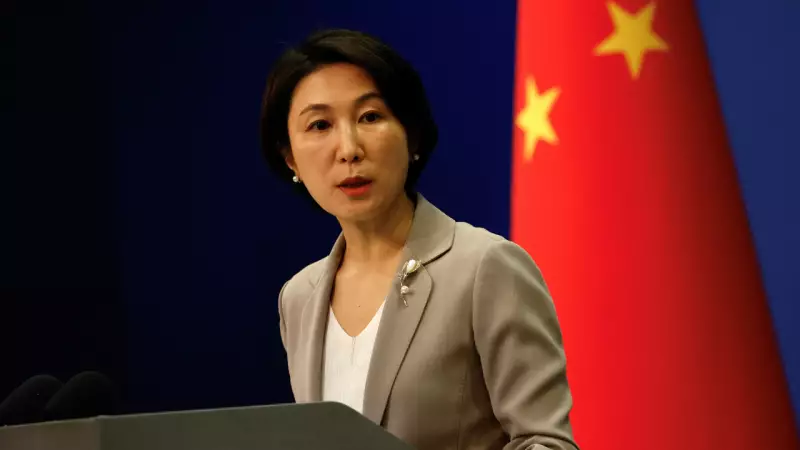
Chinese foreign ministry spokesperson Mao Ning addressed India's recent objections. She stated the area belongs to China. Mao insisted Beijing possesses the full right to conduct development work there.
China Cites Historical Agreement
"The territory you mentioned belongs to China," Mao told reporters. "It's fully justified for China to conduct infrastructure construction on its own territory."

She referenced a boundary agreement signed between China and Pakistan in the 1960s. This agreement delimited the boundary between the two nations. Mao emphasized this action falls within the rights of sovereign countries.
India's Firm Rejection
India has firmly rejected China's claims. New Delhi also disputes the legality of the 1963 China-Pakistan boundary agreement. Under this pact, Pakistan ceded approximately 5,180 square kilometers of territory in the Shaksgam Valley to China.
India maintains this land transfer occurred from areas under Pakistan's illegal occupation. The Indian government asserts the Shaksgam Valley is part of Indian territory.
External affairs ministry spokesperson Randhir Jaiswal addressed the issue on Friday. "Shaksgam Valley is Indian territory," he said. "We have never recognised the so-called China-Pakistan 'boundary agreement' signed in 1963."
Jaiswal added that India consistently views the agreement as illegal and invalid. He reiterated that the entire Union Territories of Jammu and Kashmir and Ladakh form an integral and inalienable part of India.
"This stance has been clearly conveyed to Pakistani and Chinese authorities several times," Jaiswal stated.
China Defends CPEC Project
China also rejected India's objections to the China-Pakistan Economic Corridor (CPEC). Mao reiterated China's long-held position. She described CPEC as an economic cooperation initiative.
Mao said the corridor aims to promote local socio-economic development. She noted it seeks to improve people's livelihoods in the region.
"The China-Pakistan boundary agreement and CPEC do not affect China's position on the Kashmir issue," Mao stated. "The position remains unchanged."
She added that Beijing views the Jammu and Kashmir dispute as a historical leftover. China believes it should be resolved properly and peacefully. This resolution should align with the UN Charter, relevant UN Security Council resolutions, and bilateral agreements.
Background on CPEC
The China-Pakistan Economic Corridor is a multi-billion-dollar network. It includes roads, railways, and energy projects. This infrastructure links China's Xinjiang region to Pakistan's Gwadar port.
India opposes the corridor because key segments pass through territory it claims as its own. The dispute highlights ongoing tensions in the region over territorial sovereignty and development projects.