

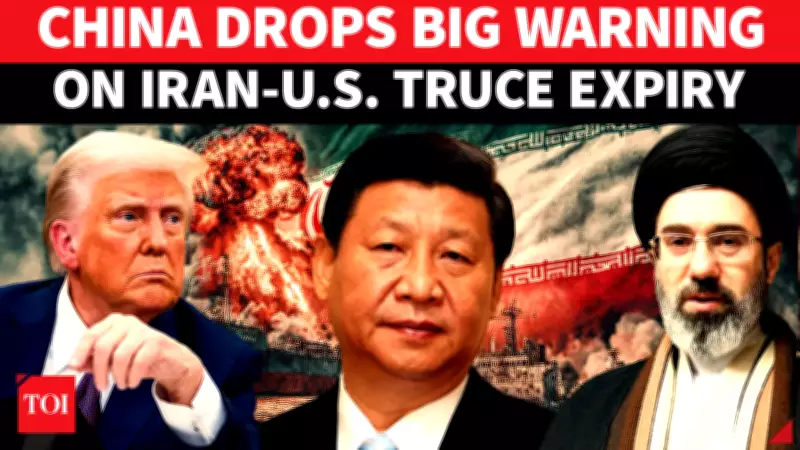
China Issues Stern Warning to Trump Administration Over Middle East Tensions
In a significant diplomatic move, China has publicly cautioned the United States against what it terms "jungle rule" in the Middle East, drawing a clear red line as the prospect of a full-scale conflict between Iran and America looms larger. The warning came during a press briefing in Beijing, where Foreign Ministry spokesperson Guo Jiakun articulated President Xi Jinping's comprehensive four-point proposal aimed at stabilizing the volatile region.
Beijing's Four-Point Peace Plan for Regional Stability
Guo Jiakun detailed the Chinese initiative, emphasizing that the first principle is to uphold peaceful coexistence. "China supports regional countries in improving relations and promoting the building of a common, comprehensive, cooperative, and sustainable security architecture for the Middle East and the Gulf region," he stated firmly. This approach underscores Beijing's commitment to diplomatic solutions over military escalation.
The second point focuses on respecting national sovereignty. Guo added, "The sovereignty, security, and territorial integrity of the Middle East and Gulf countries should be genuinely respected." This statement appears to be a direct critique of external interventions, particularly by Western powers, in the region's affairs.

Emphasis on International Law and UN Framework
Further elaborating, the proposal stresses adherence to international law, with Guo warning against a dangerous breakdown of global norms. "We must safeguard the international system with the United Nations at its core and prevent the world from reverting to the law of the jungle," he stressed. This strong language highlights China's growing role as a defender of multilateralism, positioning itself in contrast to what it perceives as unilateral actions by the U.S.
The spokesperson's remarks come amid heightened tensions, with recent incidents such as Iranian ships evading American blockades and military deployments in the Gulf raising fears of an imminent confrontation. China's intervention signals its intent to play a more active role in Middle Eastern diplomacy, potentially as a mediator between conflicting parties.
Context of Escalating Iran-U.S. Standoff
The warning is set against a backdrop of escalating provocations, including reports of the U.S. military capturing Iranian vessels and discussions of surprise attacks if diplomatic talks fail. Other global players, like Russia, have also urged for a diplomatic path, adding to the international pressure on both Tehran and Washington. China's stance could influence the dynamics of the crisis, as it seeks to assert its influence and prevent a conflict that could disrupt global trade, particularly through critical chokepoints like the Strait of Hormuz.
By outlining this proposal, China is not only addressing the immediate Iran-U.S. tensions but also positioning itself as a key stakeholder in regional security, advocating for a rules-based order over what it views as destabilizing "jungle rule." The move reflects Beijing's broader strategic interests in maintaining stability in energy-rich regions and enhancing its global diplomatic footprint.






