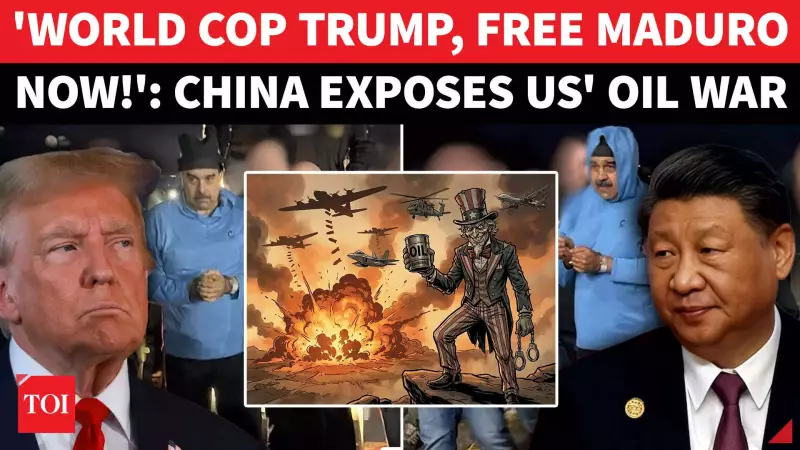
In a significant escalation of diplomatic tensions, China has issued one of its strongest condemnations yet against the United States following Washington's military intervention in Venezuela and the capture of President Nicolás Maduro. The rebuke, delivered from Beijing, frames the action as a dangerous breach of international law and a power grab for the nation's vast oil resources.
Beijing's Stern Warning on Sovereignty and International Law
Chinese Foreign Minister Wang Yi, speaking on January 5, 2026, explicitly cautioned against any nation assuming the role of the world's "policeman" or appointing itself as a global judge. He emphasized that the principles of sovereignty and security are foundational to the international order and must be upheld. The Chinese government has formally accused the United States of violating the United Nations Charter through its operations in Venezuela.
Beijing has demanded the immediate release of President Maduro and his wife, Cilia Flores. This call comes as images of the handcuffed Venezuelan leader circulate widely in global media, becoming a potent symbol of the crisis. China argues that such unilateral use of military force threatens to accelerate worldwide instability, particularly at a time when power politics are already weakening established international norms.

The Oil Factor: Unmasking the Geopolitical Game
Beyond the legal arguments, Chinese military and strategic analysts have presented a stark economic motive behind the American intervention. They contend that the operation was never primarily about counter-narcotics, as initially suggested by some quarters, but was fundamentally aimed at seizing control over Venezuela's massive proven oil reserves, the largest in the world.
Experts aligned with Beijing's view warn that establishing U.S. dominance in Venezuela would grant Washington unprecedented leverage over global oil pricing and supply. This shift, they argue, could severely undermine the authority of multilateral institutions like the United Nations and push the international system towards a primitive "law of the jungle," where might makes right.
Global Repercussions and Domestic Unrest
The Venezuelan operation has not occurred in a vacuum. Reports indicate that protests have erupted across the United States and Europe, reflecting deep public divisions over the military action. The situation presents a complex geopolitical flashpoint, merging issues of energy security, international law, and the balance of power between major nations.
China's forceful stance positions it as a leading voice opposing what it perceives as American hegemony. The crisis in Venezuela is thus transforming into a broader contest over the future rules of the international order, with control of strategic resources at its core. The coming days will be critical in determining whether diplomatic channels can de-escalate the situation or if it solidifies into a new, more confrontational phase of global politics.