China's Limited Support for Iran Highlights Partnership Boundaries
Iran's government faces mounting pressure from street protests and a failing economy. Its key ally, China, shows few signs of strong support. This reveals the limited scope of a partnership that once worried Western and Middle Eastern governments.
US Tariffs Add Pressure on Both Nations
President Trump declared on Monday that the United States would impose an additional 25% tariff on countries doing business with Iran. He did not detail implementation methods. This move risks disrupting the trade truce Trump reached with Chinese leader Xi Jinping in South Korea last October.
China denounced the proposed tariffs. Liu Pengyu, spokesman for the Chinese Embassy in Washington, stated on X that China firmly opposes any illicit unilateral sanctions and long-arm jurisdiction. He added China would take all necessary measures to safeguard its legitimate rights and interests.

When asked about reports of hundreds killed in Iran's crackdown on protests, Mao Ning, a spokeswoman for China's Ministry of Foreign Affairs, expressed hope that the Iranian government and people would overcome current difficulties and maintain national stability.
China's Reluctance Mirrors Previous Patterns
China's reticence to stand firmly for Iran follows its unwillingness to offer significant support for Venezuela before the US raid to seize Nicolás Maduro. China has been the largest buyer of Venezuelan oil amid US sanctions.
Similarly, China serves as Iran's top trading partner, buying an estimated 90% of its oil exports. To evade sanctions, this oil often undergoes ship-to-ship transfers. Payments use infrastructure financing that avoids traditional banking systems.
About 12% of China's total oil imports came from Iran last year. Chinese refiners could potentially find these supplies elsewhere. China officially exported $8.9 billion in goods to Iran in 2024 and imported $4.4 billion in products including iron ore, copper and chemicals.
This trade represents just a sliver of China's $6 trillion in global commerce. Yet doing business with China remains critical for Iran's isolated government.
Strategic Importance Versus Practical Limitations
Chong Ja Ian, an associate professor of political science at the National University of Singapore, explained the dynamic. "For Beijing, Iran is not a be-all end-all, but a way to get energy and access to the Middle East," he said. "For Iran, the PRC is in a limited way a bit of a lifeline amid all the sanctions."
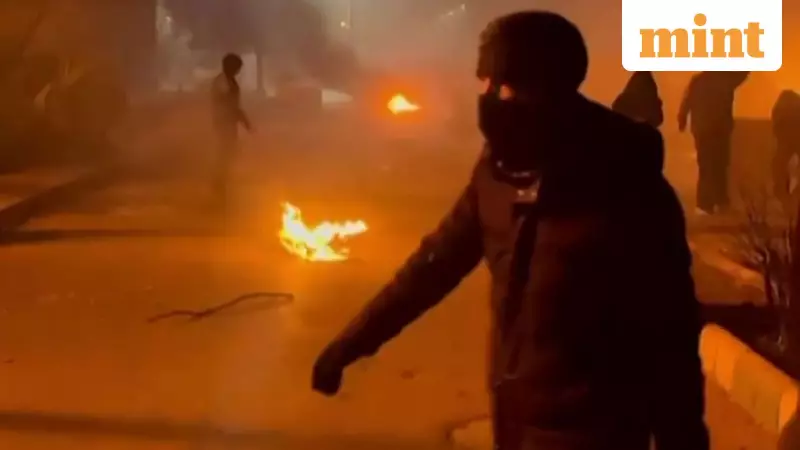
The limits of that lifeline have become apparent as Iran's economic difficulties fuel street protests. These protests create one of the greatest challenges to the Islamic Republic's 47-year rule.
"PRC support is important, but it doesn't completely save Iran," Chong added.
The "Crink" Axis and Its Limitations
China and Iran, along with Russia and North Korea, comprise an unofficial axis called "Crink" by some Western officials. These nations share a wish to push back against US influence.
China has helped Russia prop up its isolated economy and provided dual-use materials for military purposes. Iran has supplied Russia with ammunition and helped develop drones for use in Ukraine. North Korea sent thousands of soldiers to fight alongside Moscow's forces.
After Israel and the US launched strikes on Iran last year, other Crink nations did little to come to Iran's aid. China remained concerned about exposing its banks and key companies to US and European sanctions.
Economic Agreements and Security Cooperation
Beijing and Tehran signed a 25-year economic cooperation agreement in 2021. This called for China to invest $400 billion across Iran's economy in exchange for discounted oil. Iranian officials have urged China to implement the deal more fully, but results remain limited amid continuing sanctions pressure.
China has helped blunt Iran's international isolation in security matters. In December, Iran hosted troops from China, Russia and seven other countries for Sahand-2025 counterterrorism drills. These exercises were organized under the Shanghai Cooperation Organization, a security and economic grouping led by China and Russia.

Last week, China, Iran and Russia began naval drills hosted by South Africa and organized by BRICS. Beijing and Moscow helped Iran join this organization of developing nations.
Public Sentiment in China
Appeals from Iranian officials for more help from China have met scathing criticism on Chinese social media. Tuvia Gering, a China researcher at the Institute for National Security Studies in Israel, highlighted this in his newsletter Discourse Power on Monday.
He cited a post by Zhanhao, a popular nationalist-leaning account on WeChat. The post sharply expressed prevailing sentiment: "Iran continues to expect China to take the bullet for it. That's pure fantasy!"
The violent crackdown on protests in Iran has killed at least 648 people, according to a rights group report on January 12. Iranian authorities sought to regain control of the streets with mass nationwide rallies as the situation continues to develop.