

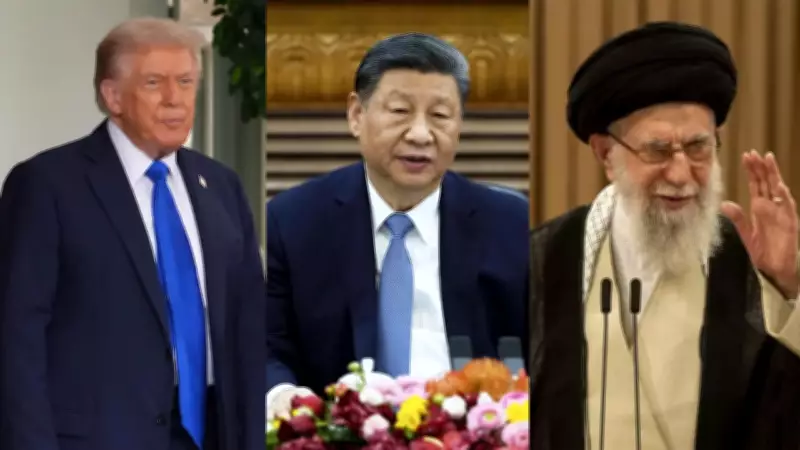
China's Delicate Middle East Balancing Act Faces Strategic Shock
For an extended period, China pursued a dual-track approach in the volatile Middle East region. Beijing sought to maintain access to discounted Iranian oil supplies while avoiding deep entanglement with Tehran's Ayatollah-led government. Simultaneously, China cultivated economic relationships with Gulf nations, securing investment opportunities, market access, and diplomatic goodwill from Arab states, all while preserving its connections to Iran.
This intricate strategy also involved benefiting from American preoccupation with regional crises, provided such instability did not trigger dramatic spikes in global energy prices that could harm China's economy. Above all, President Xi Jinping aimed to project China as a rising, benevolent superpower that operates within international norms, contrasting with what Beijing portrays as American overreach and unilateralism.
The Trump Administration's Actions Reveal Strategic Vulnerabilities
The recent military actions against Iran by the United States under President Donald Trump have exposed the fundamental fragility of China's carefully constructed Middle East approach. This conflict represents more than just another regional crisis—it delivers a strategic shock to Beijing's foreign policy calculations.

For Xi Jinping, the situation presents immediate challenges, reveals uncomfortable truths about China's limitations on the global stage, and offers only potential long-term benefits if the United States becomes mired in another protracted regional conflict.
The core dilemma for China stems from Iran's unique position within Beijing's strategic framework. Iran served multiple purposes: as a significant energy supplier offering favorable terms, as a geopolitical counterweight to American influence, and as a symbolic component of Xi's broader vision for a world less dominated by Washington. The American military actions have now weakened this valuable asset, demonstrated Beijing's incapacity to shield its partners from such pressure, and reinforced Xi's fundamental belief that hard power ultimately dictates international relations.
The Hard Power Reality Confronts China's Ambitions
As noted in international analysis, the sudden and forceful attacks by American and Israeli forces against Iran, including significant leadership targeting, have validated Xi Jinping's worldview that military strength remains paramount in global affairs. This realization represents both vindication and humiliation for Beijing's leadership.
While the conflict confirms Xi's long-standing emphasis on modernizing the People's Liberation Army and his warnings about American threats, it simultaneously highlights a harsher reality: China remains unable to decisively shape events in distant geopolitical theaters where the United States still holds dominant influence.
When Washington chooses to exercise military force, it can dramatically alter strategic landscapes overnight—capturing officials, eliminating leaders, threatening regimes, and forcing recalculation of regional balances. China can respond with diplomatic condemnation, rhetorical posturing, and careful hedging, but lacks the capability or will to prevent such American actions.
Three Major Strategic Setbacks for Beijing
The conflict creates significant challenges for China across multiple dimensions:
Energy Security Concerns: China remains heavily dependent on imported petroleum, with substantial volumes originating from the Gulf region. Any prolonged disruption in the Strait of Hormuz would impact the Chinese economy during an already challenging period marked by sluggish consumption, property sector difficulties, and local government debt pressures. The discounted Iranian crude oil represented not merely convenience but an important component of China's economic cushioning strategy.
Strategic Positioning Complications: Chinese strategists have traditionally assumed that American distraction in other regions benefits Beijing's interests. If the American strikes weaken Iran and its proxy networks without drawing the United States into another prolonged occupation or regional quagmire, China loses one of the mechanisms that previously diverted American attention away from the Indo-Pacific theater.

Prestige and Credibility Damage: China aspires to be perceived as a rising superpower and responsible alternative to American leadership. However, when crucial partners face existential pressure, Beijing consistently demonstrates a predictable pattern: rhetorical condemnation, minimal direct intervention, and careful self-protection. This approach reveals China as what analysts term "an unentangled superpower"—one that prefers distance over obligation, avoiding alliance burdens but appearing as a bystander rather than security provider during crises.
Broader Implications for China's Global Strategy
The conflict carries particular significance for China's approach to Taiwan. One underlying assumption behind Xi's strategy has been that China could develop sufficient economic resilience, diplomatic reach, and external partnerships to withstand potential international punishment following any action regarding Taiwan. Iran and Russia mattered within this broader picture not as military allies but as components of a looser ecosystem that could help Beijing weather sanctions, secure energy supplies, and complicate American-led coalitions.
If Iran becomes weakened, further isolated, or destabilized, this supportive ecosystem grows less reliable. Additionally, from Beijing's perspective, the strikes reinforce a troubling conclusion: if the United States under the Trump administration determines that a target matters sufficiently, it will employ military force first and provide explanations afterward.
Mixed Outcomes with Negative Overall Balance
The strategic ledger for China presents a complex but predominantly negative assessment. Potential benefits from Beijing's standpoint remain conditional: if the conflict prolongs, depletes American military resources, divides Western allies, and delays American focus on Asia, China might recover some strategic advantage. Beijing could also utilize the crisis to position itself as the more stable global actor, condemning warfare while promoting itself as a champion of sovereignty and stability.
Immediate negative consequences include energy market exposure, a weakened strategic partner, increased uncertainty preceding Trump's anticipated visit to China, and another blow to China's image as a rising power capable of protecting its interests.
The most troubling revelation concerns what the conflict exposes about China's actual capabilities. Despite possessing substantial economic weight, expanding diplomatic reach, and growing military power, China still lacks either the ability or willingness to defend key partners when they face severe pressure.
Xi Jinping envisions a world where China helps shape international order. The current conflict demonstrates that, for the present moment, the United States retains greater capacity to disrupt that order.
Anticipated Chinese Responses and Future Directions
Beijing will likely respond through familiar channels: intensified rhetoric against American "hegemonism," accelerated military modernization programs, heightened attention to energy security measures, and more cautious diplomacy with Gulf states that China cannot afford to alienate.
Xi Jinping will approach expected discussions with President Trump with diminished confidence that trade diplomacy can be neatly separated from demonstrations of raw power. While China may eventually find opportunity in prolonged American overextension, for now, the Trump administration's actions regarding Iran appear less as a strategic gift to Beijing and more as both warning and setback.





