

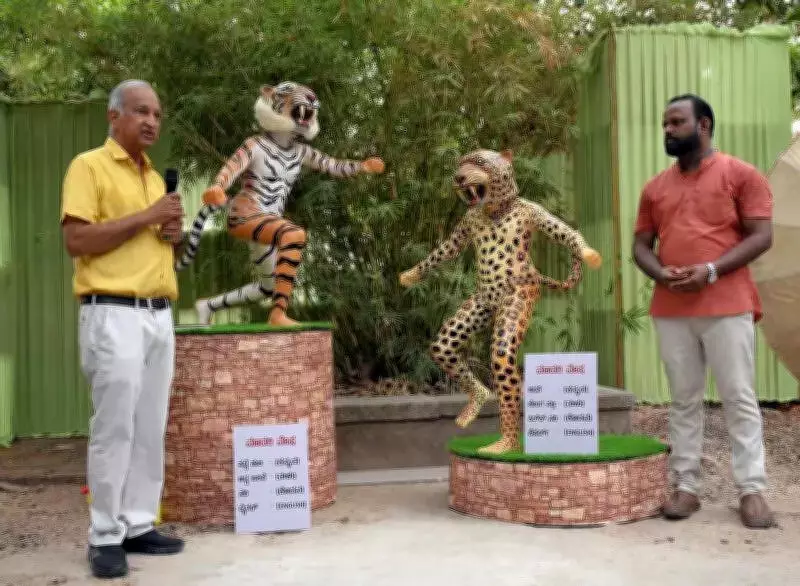
Dr K Ullas Karanth Unveils Realistic Tiger Dance Models in Mangaluru
Renowned zoologist and tiger conservationist Dr K Ullas Karanth introduced 'Naturalistic Tiger Dance Models' at the Kodialguthu Centre for Art and Culture in Ballalbagh, Mangaluru, on Monday. This innovative initiative aims to infuse greater realism and authenticity into Pilivesha, the traditional tiger dance of Dakshina Kannada, by addressing its drift from natural tiger characteristics.
Artistic Sculptures and Collaborative Creation
The models consist of two meticulously crafted art sculptures representing a tiger and a leopard. These pieces showcase authentic body colours, natural patterns such as stripes and rosettes, and detailed elements including headgear and tail. Artist Harish Kodialbail, with assistance from Siddakatte Bhushan Shetty and Nagaraj Bajal, created the sculptures based on extensive research. Dr Karanth, who conceived and curated the project, provided crucial inputs from his decades of field experience in tiger conservation.
The formal inauguration was conducted by Group Captain Kodialguthu Pradip Shetty, with Pilivesha scholars Chandrashekar Shetty and KK Pejavar in attendance. During the event, Dr Karanth shared his personal journey, recalling how his childhood fascination with tigers began after witnessing a tiger dance and later seeing a real tiger in a circus. He highlighted the critical conservation efforts led by former Prime Minister Indira Gandhi in the 1960s, when rampant hunting pushed tiger populations to the brink of extinction.

Call for Authenticity in Traditional Art
Dr Karanth expressed concern over the contemporary state of Pilivesha, noting that it often lacks a connection with real tiger traits. He explained, 'Earlier, the performance carried social prestige while also reflecting aspects of real tiger behaviour. Today, unrelated colours and patterns are used, and the form has drifted from its roots. By becoming a showcase for glamour and vanity, it has transitioned from attracting children to appeasing adults.' He urged performers and organisers to embrace more realistic representations and called for increased research into the art form to preserve its authenticity.
Artist Harish Kodialbail described the project as a unique experience, involving the translation of tiger features to human anatomy in the sculptures. Chandrashekar Shetty pointed out the scarcity of documented material on the evolution of tiger dance, while K Pejavar emphasised Pilivesha's deep ties to local traditions of faith, physical culture, and community institutions.
Support and Distribution
The event saw complimentary copies of a book on tiger dance, authored by Chandrashekar Shetty, distributed by Jyothi Alva of the Kodialguthu family. Support for the initiative was provided by the Mangaluru chapter of INTACH and the Art Kanara Trust, underscoring the collaborative effort to revitalise this cultural heritage.






