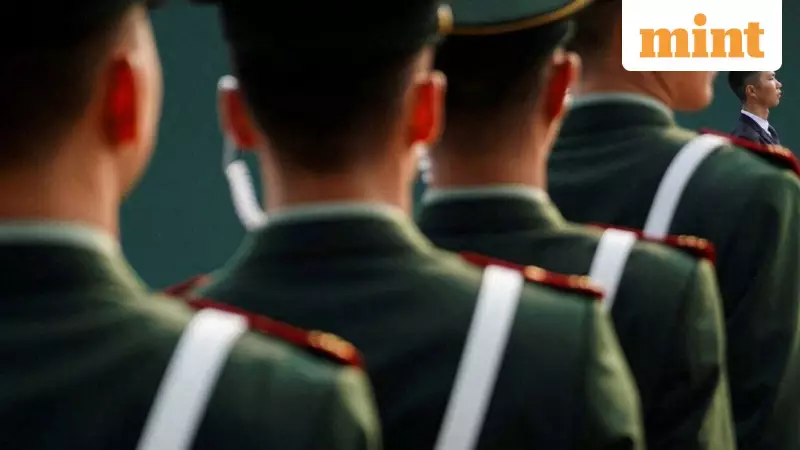
China's Military Buildup Sparks Corruption Scandals and Leadership Purges
Decades of substantial spending increases have enabled China to develop one of the world's most formidable militaries, raising concerns about potential actions against Taiwan or territorial disputes with neighbors like Japan and the Philippines. However, the primary casualties of this military expansion have been China's own elite, as President Xi Jinping has initiated a sweeping purge of top generals accused of corruption and disloyalty.
Rapid Spending Growth and Graft Opportunities
Between 2015 and 2024, China's official military expenditure surged by nearly 60%, according to an analysis by the Stockholm International Peace Research Institute. While China has long held the second-largest military budget globally, trailing only the United States, researchers estimate its actual spending may be up to 30% higher than officially reported figures.
This rapid influx of funds has created abundant opportunities for graft within a defense establishment that has historically struggled with corruption issues. Dennis Wilder, a senior fellow at Georgetown University and former U.S. intelligence officer, noted: "Money spent very quickly on the military corrupts very quickly."

High-Profile Cases and Nuclear Expansion Concerns
The latest senior military figures to face investigation are Generals Zhang Youxia and Liu Zhenli, who rose to prominence during this period of accelerated military spending. Both generals face allegations not only of corruption but also of factionalization and defiance of Xi's authority—charges that analysts consider particularly serious in China's political landscape.
Some of the most significant aspects of China's military modernization have been marred by corruption allegations:
- The construction of approximately 350 ballistic missile silos in remote northern China, described as "the most significant recent development in China's nuclear arsenal" by Hans Kristensen of the Federation of American Scientists
- Problems with silo construction that reportedly required repairs, according to the Pentagon's 2024 report on China's military power
- The removal of several commanders from the rocket force, which oversees these nuclear assets
- Allegations against former Defense Minister Li Shangfu, who previously headed the Equipment Development Department
Historical Context and Xi's Consolidation of Power
Corruption within the Chinese military has deep historical roots, including widespread practices of buying and selling ranks and extensive side businesses operated by military personnel. Xi Jinping began his purge of military leadership soon after assuming power in 2012, targeting both former officials from his predecessor's administration and, more recently, active-duty generals who rose under his own leadership.
Anushka Saxena, a research analyst with the Takshashila Institution, observed: "In hindsight, we can say that the metaphorical writing was already on the wall, and that more cases of skimming off the top, seeking favors for preferred protégés and businesses, would come up when reforms began and way too much money began being pumped into modernization."
Personal Connections and Serious Allegations
General Zhang Youxia was previously considered one of Xi's most trusted military allies, with family connections dating back to the Chinese civil war when their fathers fought together. Despite this historical bond, Zhang now faces serious accusations including accepting bribes to facilitate Li Shangfu's promotion to defense minister and allegedly leaking information about China's nuclear program to the United States.
Wilder emphasized the political dimension of these charges: "The key article is about not remaining loyal to the chairman responsibility system, which is what Xi Jinping instituted when he declared himself commander in chief of the armed forces."
Military Modernization and Strategic Implications
China's military expansion has yielded tangible results in terms of capabilities:

- The commissioning of a third aircraft carrier in late 2025
- A naval fleet that now surpasses the U.S. Navy in ship count
- Research into nuclear propulsion systems for large warships that could give Chinese carriers range comparable to American vessels
- Significant advancements in nuclear weapons infrastructure
However, these achievements have been shadowed by procurement scandals, including allegations that fraudulent practices contributed to the dockside sinking of a new submarine prototype.
The Pentagon's 2024 report suggested that the "wholesale dismissal" of rocket force leadership may be connected to fraud cases involving ballistic missile silo construction during this period of rapid expansion. The report noted that Chinese leaders likely took these problems particularly seriously due to the force's "uniquely important nuclear mission."
As China continues its military modernization, the tension between rapid expansion and institutional corruption remains a significant challenge for Xi Jinping's leadership and China's strategic ambitions in the Asia-Pacific region.