

China's Secret Nuclear Expansion in Sichuan: A Strategic Challenge for India
As China accelerates construction at its secretive nuclear facilities deep inside Sichuan province, a complex geopolitical puzzle is emerging. This development not only highlights China's military modernization but also directly impacts India, exposes gaps in global nuclear governance, and raises alarms about a potential renewed arms race. Satellite imagery and expert assessments indicate a scale of expansion that surpasses incremental upgrades, with entire villages cleared and high-security complexes erected, signaling a significant leap in China's nuclear production capabilities.
Evidence of Rapid Expansion
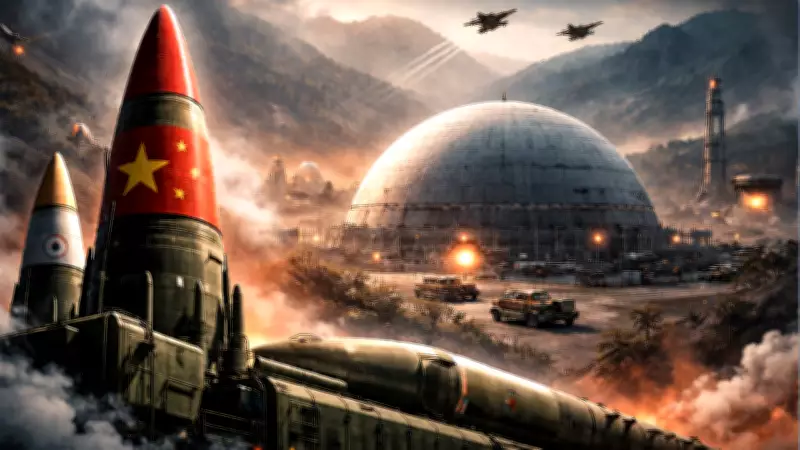
Satellite images and Chinese government documents reveal large-scale construction at facilities such as Sites 906 and 931 in Sichuan. Villagers were evicted in 2022, with authorities citing "state secret" reasons, and the land has been transformed into facilities linked to nuclear weapons manufacturing. This expansion supports claims by the US administration under Donald Trump that China is undertaking its most ambitious nuclear modernization campaign in decades. Notably, a 36,000-square-foot reinforced dome, shaped like a Tic Tac, has been built at Site 906, equipped with radiation monitors and blast doors, indicating advanced uranium and plutonium handling capabilities.
Strategic Implications for India
For India, China's nuclear build-up raises fundamental questions about the strategic balance in Asia. China already possesses a larger arsenal than India, but this expansion suggests a move towards qualitative enhancement, including survivability and integrated command systems. This could complicate India's doctrine of "credible minimum deterrence," potentially requiring recalibration of delivery systems and second-strike capabilities. The timing is critical, with ongoing tensions along the Line of Actual Control (LAC), where a stronger nuclear backing might embolden China's conventional military posture.

Global Governance and Double Standards
Beyond technical details, a deeper contradiction exists: China expands its nuclear footprint while blocking India's entry into global nuclear regimes like the Nuclear Suppliers Group (NSG) on procedural grounds. China itself remains outside key export control frameworks, such as the Wassenaar Arrangement, raising questions about consistency in global nuclear governance. As the New START Treaty expires and no trilateral agreement includes China, the world enters uncertain territory with fewer constraints on nuclear expansion.
Risks of a New Arms Race
Analysts warn that China's rapid expansion could trigger a new arms race, complicating global strategic calculations. Jeffrey Lewis, a scholar at Middlebury College, notes that matching perceived threats could lead to dangerous escalations. For India, this presents a dilemma: whether to respond with capability enhancement or maintain strategic restraint and diplomacy. Options include accelerating modernization in missile systems and submarine-based deterrence, while diplomatically highlighting inconsistencies in global governance.
Conclusion
The developments at Sites 906 and 931 illustrate China's robust commitment to nuclear modernization and strategic deterrence. However, they also expose contradictions between expansion on the ground and restrictive stances in global governance. For India, the challenge is twofold: adapting to an evolving security environment and navigating a world where rules are unevenly applied. As China builds, the focus shifts from capacity to intent and influence, requiring careful positioning in a rapidly shifting nuclear landscape.






