

China's Extensive Ocean Mapping Program: A Dual-Use Strategy for Naval Dominance
China is executing a comprehensive ocean-mapping and monitoring initiative across the Pacific, Indian, and Arctic oceans, gathering data that naval experts assert could substantially boost its submarine warfare capabilities against the United States and allied nations. This effort, involving dozens of research vessels and hundreds of underwater sensors, extends beyond mere scientific inquiry. A recent Reuters investigation reveals that the scale and patterns of activity suggest a dual-use approach—civilian on the surface but with evident military applications underneath.
Strategic Focus on Securing Critical Sea Lanes
At the core of this initiative is Beijing's long-standing strategic worry: safeguarding vital sea routes, particularly through the Strait of Malacca, and minimizing vulnerabilities in potential conflicts that could jeopardize its energy and trade lifelines. This concern directly influences India's strategic calculations. Positioned near key Indian Ocean pathways and close to the Malacca chokepoint, India is widely perceived as capable of influencing or even restricting access during conflicts, a risk often termed China's "Malacca dilemma." China's expanding undersea mapping and surveillance efforts, including in waters around India and Sri Lanka, are thus increasingly viewed as part of a broader strategy to reduce this dependency and counter potential blockades by regional adversaries.
A Vast and Coordinated Mapping Operation
Data analyzed by Reuters indicates that at least 42 Chinese research vessels have actively surveyed crucial maritime regions over the past five years. Among them, the Dong Fang Hong 3, operated by Ocean University of China, conducted repeated missions near Taiwan, Guam, and across strategic stretches of the Indian Ocean between 2024 and 2025. The vessel's movements, characterized by tight, grid-like patterns, point to systematic seabed mapping. It also monitored underwater sensor arrays near Japan and traversed waters between Sri Lanka and Indonesia, covering approaches to the Malacca Strait.

While Chinese institutions describe such missions as "mud surveys" or climate research, a scientific paper cited by CNN confirms extensive deep-sea mapping activity. Strategic experts emphasize that this data is vital for military planning. Peter Scott, a former chief of Australia's submarine force, told Reuters that the survey data "would be potentially invaluable in preparation of the battlespace" for submarines.
Why Seabed Mapping is Crucial in Modern Warfare
Contemporary submarine operations heavily depend on understanding underwater terrain and oceanographic conditions. Factors like seabed topography, water temperature, salinity, and currents affect how sound propagates underwater, which is critical for both detecting and evading submarines. Tom Shugart, a former US submarine commander, has noted that sonar performance and submarine detection rely on how sound waves interact with the underwater environment.
Rear Admiral Mike Brookes of the US Office of Naval Intelligence informed a congressional panel that such data enables "submarine navigation, concealment, and positioning of seabed sensors or weapons." In practical terms, this translates to improved stealth for Chinese submarines and enhanced ability to track adversaries.
'Transparent Ocean': China's Ambitious Sensor Network
China's mapping endeavors are part of a larger project to construct what it calls a "transparent ocean," a network of sensors, buoys, and subsea arrays providing real-time data on ocean conditions. First proposed around 2014 by Chinese scientist Wu Lixin, the project received at least $85 million in funding and commenced in the South China Sea before expanding to the Pacific and Indian oceans.
According to Chinese academic and government records cited in a report, hundreds of sensors have been deployed in areas east of Japan, around Guam, and near the Philippines—regions critical to US naval operations. In the Indian Ocean, similar sensor arrays have been placed around India and Sri Lanka, including along the Ninety East Ridge, a key underwater feature near the Malacca Strait. Although officially framed as scientific infrastructure, Chinese officials have linked the project to "maritime defence and security."

Concentration on Strategic Chokepoints
A key pattern in China's mapping effort is its focus on critical maritime chokepoints and military hubs. These include:
- Waters near Guam and Hawaii, major US military bases
- The First Island Chain, which Beijing views as a barrier to its naval expansion
- The Malacca Strait, through which a significant portion of China's oil imports passes
Jennifer Parker, a defence expert at the University of Western Australia, told Reuters: "If you look at the sheer extent of it, it's very clear that they intend to have an expeditionary blue-water naval capability that also is built around submarine operations."
The 'Malacca Dilemma' and China's Strategic Anxiety
China's reliance on the Strait of Malacca has long been considered a strategic vulnerability, often referred to as the "Malacca dilemma," and for years has been its most pressing Achilles' heel. A substantial share of China's energy imports from the Middle East and Africa traverses this narrow chokepoint. In a conflict scenario, adversaries could potentially disrupt these supply lines. This explains Beijing's growing emphasis on mapping seabed routes around the strait, monitoring underwater activity, and expanding submarine operations in the Indian Ocean.
Peter Leavy, a former Australian naval attaché, told Reuters China is "paranoid about being boxed in" within the First Island Chain, highlighting its desire to break out into deeper waters.
What Drives China's Paranoia
The ongoing war in the Middle East saw Iran exercising its biggest leverage against the West—its ability to control the Strait of Hormuz, a critical waterway through which over 20% of global energy supply passes. Countries across Asia and beyond have suffered repercussions from an Iranian blockade in the Strait, where a narrow maritime passage can be blocked or militarily controlled, crippling energy and trade flows. For China, that equivalent vulnerability lies at the Strait of Malacca.
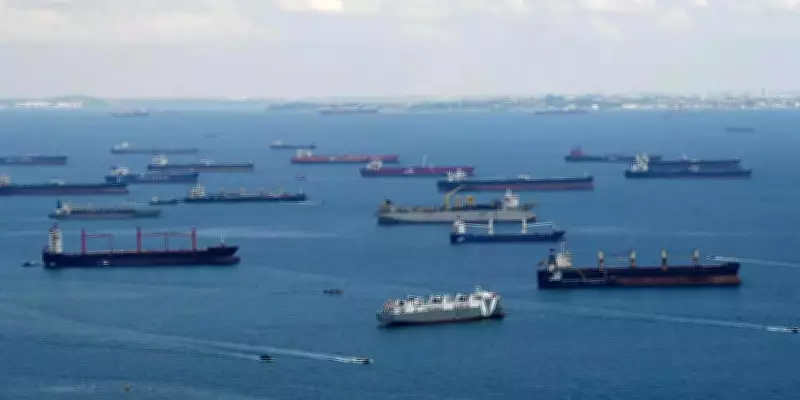
The Strait of Malacca is not only one of the world's busiest shipping lanes but also the single most critical maritime artery for global energy trade. According to the latest EIA World Oil Transit Chokepoints analysis, the strait carried about 23.2 million barrels per day of oil in the first half of 2025, accounting for nearly 29% of total global seaborne oil flows. This makes it the largest oil chokepoint in the world by volume, surpassing even the Strait of Hormuz. Additionally, around 9.2 billion cubic feet per day of liquefied natural gas (LNG) transited through the route during the same period.
For China, the significance of Malacca is even more pronounced. As per Observer Research Foundation (ORF) estimates, China's energy imports reached about $390 billion in 2024, with nearly 80%, roughly $312 billion worth, passing through the Malacca Strait. The corridor serves as the shortest and most efficient sea link between energy producers in the Middle East and consumers in East Asia, making it indispensable for sustaining China's industrial economy and trade flows.
A narrow sea lane, which China does not control, could become a chokepoint in times of conflict. Any disruption in this corridor would have immediate consequences for China's energy security, manufacturing output, and broader economic stability.
In response, China has attempted to mitigate this vulnerability through diversification, investing in overland pipelines, expanding connectivity under the Belt and Road Initiative, and developing port networks across the Indian Ocean, sometimes described as the "String of Pearls." However, these alternatives remain limited in scale and efficiency. None can fully match the speed, capacity, and cost advantages of the Malacca route, leaving China structurally exposed to potential maritime disruption.
India's Role in the Indian Ocean Equation
For India, China's activities in the Indian Ocean, particularly near Sri Lanka and critical sea lanes, carry clear strategic implications. India sits close to the Malacca Strait and has long been seen as a potential gatekeeper in the region. Its Andaman and Nicobar Command provides a vantage point over key shipping routes.
Over the years, India has:
- Strengthened maritime surveillance in the eastern Indian Ocean
- Expanded naval presence near the Andaman and Nicobar Islands
- Enhanced partnerships with countries like the US, Japan, and Australia through groupings such as the Quad
These measures are partly aimed at maintaining leverage over vital sea lanes, including the Malacca Strait. China's increased mapping activity near these waters suggests it is preparing for scenarios where access could be contested.
Civil-Military Fusion at Play
A defining feature of China's approach is the integration of civilian research and military objectives, a strategy Beijing calls "civil-military fusion." Research vessels operated by universities and state agencies are involved in mapping missions, but their findings can be utilized for defence purposes. Ryan Martinson of the US Naval War College, speaking to CNN, described the scale of Chinese marine research as "astonishing," warning that it could erode the US Navy's long-standing advantage in undersea knowledge.
Global Reach: From the Pacific to the Arctic
China's ambitions extend beyond the Indo-Pacific. Its vessels have also mapped seabed areas near Alaska and Arctic sea routes, aligning with its goal of becoming a "polar great power" by the 2030s. This global footprint reflects a broader shift: China is positioning itself as a major maritime power with the ability to operate far from its shores.
Collin Koh, a maritime security expert in Singapore, told Reuters: "They now have a reasonably good picture of the maritime domain they hope to operate in, either in peacetime or in war."
What It Means Going Forward
China's ocean-mapping campaign signals a long-term strategic shift rather than a short-term tactical move. By combining scientific research with military planning, Beijing is building a detailed understanding of the underwater domain, one that could shape future naval conflicts.
For India, the implications are immediate. Increased Chinese presence and data-gathering in the Indian Ocean could challenge its traditional advantage in the region. For the US and its allies, the concern is broader: a potential narrowing of the undersea intelligence gap that has historically favored Western navies. As competition moves beneath the surface, the oceans are becoming a critical frontier, not just for trade and resources, but for strategic dominance in an increasingly contested maritime world.





