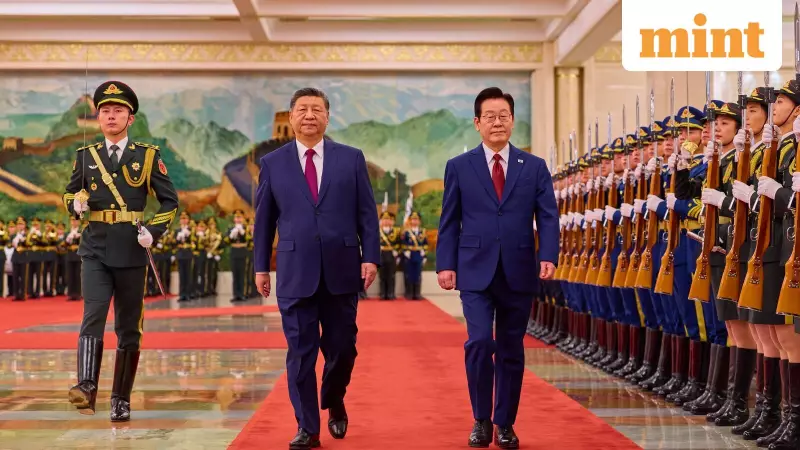
In a significant foreign policy recalibration, China has quietly ceased its public calls for North Korea to abandon its nuclear weapons program. This strategic pivot was evident during the recent meeting between Chinese President Xi Jinping and South Korean President Lee Jae Myung in Beijing on Monday, January 5, 2026, where denuclearization was notably downplayed.
A Diplomatic Meeting with a Notable Omission
During the summit at a Chinese state guesthouse—a venue historically used for denuclearization talks—the two leaders focused on maintaining peace and stability in Northeast Asia. According to China Central Television, left-leaning South Korean President Lee Jae Myung vowed to collaborate with China on finding viable measures for peace on the Korean Peninsula. However, the long-standing goal of denuclearization, which Beijing once openly championed, was not emphasized publicly by Xi.
This marks a stark departure from China's previous stance. For years, Beijing openly opposed Pyongyang's nuclear ambitions, often mentioning disarmament as a key objective in dialogues with Kim Jong Un's regime. The change became clear in late November, when China, for the first time in nearly two decades, omitted any mention of North Korean disarmament from its defense white paper outlining global threats.

Geopolitical Calculations Behind the Shift
Security analysts point to a confluence of factors driving China's new approach. Primarily, with rising tensions with the United States over Taiwan, President Xi Jinping likely sees more utility in keeping a nuclear-armed North Korea as a strategic ally. A nuclear North Korea pins down American military resources that might otherwise be directed at countering Chinese moves in the Taiwan Strait.
Furthermore, China's influence over Pyongyang has waned as North Korea has grown closer to Moscow. Victor Cha, the Korea Chair at the Center for Strategic and International Studies, noted that Xi appears to have little power to bring North Korea back to denuclearization talks. The regime, emboldened by Russian backing and China's hesitation, now declares its nuclear status "irreversible."
Patricia M. Kim, a China expert at the Brookings Institution, highlighted that the Trump administration hasn't made Pyongyang's denuclearization a central condition for U.S.-China relations. "Absent such pressure, Beijing has little reason to recalibrate its hands-off approach," she stated. This was mirrored in December when the U.S. National Security Strategy document, for the first time in years, made no reference to North Korean denuclearization, though officials later reaffirmed commitment to the goal.
Implications for Regional Security and Diplomacy
The consequences of this shift are profound. With both China and Russia providing a shield against stricter UN sanctions, North Korea has vowed to expand its nuclear program. Just a day before the Xi-Lee summit, on Sunday, January 4, Kim Jong Un oversaw a test-launch of what state media called hypersonic missiles, underscoring his commitment to a "nuclear war deterrent."
This creates a new reality where Washington and its allies face a nuclear-armed axis involving North Korea, with tacit support from Moscow and Beijing. While South Korea will continue to seek China's help in curbing Pyongyang's arsenal, the prospects seem dim. China's current rhetoric advocates for a "fair and impartial" approach to peninsula peace, effectively accepting North Korea's de facto nuclear status.
Beijing is also motivated to maintain its role as Pyongyang's primary patron and prevent it from drifting entirely into Russia's orbit. The breakdown of the Six-Party Talks in 2009 and the failed diplomacy since have led to this hardened stance. While China and Russia supported tighter UN sanctions as recently as 2017, they now shift blame to the U.S. for escalating military tensions, closing a chapter on public denuclearization appeals and opening a more volatile phase in Northeast Asian security.