China's Shaksgam Valley Assertion Reopens Old Kashmir Wounds
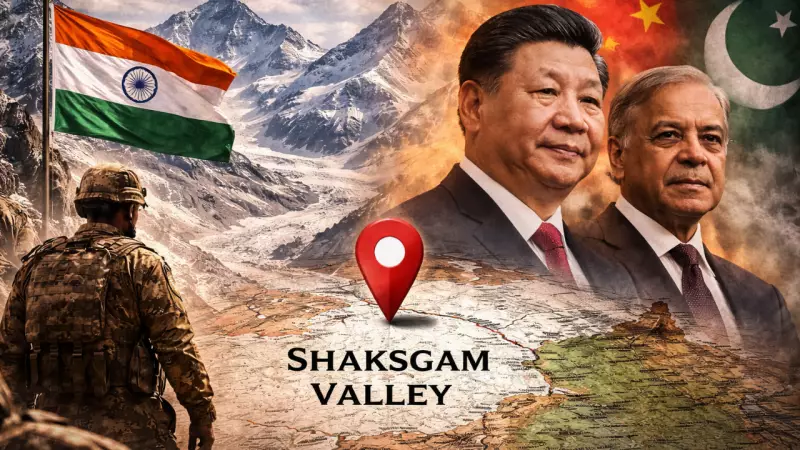
China has made a fresh assertion that the Shaksgam Valley "belongs to China." This statement has reopened a largely forgotten but strategically explosive fault line in the long-running Kashmir dispute. Beijing's defense of infrastructure construction in the region has drawn a sharp response from New Delhi. India has once again described the area as an "integral and inalienable part of India."
The disagreement goes far beyond mere semantics. At stake are several critical issues. Territorial sovereignty hangs in the balance. India's claims over Pakistan-occupied Kashmir face a challenge. China's growing footprint in the western Himalayas expands. The future shape of regional connectivity linking Xinjiang, Gilgit-Baltistan and the Arabian Sea remains uncertain.
What Exactly is the Shaksgam Valley?
The Shaksgam Valley, also known as the Trans-Karakoram Tract, is a sparsely populated, high-altitude region. It sits north of the Siachen Glacier. The valley borders China's Xinjiang province to the north. Pakistan-occupied Gilgit-Baltistan lies to the south and west. The Siachen area is to the east.

Geographically, the region is inhospitable. Glaciers, mountain passes and extreme weather define the landscape. Politically, however, it represents one of the most sensitive pieces of territory in the Kashmir puzzle. India maintains a clear position. The Shaksgam Valley is part of the former princely state of Jammu and Kashmir. Therefore, it legally belongs to India.
Pakistan transferred control of the area to China in 1963. New Delhi has never recognized this move. China currently administers the territory as part of Xinjiang. Beijing treats it as sovereign Chinese land.
The Core of the Dispute
At its heart, the dispute revolves around legal authority. Who has the right to decide the fate of the Shaksgam Valley? India's position is straightforward. Pakistan had no legal right to cede any part of Jammu and Kashmir to a third country. New Delhi views Pakistan as an occupying power in PoK. Therefore, any agreement signed by Pakistan concerning that territory is "illegal and invalid."
China and Pakistan argue a different case. They say the 1963 China-Pakistan boundary agreement was a sovereign decision. Two independent states demarcated their frontier to bring stability to a previously undefined border. Beijing has now taken a further step. It asserts that infrastructure development in the region is "fully justified." This signals that China considers the issue closed from its perspective.
Strategic Importance of the Valley
Despite its harsh terrain, the Shaksgam Valley holds outsized strategic importance. Several key reasons explain this significance.
- Proximity to Siachen and Ladakh: The valley lies close to the Siachen Glacier. Indian and Pakistani troops have been locked in a military standoff there for decades. Chinese activity in the area adds a third actor to an already volatile theatre.
- China-Pakistan Strategic Depth: The region provides China and Pakistan with contiguous territorial access. This enables coordination between Xinjiang and Gilgit-Baltistan. Such coordination was impossible before the 1963 agreement.
- Military and Logistics Implications: Infrastructure in the Shaksgam Valley improves China's ability to move troops, equipment and supplies. These movements occur near India's northern frontiers, particularly Ladakh.
- Precedent for Territorial Claims: For India, accepting Chinese control over Shaksgam would weaken its legal position on PoK as a whole. It would also dilute the 1994 parliamentary resolution asserting that the entire region belongs to India.
India's Firm Diplomatic Response
India's response has been unusually firm and consistent. Ministry of External Affairs spokesperson Randhir Jaiswal has categorically rejected both China's claims and Pakistan's role in facilitating them.
"Shaksgam Valley is an Indian territory. We have never recognised the so-called China-Pakistan boundary agreement of 1963," Jaiswal said during a weekly briefing.

He added that India also does not recognise the China-Pakistan Economic Corridor. This project passes through territory "under forcible and illegal occupation of Pakistan." Jaiswal underlined that the entire Union Territories of Jammu and Kashmir and Ladakh are an integral and inalienable part of India. He stated that New Delhi has consistently protested attempts to alter the ground reality in the Shaksgam Valley.
Importantly, India has reserved the right to take necessary measures to safeguard its interests. This language signals that both diplomatic and strategic options remain open.
China's Direct Counter-Statement
China's response has been equally direct. Beijing's foreign ministry spokesperson Mao Ning rejected India's objections. She stated, "The territory you mentioned belongs to China. It's fully justified for China to conduct infrastructure construction on its own territory."
Mao said China and Pakistan signed a boundary agreement in the 1960s. They demarcated their border as an exercise of sovereign rights. On India's criticism of CPEC, Mao repeated Beijing's long-standing line. She described the project as an economic cooperation initiative aimed at development and improving livelihoods.
Crucially, she added that the boundary agreement and CPEC do not affect China's position on the Kashmir issue. Beijing says this issue should be resolved peacefully in accordance with UN resolutions and bilateral agreements.
The 1963 Boundary Agreement Explained
Signed on March 2, 1963, the China-Pakistan boundary agreement formally transferred 5,180 square kilometres of territory. This land in the Shaksgam Valley moved from Pakistan-occupied Kashmir to China.
At the time, Pakistan described the move as a provisional arrangement. It was pending the final settlement of the Kashmir dispute. The agreement includes a specific clause. Once Kashmir is resolved, the sovereign authority would renegotiate the boundary with China.
India rejected the agreement outright. New Delhi argued that Pakistan had no locus standi to sign away territory that legally belonged to India. For China and Pakistan, however, the agreement served a vital purpose. It created a shared land border, laying the foundation for their enduring strategic partnership.
India's Legal Objections
India calls the 1963 agreement illegal for three main reasons.
- Pakistan is an occupying power: New Delhi holds that Pakistan's control over parts of Jammu and Kashmir is illegal. This makes any territorial transfer invalid.
- Violation of India's sovereignty: Any alteration of borders in Jammu and Kashmir without India's consent infringes upon its territorial integrity.
- Dangerous precedent: Accepting the agreement would legitimise third-party involvement in the Kashmir dispute. This legal position has remained unchanged across governments and decades.
CPEC's Connection to the Valley
The China-Pakistan Economic Corridor is Beijing's flagship Belt and Road Initiative project. It is valued at around $60 billion. CPEC links China's Xinjiang region to Pakistan's Gwadar port. This connection happens through roads, railways, energy projects and industrial zones.
Parts of CPEC pass through Gilgit-Baltistan, which is a part of PoK. While Shaksgam Valley is not the most visible segment of CPEC, its integration into Chinese logistics networks strengthens Beijing's western connectivity. It also supports Pakistan's role as China's gateway to the Arabian Sea.
India argues that CPEC directly infringes on its sovereignty. New Delhi has repeatedly warned against third-country participation in projects passing through PoK.
China's Current Infrastructure Push
Several factors appear to be driving Beijing's current assertiveness in the region.
- Securing Xinjiang's western approaches
- Protecting CPEC assets amid militant threats in Pakistan
- Signalling resolve after standoffs in eastern Ladakh
- Reinforcing claims through physical presence
Infrastructure, in this sense, becomes both a logistical asset and a political statement.
Pakistan's Stance and India's Accusations
Pakistan has backed China's position. Islamabad insists that the 1963 agreement is valid. It also states that CPEC is critical to its economic future. Pakistan recently announced the creation of a Special Protection Unit. This unit will safeguard Chinese nationals working on CPEC projects. This move underscores how central the corridor has become to Pakistan-China ties.
India, however, continues to describe Pakistan's actions as illegal. New Delhi accuses Islamabad of trading away territory that does not belong to it.
What Comes Next in This Dispute?
In the short term, the dispute is likely to play out diplomatically. India will continue to lodge protests. China will proceed with its infrastructure projects. In the longer term, the Shaksgam Valley could emerge as another pressure point. This would add to the already strained India-China relationship. Such development becomes more likely if infrastructure work alters the strategic balance near Ladakh and Siachen.
For New Delhi, the challenge lies in defending its territorial claims without triggering escalation. It must also prevent the gradual normalisation of a situation it considers unlawful. The Shaksgam Valley may be remote and uninhabited, but it sits at a critical crossroads. India-China rivalry, Pakistan's territorial gambits, and China's westward expansion all converge here.
China's renewed claim and India's firm rejection show that the issue is far from settled. What was once a quiet footnote to the Kashmir dispute is now re-emerging as a live geopolitical fault line. This development could shape the strategic landscape of the Himalayas for years to come.