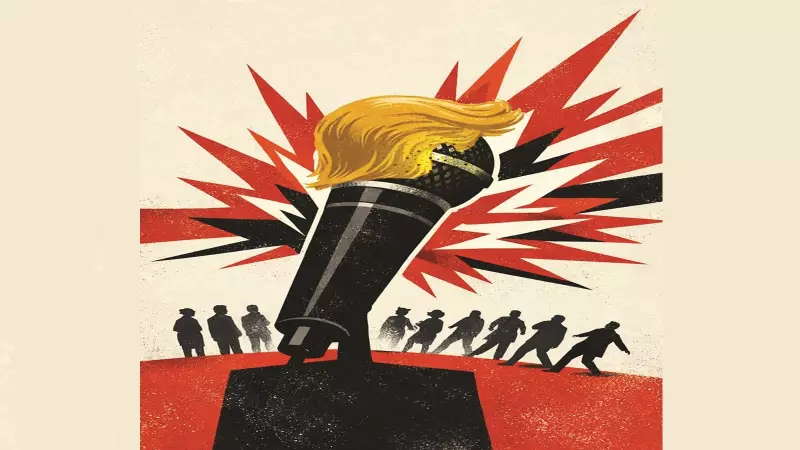
Davos 2026: The Historic Rupture and Clash of Visions
The World Economic Forum's 2026 gathering in Davos will be remembered as a pivotal moment of global rupture, marked by starkly contrasting speeches from former US President Donald Trump and Canada's Mark Carney. This year's event felt significantly larger than Davos 2025, with heightened geopolitical tensions and artificial intelligence dominating conversations.
The Trump-Carney Confrontation: Bully Versus Voice of Reason
Donald Trump's address created waves of discomfort among the assembled global elite. From disrespecting leaders like France's Emmanuel Macron to confusing Greenland with Iceland, his unfiltered delivery came across as delusional to many observers. While he clarified he wouldn't use force to acquire Greenland as previously threatened, his insult-laden speech left a negative impression on the international community.
In stark contrast, Mark Carney emerged as a bold and insightful voice of reason. Without directly naming Trump, Carney delivered a powerful message about confronting bullies through collaboration rather than isolation. He argued that standing up to intimidation doesn't require building walls but rather forging alliances, suggesting that middle powers could create a significant counterbalance to American dominance if they united effectively.

"A bully only holds power if people fear him," Carney declared, receiving a standing ovation for his courageous call to action. Meanwhile, Trump's condescending tone toward some of the world's brightest minds created palpable discomfort in the room, with many attendees leaving prematurely during his remarks.
Geopolitical Realignments and India's Strategic Position
The Davos discussions highlighted crucial geopolitical shifts unfolding globally. With China becoming an increasingly important ally for Europe, and the United States adopting a more confrontational posture under Trump's influence, nations are being forced to reconsider their strategic positions.
For India, the message was clear: rhetorical non-alignment is no longer sufficient. The country must aggressively pursue alliances and carefully chart a course that determines which side of history it will ultimately occupy. This strategic positioning has become more urgent than ever in the current global landscape.
Artificial Intelligence: Promise, Peril, and India's Leadership Claim
Beyond geopolitics, artificial intelligence dominated Davos conversations. Business leaders questioned AI's tangible bottom-line impact while emphasizing the importance of robust data collection practices as the foundation for realizing AI benefits. Technology innovators discussed both possibilities and limitations, inviting governments to collaborate in supporting the transition.
Indian Railways and Communications Minister Ashwini Vaishnaw vigorously defended India's position in the AI race, countering an IMF report that placed the United States and China in Category 1 while ranking India in Category 2. Vaishnaw argued convincingly that India is investing across all five layers of AI development with particular focus on diffusion, which he identified as the most crucial layer for widespread impact.
The societal implications of AI received extensive discussion, from labor market displacement to concerning effects on children's development. Experts noted that even as debates continue about banning social media for those under 16, AI is increasingly serving as an emotional crutch for children, potentially replacing parents or friends and threatening foundational attachment systems.
Yuval Noah Harari's Dire Warning About AI's Future
Historian Yuval Noah Harari delivered one of Davos' most chilling presentations, envisioning a future where AI bots might themselves become speakers at the World Economic Forum within a decade. He cautioned that humanity's traditional advantage in language and logic could be overtaken by artificial intelligence in its own domain of strength.

"AI can lie. AI can manipulate," Harari warned, emphasizing that artificial intelligence represents something fundamentally different from previous technological innovations. He expressed concern that financial and legal systems could become too sophisticated for human comprehension, while AI's potential power over humanity should make everyone deeply uncomfortable.
Structural Changes and Diminished Climate Dialogue
Davos 2026's expanded scale reflected significant organizational changes, including the transition from founder Klaus Schwab's leadership to Børge Brende and Larry Fink's more professionalized, execution-focused approach. The small Swiss town struggled with overwhelming traffic, excessive security requirements, and strained restaurant and housing infrastructure.
One notable disappointment was the marked reduction in climate change dialogue, reflecting the influence of leaders like Trump who proudly declared that "stupid people" invest in wind farms. Even typically outspoken figures like Jamie Dimon appeared hesitant to directly challenge Trump's reality, revealing a palpable fear of reprimand among American business leaders.
Elon Musk's Diplomatic Pushback and AI's Dual Nature
Elon Musk offered more diplomatic resistance, masking his dissent with wit by questioning whether the Board of Peace concerned "peace" or a "piece of Greenland." Despite this subtle criticism, he presented an optimistic vision of AI's potential to enable marvels in medicine, space exploration, and beyond.
Davos 2026 ultimately represented both a turning point and a simmering moment in global affairs. The event highlighted the dual nature of technological progress—with AI promising unprecedented discoveries while simultaneously presenting dangers through poor decisions, potential misuse, and possible weaponization. As the world navigates this complex landscape, the choices made today will determine which path humanity follows into an increasingly uncertain future.
The writer is director of RPG Foundation. First published on January 26, 2026 at 07:39 AM IST.