

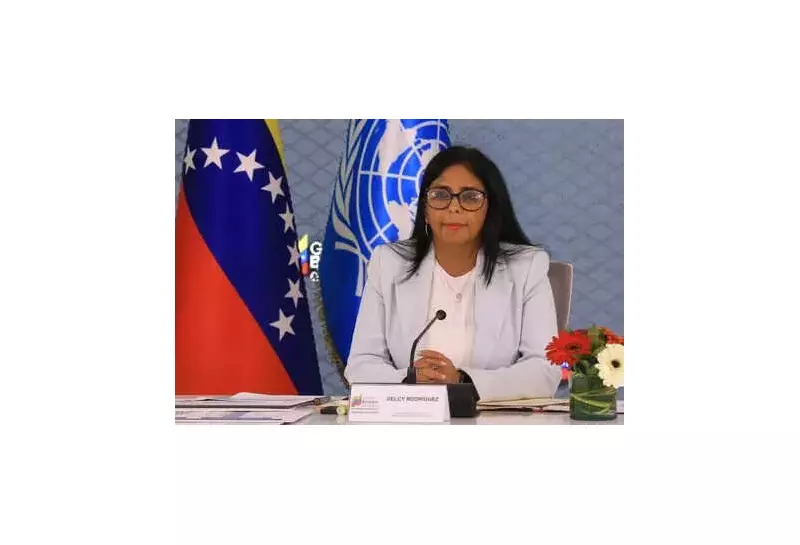
In a dramatic escalation of tensions, Venezuelan President Nicolás Maduro was captured on Saturday by United States military forces. Following the operation, executive authority in Venezuela was immediately transferred to Vice President Delcy Rodríguez, as mandated by the country's constitution.
Constitutional Transfer and Immediate Response
The power shift was executed under Articles 233 and 234 of the Venezuelan constitution, which stipulate that the vice president assumes power in the event of a president's temporary or absolute absence. Within hours, Rodríguez convened a meeting of Venezuela’s National Defense Council.
Addressing the nation on state broadcaster VTV, Rodríguez strongly condemned the US action. She demanded the "immediate release" of Maduro and his wife, Cilia Flores, labelling the operation a blatant violation of Venezuela’s sovereignty. She called on Latin American governments to reject what she described as the use of force against a democratically elected government.

Delcy Rodríguez: A Pillar of Chavismo
Rodríguez's swift assumption of control came as no surprise to observers of Venezuelan politics. A central figure in the chavismo movement for over two decades, her career spans key roles in communications, foreign policy, legislation, and economic management.
Born in Caracas in 1969, Rodríguez studied law at the Central University of Venezuela, graduating in 1993. She was an active student leader and later taught law at the same university. Her early career was rooted in legal and institutional frameworks, including leading the union within the Venezuelan Association of Labour Lawyers.
Her political rise accelerated under Hugo Chávez. She served as Minister of Communication and Information (2013-2014) and later as Foreign Minister (2014-2017), where she frequently defended Venezuela against international criticism. In 2017, she was appointed president of the powerful Constituent National Assembly.
Since 2018, Rodríguez has served as Executive Vice President. Following the disputed July 28, 2024 elections, she continued in this role for Maduro's third term beginning January 10, 2025. She also concurrently held the portfolios of Minister of Economy and Finance and Minister of Petroleum, placing her at the heart of the nation's economic policy amidst severe sanctions.
Continuity, Not Change
Constitutional lawyer José Manuel Romano noted that Rodríguez's long tenure across senior roles reflects her standing as a figure of "full trust" within the government, with significant influence over the entire state apparatus, including the Ministry of Defense.
Following the capture, US President Donald Trump indicated that Secretary of State Marco Rubio had spoken with Rodríguez and that she seemed open to cooperation. However, analysts like Imdat Oner urged caution, describing Rodríguez as a powerful actor within the existing system, not a moderate, and suggesting any transition would be tightly controlled.
Rodríguez's own statements offered no hint of compromise. In a phone interview with VTV, she stated the whereabouts of Maduro and Flores were unknown and demanded proof of life. She emphatically declared, "There is only one president in this country, and his name is Nicolás Maduro Moros."
While her role is constitutionally interim, Rodríguez's authority is built on two decades of continuity within Venezuela's ruling structure. Her leadership in this crisis signifies not a break from the past, but the consolidation of the political system she has helped shape.






